AG Coating Services | Anti-Glare Display Glass
- Share
- publisher
- Felix Optical Glass Co., Limited
- Issue Time
- Oct 28,2026
Summary
Custom anti-glare glass with etched or coated surface options. Define gloss, haze, clarity and sparkle for display covers, touch panels and instrument windows.
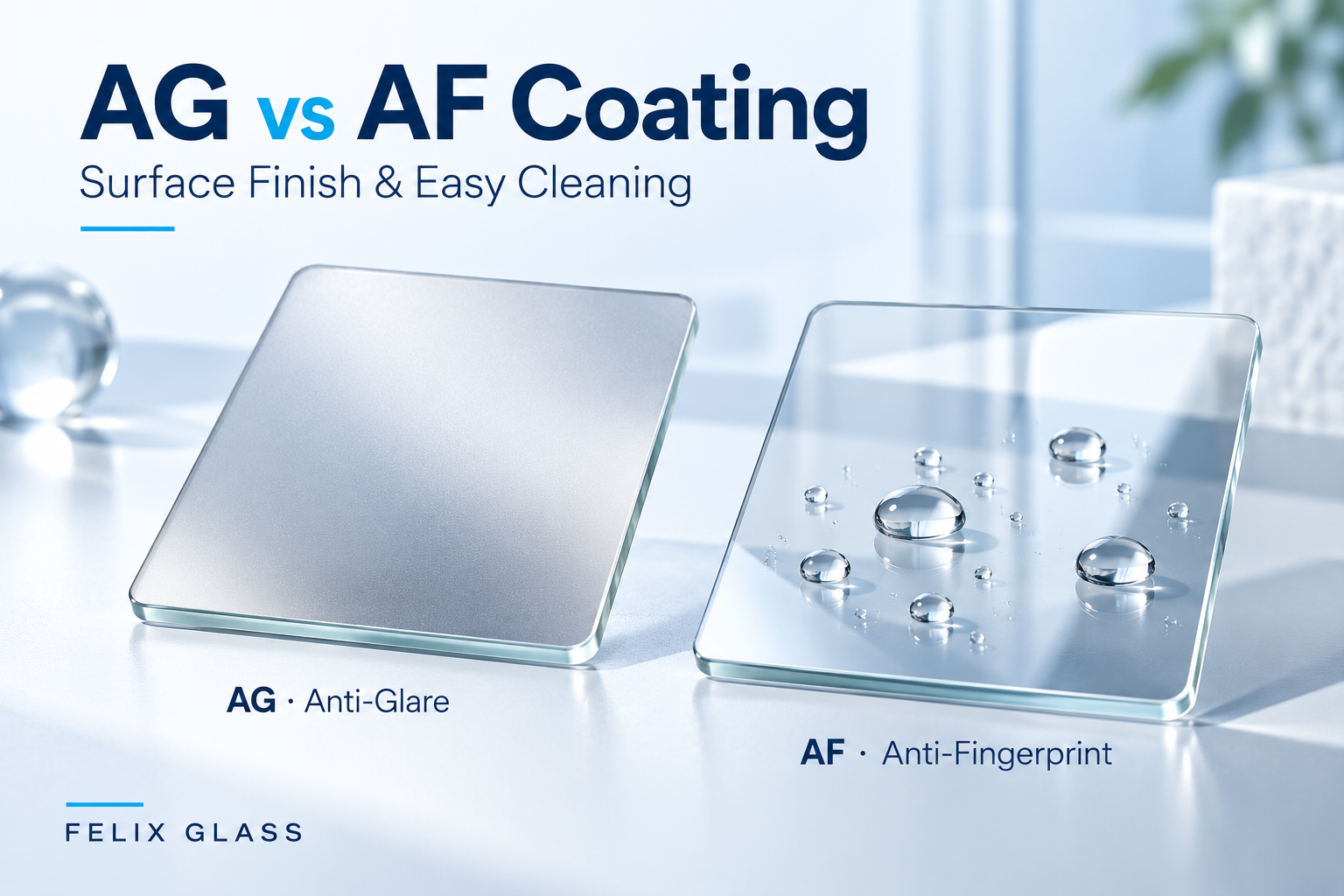
Services · Anti-Glare Surface Processing Etched and coated surface options for display clarity and glare control Custom anti-glare requirements reviewed around the glass substrate, texture, display configuration and final service environment. Felix Glass supports custom anti-glare glass projects for display covers, instrument panels and viewing interfaces. The surface treatment is reviewed against the glass grade, display configuration, lighting and required appearance. Although commonly called AG coating, an anti-glare surface may be produced by etching the glass or applying a textured coating. Specify the intended route when it matters. Performance should be defined by measurable optical and durability requirements rather than a matte appearance alone. Targets and achievable limits are confirmed after reviewing the actual substrate and display application. AG microtexture spreads reflected light over a range of directions, softening recognizable reflections of lamps or surrounding objects. The same texture can also affect transmitted display light. The design task is to balance glare reduction with image clarity, contrast and appearance. Stronger diffusion is not automatically better: it may reduce image sharpness or produce a washed-out appearance under some lighting conditions. Etched AG modifies the glass surface itself. An applied AG coating adds a layer that creates the intended texture or scattering behavior. The substrate and process requirements differ between these approaches. An etched texture has no separate AG film interface to delaminate, but it can still be scratched, contaminated or affected by other processing. Applied coatings require appropriate adhesion and wear evaluation. Neither route implies unlimited durability. State whether the project specifically requires etched glass, a coating or a performance-based alternative. Review cleaning, appearance and downstream treatments for the selected construction. Gloss describes specular reflection under a defined measurement geometry. A gloss value without the instrument angle and method is incomplete. Keep the setup consistent when comparing samples or production batches. Lower gloss can indicate a less mirror-like surface, but gloss alone does not establish haze, image clarity or sparkle. Include these other properties when they affect the display. Approve a representative appearance sample under agreed lighting as well as numerical limits. Transmission haze quantifies scattered transmitted light according to the selected method. Clarity addresses another aspect of how distinctly an image is seen through the material. The values should not be treated as interchangeable. Specify whether measurements apply to the treated glass alone or the final bonded stack. Substrate, coatings, adhesive and measurement geometry can affect the result. A favorable total-transmission value does not guarantee a sharp displayed image. Sparkle is a visible nonuniformity that can occur when surface texture interacts with a display’s pixel structure and viewing setup. Its appearance depends on more than a generic AG grade. Provide the display model or pixel pitch, brightness, viewing distance, glass thickness and spacing or bonding configuration. Evaluate representative samples over the intended display. A low-sparkle claim without a defined test condition is not a complete acceptance requirement. Do not use resolution alone to choose the treatment: displays with the same pixel count can have different pixel densities and optical constructions. AG diffuses reflections. AR reduces reflection within defined optical conditions. AF supports cleanability and repellency. These functions can be combined where the complete surface system is compatible. An AG surface does not automatically meet an AR reflection target or an AF durability requirement. Specify the function and acceptance limits of each treatment separately, then assess the finished combination for haze, clarity, reflected appearance and cleaning performance. Specify the glass grade and mechanical drawing before selecting the texture. Thickness, edge design, holes and strengthening requirements affect the component and its processing route. Chemical strengthening and thermal tempering are separate substrate-dependent treatments. AG processing and later treatments must be sequenced to preserve the required surface and mechanical properties. Do not assume an etched part is strengthened merely because its surface feels matte. Provide the touch technology, display stack, print layout and adhesive requirements. Glass thickness and the full assembly must be evaluated with the intended touch sensor and controller. AG treatment alone does not guarantee touch compatibility. Identify the treated face and any surface that will be bonded. An exposed texture and a texture covered by adhesive can have different optical effects. Review printing adhesion, mask boundaries and registration with the planned treatment sequence. For OCA projects, state whether the scope is pre-applied adhesive film or complete display lamination. These are different delivery and inspection requirements. Mark camera, optical sensor and indicator regions separately from the main display area. A texture suitable for a display may scatter light in ways that impair an imaging or sensing channel. Specify which areas must remain clear or receive another treatment, including transition boundaries and alignment tolerances. Provide operating wavelengths and optical acceptance for the sensor aperture rather than assuming that visible clarity establishes its performance. Define exposure to fingerprints, approved cleaners, repeated wiping, abrasion, humidity and temperature as relevant to the product. State the post-test changes allowed in appearance, gloss, haze and other critical properties. Use test methods and conditions agreed for the supplied stack. A scratch-hardness value alone does not establish service lifetime or resistance to every cleaning process. If AF or AR is also present, assess the complete combination after exposure. Document compatible handling and cleaning instructions. Residue can change the appearance of a textured surface, so inspection should distinguish contamination from permanent damage. An inspection plan can include dimensions, visual uniformity, gloss, haze, transmission, pattern registration and application-specific sparkle evaluation. Agree on instrument geometry, sample orientation, map locations and sampling. Approve samples with the intended display, illumination and viewing conditions. Photographs can support discussion but do not reproduce every glare or sparkle effect reliably. Retain the approved reference and its test conditions for repeat production. Send the drawing, glass grade, AG route, optical targets, display details, coatings, printing and bonding scope. Include prototype and production quantities, destination and required reports. Paid samples, minimum order, tooling and lead time are confirmed after review. No. Anti-glare glass may use an etched surface or an applied coating. Identify the required construction when it matters. No. Glare reduction must be balanced with clarity, haze, contrast and sparkle on the actual display. No. AG redistributes reflected light through scattering; AR reduces selected reflection losses. A compatible combination can be reviewed, with cleaning performance and durability assessed on the final surface. Provide pixel density, display construction and viewing conditions and evaluate representative samples. Resolution alone is insufficient. Mark clear or differently treated apertures on the drawing and specify their boundary tolerances and optical requirements. No. Durability depends on the construction and defined exposure. Request the relevant test and acceptance limits. Send the drawing, substrate, preferred AG route, gloss/haze/clarity targets, display details, integration requirements and quantities. Send your display-cover drawing and appearance requirements to Felix Glass. A review of the glass, texture and display stack helps define a practical sample-evaluation and production inspection plan. Dongguan Felix Glass Co., Ltd.AG Coating (Anti-Glare)
1. Custom Anti-Glare Surface Processing
2. AG Surface Specification Checklist
Requirement Information to provide Substrate Grade, thickness, outline and strengthening requirement Process Etched AG or applied coating; alternatives subject to approval Treated face Surface orientation, coverage and excluded apertures Gloss Target, tolerance and measurement angle Haze and clarity Limits, methods and finished-stack configuration Sparkle Display model, pixel density and evaluation setup Optical performance Transmission, appearance and contrast requirements Durability Cleaning, abrasion and relevant environmental exposure Integration Printing, AR/AF, touch technology and bonding details 3. How Anti-Glare Surfaces Work
4. Etched AG Glass and Applied AG Coatings
5. Gloss: Define the Measurement Angle
6. Haze and Clarity: Different Measures
7. Sparkle and High-Resolution Displays
8. AG, AR and AF Serve Different Functions
9. Substrate, Thickness and Strengthening
10. Touchscreens, Printing and Optical Bonding
11. Camera and Sensor Apertures
12. Cleaning, Wear and Environmental Performance
13. Inspection, Sample Approval and RFQ Inputs
14. Frequently Asked Questions
Is AG always an applied coating?
Does lower gloss always mean a better display?
Are AG and AR the same treatment?
Can AG be combined with AF?
Which AG grade should I choose for a high-resolution screen?
Can camera windows remain untreated?
Does AG glass guarantee scratch resistance?
What is needed for an AG glass quotation?
15. Request an Anti-Glare Glass Review
Email: james@felixglass.com
Phone: +86-18565032888