AG vs AF Coating: Anti-Glare vs Anti-Fingerprint
- Share
- publisher
- Felix Glass Co., Limited
- Issue Time
- Oct 26,2026
Summary
AG softens glare with matte texture; AF uses surface chemistry to resist fingerprints and ease cleaning. Learn when to combine AG+AF, and specify haze, gloss, clarity and durability. Get a quote.
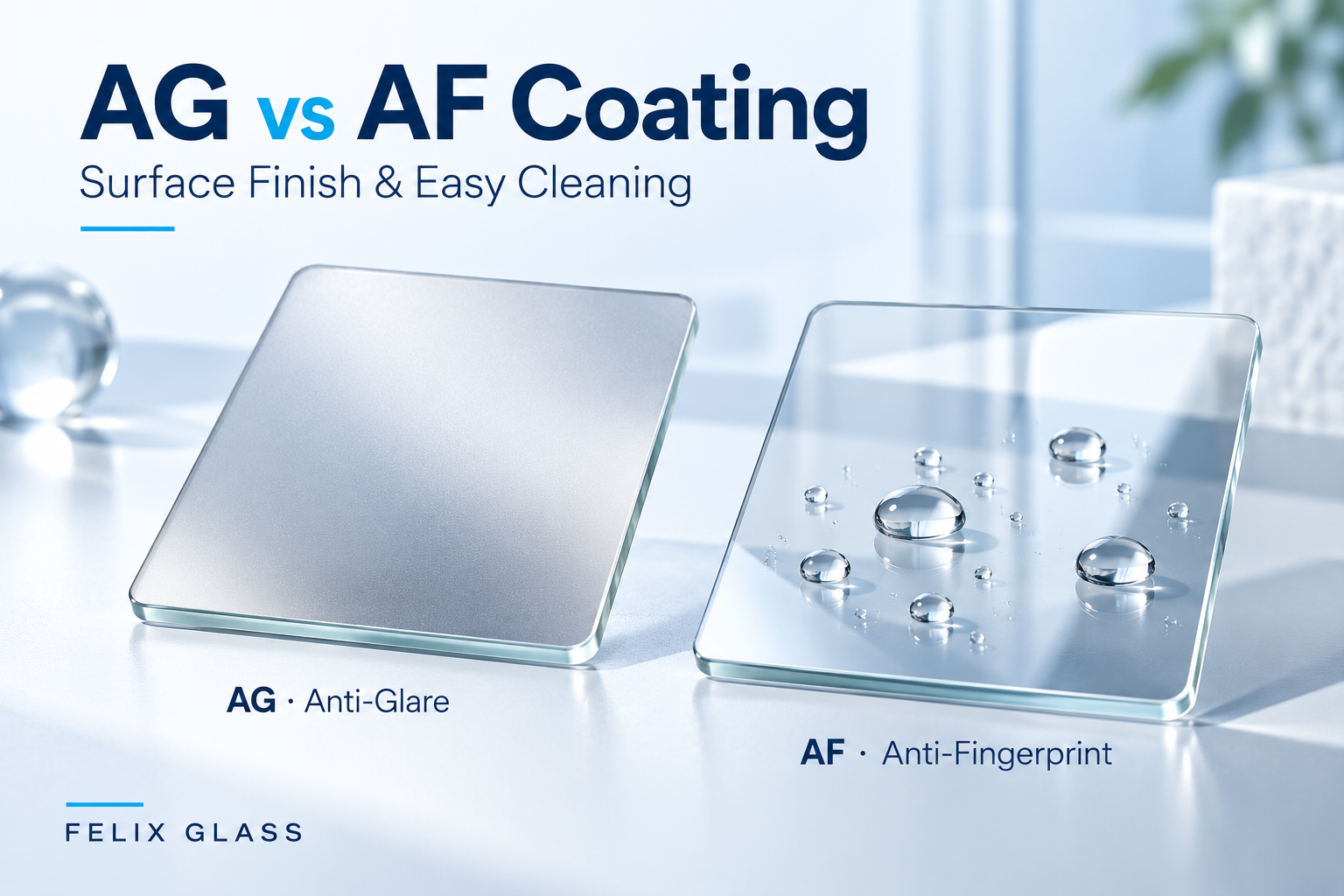
Knowledge Center · Optical Coating Guide Understand the difference between anti-glare and anti-fingerprint treatments—and when your cover glass needs both. AG changes how a glass surface distributes light. AF changes how the surface interacts with fingerprints and other contaminants. They address different problems and can be combined when a product needs both controlled glare and easier cleaning. For touchscreens, industrial displays, and glass control panels, the best specification balances appearance, readability, touch feel, and performance after repeated use. Uses an engineered surface texture to spread reflected light, making sharp reflections less concentrated. It commonly produces a matte appearance. Uses surface chemistry to reduce contaminant adhesion or improve removal. Many AF treatments are oleophobic and hydrophobic; they do not make the surface immune to fingerprints. Choose AG when distracting reflections are the problem. Evaluate AF when smudges, cleaning, or finger glide are the problem. Evaluate AG+AF when both functions are needed. “AG coating” is a common commercial term, but AG can also be created by modifying the glass itself rather than depositing a separate coating. A smooth surface can form a recognizable reflection of a light source. An AG texture redistributes reflected light over a wider angular range, softening that reflection. The texture can also affect light transmitted from the display. Reducing a distracting reflection may therefore introduce a tradeoff in image sharpness or ambient-light contrast. AG should not be described as simply eliminating reflected light. Its performance must be assessed in the intended lighting, viewing geometry, and display assembly. Manufacturer development work on high-resolution AG glass highlights sparkle and clarity as distinct design issues. These cannot be represented by a single “matte” label. [1] An etched texture cannot peel off as a separate film, but it can still be scratched or altered by wear and contamination. Applied coatings and films have their own advantages and limitations. Select from measured requirements rather than assuming one route is always superior. Fingerprints contain a mixture of water, oils, and other residues. AF treatments modify the surface so selected contaminants adhere or spread differently and can be easier to remove. Some AF surfaces reduce visible smearing; others primarily improve cleaning or touch feel. These outcomes should be specified separately rather than treated as interchangeable. SCHOTT’s AF-treated cover glass illustrates that anti-fingerprint functionality can be combined with an optical coating. Such supplier examples establish a possible combination, not a performance guarantee for every AF chemistry or substrate. [2] In this article, AF means anti-fingerprint. It does not mean anti-fog. State the full treatment name on drawings and purchase specifications to avoid ambiguity. Two AG samples with similar haze can still look different on the same screen. Likewise, a high total-transmission value does not establish sharp text or low sparkle. Corning discusses glare and sparkle as separate surface-treatment challenges. Evaluate samples on the intended display, with representative pixel density, cover spacing, viewing distance, and lighting. [3] Do not choose an arbitrary haze range before testing the actual application. A decorative control panel and a high-resolution screen may need different textures. A water-contact-angle measurement describes water wetting under specified conditions. It does not directly prove resistance to oily fingerprints or easy removal of residues. Record the liquid, droplet volume, temperature, surface preparation, measurement timing, and whether the value is static or advancing/receding. Texture can influence the apparent angle, so comparing AG+AF with smooth AF glass requires care. For practical acceptance, combine relevant wetting measurements with a repeatable contamination-and-cleaning test. Define the contaminant, application load, dwell time, cleaning cloth, cleaning force, and number of passes. Assess residual marks under controlled lighting. A high initial water contact angle alone does not establish service life or low fingerprint visibility. Yes. AG+AF combines glare management with a surface intended to support cleaner appearance or easier wiping. AGC presents cover-glass designs incorporating both treatments. [4] A common functional arrangement places the AG surface and compatible AF treatment on the user-facing side. The actual process order depends on glass forming, strengthening, decoration, coating compatibility, and curing conditions. Validate the finished part. Results from an untreated glass coupon or a smooth AF sample may not represent the final textured, printed, and assembled cover. AR, or anti-reflection, reduces reflection within specified spectral and angular conditions. AG mainly redistributes reflected light, while AF addresses contamination and surface interaction. Adding more treatments does not automatically improve the product. Each layer or surface modification must fit the optical, durability, and manufacturing requirements. AG texture should not automatically extend across a camera or laser aperture. Consider separately specified clear zones when the product combines a display cover with optical sensors. The final touch experience depends on texture, friction, contamination, humidity, and the user’s finger or glove. “Smooth matte” should be supported by an approved sample or an agreed test rather than appearance alone. For capacitive touch assemblies, glass thickness, dielectric properties, electrode layout, and controller settings all matter. AG or AF does not by itself guarantee touch sensitivity. Back printing, colored masks, optical bonding, and backlighting change the finished appearance. Review black and light-colored areas as well as illuminated icons. A fingerprint may be more obvious on one background than another. Define treated sides and excluded zones on the drawing. Confirm the manufacturing sequence with the supplier rather than assuming strengthening, printing, bonding, and AF application can occur in any order. A meaningful wear requirement specifies more than a cycle count. Define the contact material, force, contact area, stroke, speed, environment, and inspection method. Water beading after testing is useful evidence, but it should not replace the agreed fingerprint-cleaning assessment. Neither an AG label nor an AF label establishes a universal scratch-hardness rating. Provide compatible maintenance instructions. A cleaning method safe for bare glass may be unsuitable for the topcoat, printed areas, adhesive, or adjacent seals. For an initial evaluation, request representative samples with a controlled AG variation, then compare them on the actual product. Freeze the selected finish and its acceptance criteria before production. No. AG modifies glare appearance. Fingerprint behavior depends on surface chemistry, texture, contamination, and cleaning. Add and qualify AF if that function is needed. Not inherently. AF can be applied to a smooth glossy surface or a compatible textured surface. Matte appearance is primarily determined by the underlying surface treatment. It can be useful for frequently touched surfaces, but the added benefit must be verified through cleaning, touch, optical, and durability tests for the intended use. No. Stronger scattering can affect clarity and display contrast. Choose the finish on the actual display rather than maximizing haze. No. It describes water wetting under the test conditions. Fingerprint visibility, oily contamination, cleanability, and performance after wear need additional evaluation. Yes. Repeated contact, abrasion, chemicals, and environmental exposure can reduce performance. Define acceptance after representative service exposure. Potentially. Their functions are different, and the full stack must be designed and qualified for the substrate, optical targets, and durability requirements. Send the reference together with the glass drawing, application, display or backlighting details, touch requirements, cleaning conditions, and quantities. Physical samples help establish an agreed finish. Felix Glass supports custom glass components for displays, touch interfaces, and control panels. Share your drawing, material, finish reference, printing requirements, application conditions, and quantities for a project-specific review. AG appearance, AF performance, durability tests, manufacturing sequence, inspection scope, and delivery conditions should be agreed for the finished part before production. Dongguan Felix Glass Co., Ltd.AG vs AF Coating
1. The Main Difference: Light vs. Surface Contamination
AG: Anti-Glare
AF: Anti-Fingerprint
2. AG vs. AF: Side-by-Side Comparison
Factor AG treatment AF treatment Main function Reduce the concentration and sharpness of reflected glare Improve resistance to fingerprint contamination or its removal Mechanism Controlled surface texture and light scattering Surface chemistry and wetting behavior Appearance Usually matte or satin, depending on texture Can be applied to glossy or matte surfaces Optical tradeoff May affect haze, clarity, contrast, and display sparkle Optical changes should be controlled and measured on the finished stack Key checks Gloss, haze, image clarity, uniformity, and display-based evaluation Cleanability, fingerprint appearance, wetting properties, and performance after wear Does not guarantee Low total reflectance, easy cleaning, or fingerprint resistance Anti-glare behavior, scratch resistance, or a permanently mark-free surface 3. How Anti-Glare Glass Works
4. Etched AG vs. Applied AG Layers
Approach What is modified? What to confirm? Etched or otherwise textured glass The glass surface itself Texture uniformity, optical effect, processing compatibility, and strength after the complete manufacturing route Applied AG coating A layer on the substrate Adhesion, wear, chemical resistance, coating uniformity, and optical performance AG film A separate film and usually an adhesive interface Bonding, bubbles, aging, replacement, and total display-stack performance 5. How Anti-Fingerprint Treatments Work
6. Haze, Gloss, Clarity, and Sparkle Are Different
7. Contact Angle Is Useful, but Not a Complete AF Test
8. Can AG and AF Be Combined?
9. When Should AR Also Be Considered?
Requirement Treatment to evaluate Soften recognizable reflections and create a matte appearance AG Improve fingerprint cleaning on a glossy surface AF Combine a matte finish with easier cleaning AG+AF Reduce reflected light while retaining a smooth optical surface AR, with AF if handling requires it Address reflection, glare appearance, and cleaning together A qualified AG+AR+AF stack 10. Application-Based Selection
Application Starting point Main validation High-resolution touchscreen AF plus AG or AR as needed Text clarity, sparkle, touch response, and cleaning Industrial HMI AG+AF where glare and handling are concerns Readability, glove operation, cleaners, and wear Matte glass wall control panel AG+AF Color, backlit icons, uniform finish, fingerprints, and touch feel Outdoor display Compare AG, AR, and combined options Complete-display sunlight readability, weathering, and cleaning Camera or precision sensing aperture Preserve a suitable optical surface; evaluate AR and contamination treatments Scatter, image quality, beam behavior, and sensing-band transmission 11. Touch Feel, Printing, and Assembly
12. Test Durability and Cleaning as a Complete System
13. What to Specify in an AG / AF Glass RFQ
Item Required information Glass and geometry Grade, thickness, outline, corners, edges, holes, tolerances, and strengthening needs Treatment location User-facing side, back side, clear zones, and masked or untreated regions AG appearance Approved reference sample, gloss with measurement angle, haze with method, and uniformity Display performance Resolution or pixel density, cover spacing, viewing conditions, clarity and sparkle criteria AF function Fingerprint appearance, cleanability, wetting measurements, and touch-feel expectations Durability Test conditions, cycles, cleaning chemicals, and pass/fail limits after exposure Decoration and supply Printing, colors, backlit areas, bonding requirements, quantities, and inspection reports 14. Frequently Asked Questions
Does AG glass prevent fingerprints?
Does AF make glass matte?
Is AG+AF better than AG alone?
Is higher haze always better for glare control?
Does a high water contact angle prove excellent AF performance?
Can AF coatings wear out?
Can AG, AR, and AF be used together?
What should I send if I only have a matte appearance reference?
15. Discuss Your Custom AG / AF Cover Glass
Email: james@felixglass.com