Best Cover Glass Solutions for Outdoor Kiosks & Sunlight Readable Displays | Felix Glass
- Share
- publisher
- Felix Glass
- Issue Time
- Jun 4,2026
Summary
Find durable outdoor HMI cover glass for sunlight kiosks, EV chargers & public terminals. Compare AR, AG, AF multi-coated glass for anti-glare, low reflection, 9H scratch resistance and all-weather performance.
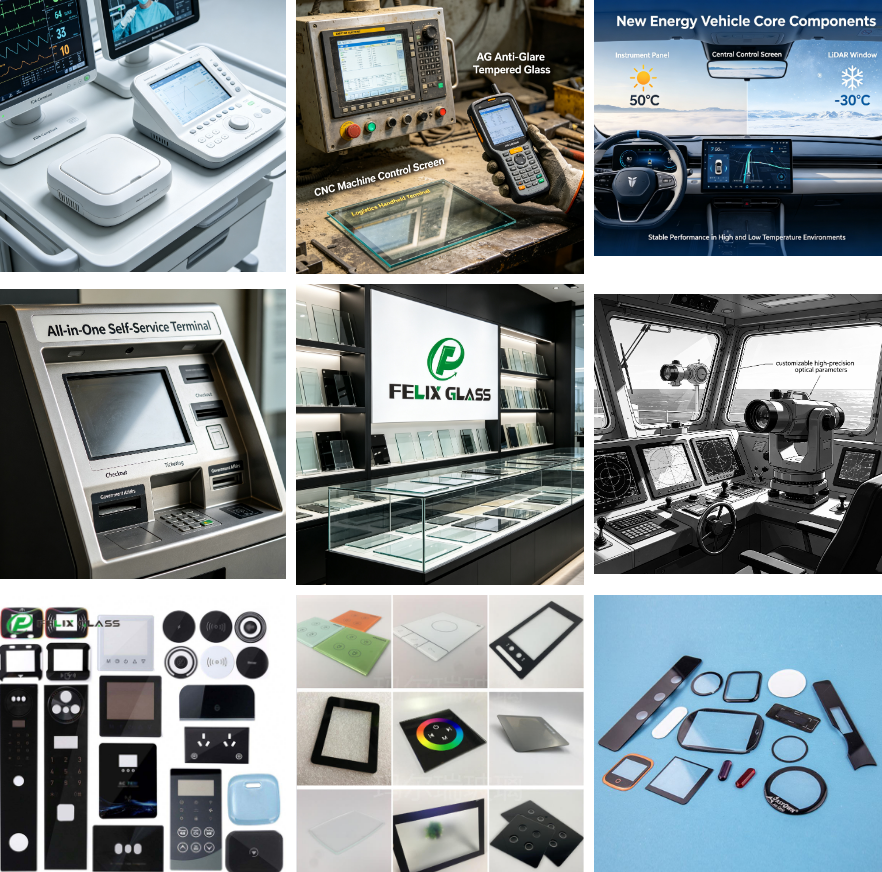
Best Cover Glass Solutions for Outdoor Kiosks & Sunlight Readable Displays | Felix Glass
Outdoor touch kiosks, EV charging stations, construction machinery HMIs, traffic monitoring terminals and marine control screens face far harsher operating conditions than indoor factory displays: intense direct sunlight, UV radiation, wide temperature swings (-40°C ~ 85°C), rain, dust, sand abrasion, fingerprints and oil residue.
Ordinary uncoated tempered glass generates severe mirror reflection under sunlight, making screen content completely unreadable. Many OEM buyers select low-cost single AG glass or standard soda-lime glass, resulting in constant customer complaints, high maintenance costs and shortened equipment service life.
This engineering guide breaks down all qualified outdoor cover glass solutions, compares optical performance data, outlines critical technical standards and matches each glass type to specific outdoor terminal scenarios.
1. Core Environmental Challenges for Outdoor Display Glass
1. Strong solar glare & mirror reflection
Visible sunlight reflectance of bare glass reaches over 8%, creating mirror images that block screen text and graphics.
2. Long-term UV aging
Unprotected glass coating layers yellow, peel or fade after 1–2 years of outdoor UV exposure.
3. Wide temperature cycling stress
Alternating hot summer and cold winter creates thermal stress, causing edge chipping or coating delamination.
4. Sand & particulate abrasion
Road dust, silica sand and metal debris leave permanent scratches on low-hardness glass surfaces.
5. Fingerprint, rainwater and industrial contamination
Uncoated glass traps oil marks and water stains that cannot be wiped clean, degrading daily visibility.
2. 4 Grades of Outdoor Sunlight-Readable Cover Glass (Engineering Comparison Table)
| Glass Solution | Core Optical Configuration | Key Optical Parameters | Hardness & Durability | Ideal Outdoor Application | Limitations |
|---|---|---|---|---|---|
| Single AR Coated Tempered Glass | Double-sided multi-layer AR coating, plain surface | Transmittance ≥93%, Reflectance <1% | 9H aluminosilicate optional | EV chargers, traffic monitoring terminals, highway signage | Visible mirror reflection under mixed ambient light, no anti-fingerprint performance |
| AG + AR Dual Coated Glass | AG matte etching + double-sided AR coating | Haze 5%–15%, Transmittance ≥90%, Reflectance <1.2% | 9H chemical tempered | Construction machinery HMIs, outdoor vending kiosks | Still prone to oil and fingerprint residue without AF layer |
| AR + AF + AG Triple Coated Glass | AG matte substrate + AR optical film + nano AF top coat | Haze adjustable 5%–25%, Transmittance ≥92%, Reflectance <1%, Water contact angle 110° | Premium 9H aluminosilicate, UV stabilized coating | Medical outdoor terminals, marine navigation, high-end self-service kiosks | Higher unit cost vs single/dual coating glass |
| Standard Uncoated Tempered Glass | No optical functional coating | Transmittance ~86%, Reflectance >8% | Max 6H soda lime only | Not recommended for permanent outdoor use | Severe glare, poor stain resistance, rapid surface wear |
3. Deep Dive Into Each Outdoor Glass Solution
3.1 Single AR Coated Tempered Glass
Processing Principle: Multi-layer vacuum sputtering AR film applied to both glass sides to eliminate Fresnel reflection.
Key Engineering Specs
- AR coating layers: 5–7 layers, neutral color balance with zero rainbow distortion
- Operating temperature range: -40°C ~ 85°C, UV-resistant coating formula
- Edge options: C/J chamfer, 2.5D curved edge customizable
Core Advantages
- Max light transmittance for ultra-clear sunlight visibility
- Lowest reflectance among all coating combinations
- Cost-effective for simple outdoor terminals with low touch frequency
Best Fit Scenarios
EV charging station touch panels, road traffic signal displays, parking lot payment terminals
Recommended Product Link: AR Coated Tempered Glass
3.2 AR + AG Dual Coated Tempered Glass
Processing Principle: Chemical AG matte etching base + double-sided anti-reflection coating, balances anti-glare and high transmittance.
Core Advantages
- AG surface eliminates mirror ghost images under complex mixed lighting
- AR layer retains high sunlight readability
- Matte texture hides minor surface scratches from outdoor sand abrasion
Best Fit Scenarios
Construction vehicle instrument panels, outdoor factory monitoring touch screens, low-budget retail kiosks
3.3 AR + AF + AG Triple Coated Glass (Premium All-Weather Grade)
Processing Principle: Integrated triple functional coating: AG anti-glare substrate + AR anti-reflection interlayer + top AF oleophobic nano coating.
Key Engineering Specs
- Coating abrasion resistance: 10,000 alcohol wipe cycles
- Full UV blocking coating formulation for long-term outdoor exposure
- Customizable haze values (5%–25%) for bright/dark outdoor environments
Core Advantages
1. AG matte eliminates glare and mirror reflections
2. AR high transmittance ensures sunlight readability
3. AF nano coating repels rainwater, fingerprints, grease and dust
4. UV stabilized coating prevents yellowing and peeling after years of outdoor use
Best Fit Scenarios
High-end outdoor self-service payment kiosks, marine ship control HMIs, outdoor medical diagnostic equipment, airport passenger service terminals
Recommended Product Link: AR AF AG Coated Glass
4. Mandatory Industrial Standards For Outdoor Cover Glass Substrate
Not all tempered glass can withstand long-term outdoor exposure. Felix Glass enforces 3 non-negotiable substrate rules for outdoor projects:
1. 9H aluminosilicate glass base material required
Soda-lime physical tempered glass only reaches 3H–6H hardness, easily scratched by outdoor sand and dust. Deep chemical ion exchange aluminosilicate glass delivers 9H scratch resistance and stable stress layer under thermal cycling.
2. UV stabilized coating formula
Standard indoor AR/AF coatings degrade under UV light. All outdoor-grade coated glass uses UV-blocking film layers to avoid yellowing within 5 years.
3. C/J chamfer edge processing mandatory
Raw sharp glass edges concentrate thermal stress, leading to spontaneous cracking under temperature fluctuation. CNC polished C or J chamfers disperse stress and eliminate breakage risks.
5. Step-by-Step Outdoor Glass Selection Decision Tree
1. Low budget, low-touch outdoor terminals (EV chargers, traffic screens)
→ Single AR coated 9H aluminosilicate tempered glass
2. Mid-budget industrial machinery with mixed sunlight & indoor light
→ AR + AG dual coated tempered glass
3. High-end public kiosks, marine, medical outdoor equipment with frequent touch & all-day sunlight
→ AR + AF + AG triple coated premium glass
4. Temporary short-term outdoor equipment (<1 year service life)
→ AG coated tempered glass as cost compromise
Secondary Product Link: AG coated tempered glass
6. Common Failures Caused By Low-Quality Outdoor Glass
- Severe screen reflection making touch operation impossible in direct sun
- Coating yellowing, peeling and rainbow discoloration after 6–12 months outdoor use
- Permanent sand scratches fogging the display surface
- Fingerprint and rainwater stains that cannot be fully wiped away
- Edge thermal cracking due to unpolished raw glass edges
- Low hardness substrate wearing out rapidly under road dust abrasion
7. Felix Glass All-Weather Outdoor Glass Quality Control Workflow
- ✅ UV aging test (500-hour xenon lamp simulation) before mass production
- ✅ Thermal cycling test: -40°C ↔ 85°C, 500 cycles without coating failure
- ✅ 9H pencil scratch test, sand abrasion resistance batch sampling
- ✅ Spectrophotometer optical inspection to lock transmittance & reflectance indexes
- ✅ AOI full surface defect screening for coating unevenness and pinholes
- ✅ Custom C/J chamfer edge polishing to eliminate thermal stress concentration points
8. Target Long-Tail SEO Buyer Keywords Embedded
- sunlight readable tempered glass for outdoor kiosks
- AR coated touch screen glass for EV charging stations
- triple AR AF AG coated glass for marine outdoor display
- anti-scratch 9H aluminosilicate glass for construction machinery HMI
- UV stabilized outdoor HMI cover glass OEM
- anti-glare anti-reflection glass for self-service terminal
- all-weather touch screen glass for traffic monitoring equipment
Conclusion
Outdoor kiosks and sunlight-exposed industrial HMIs demand specialized optical coated tempered glass that balances anti-glare, high transmittance, anti-fouling and long-term weather resistance. Single AR glass works for low-touch budget outdoor equipment, AR+AG dual coating suits mid-range industrial machinery, while AR+AF+AG triple coated aluminosilicate glass remains the top all-weather solution for high-end public, marine and medical outdoor terminals.
Always select 9H deep chemical tempered aluminosilicate substrate with UV-resistant coating to avoid early-stage glass degradation and frequent after-sales maintenance. Felix Glass provides fully customized outdoor cover glass with adjustable haze, C/J edge polishing, silk screen black border printing and integrated multi-functional coatings matched to your terminal’s working environment.
Call to Action
Share your outdoor equipment application, daily sunlight exposure duration, touch frequency and mechanical drawing specifications. Our optical engineering team will recommend the optimal coating combination, provide optical test samples and issue factory bulk pricing within 24 hours.