C Type vs J Type Tempered Glass: Difference in Edge Processing and Application
- Share
- publisher
- Felix Glass
- Issue Time
- Jun 25,2026
Summary
Compare C chamfer and J chamfer tempered glass for industrial HMI touch screens. Learn edge processing technology, dimensional parameters, safety performance and matching equipment scenarios for custom C/J type cover glass OEM.
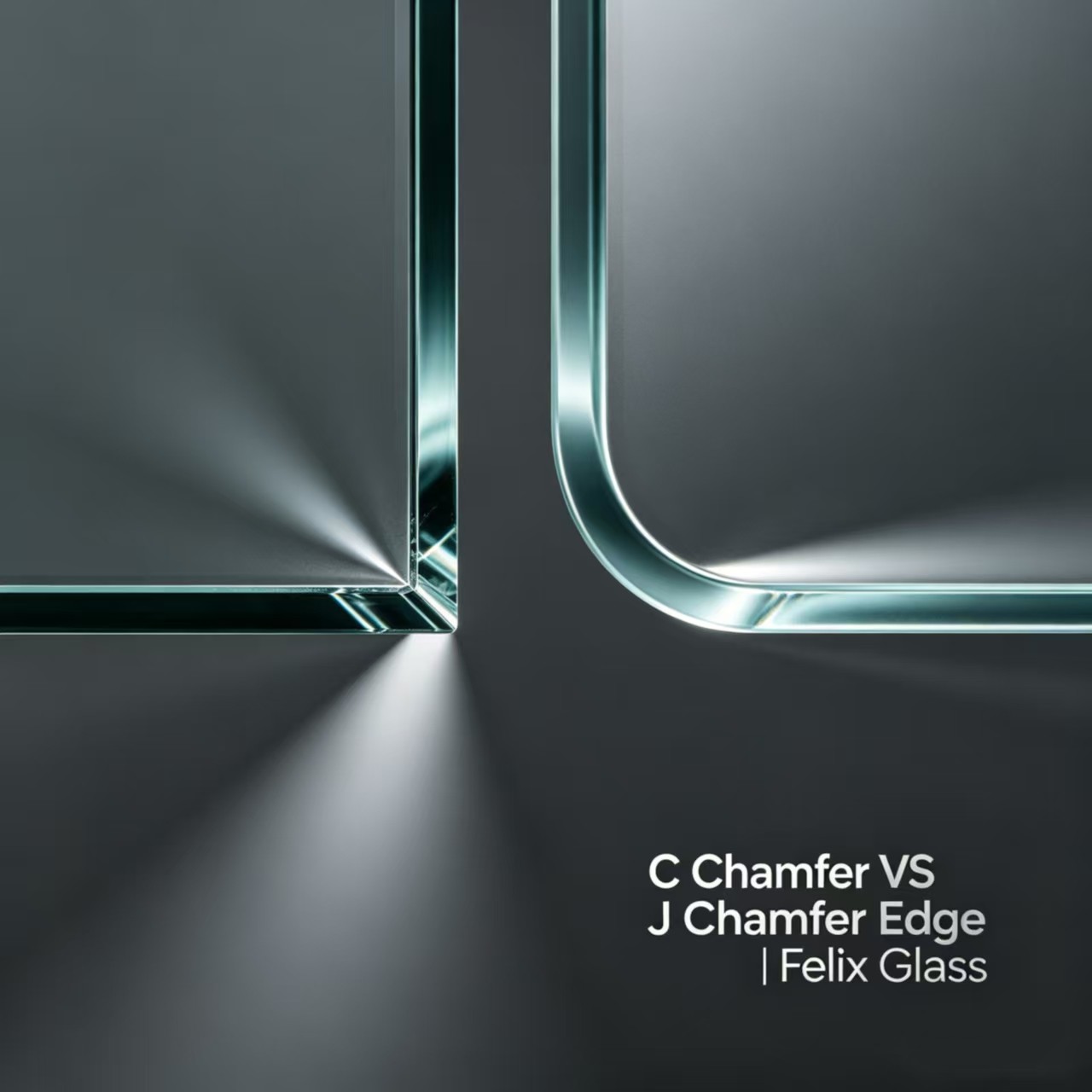
C Type vs J Type Tempered Glass: Difference in Edge Processing and Application
C/J type tempered glass refers to industrial cover glass with CNC precision chamfered edges, specially developed to eliminate sharp raw glass edges that scratch assembly workers, damage touch film layers and cause stress cracking during long-term equipment operation.
Two mainstream chamfer specifications are widely adopted in the HMI industry: C chamfer and J chamfer. Many automation equipment OEMs, CNC machine manufacturers and kiosk designers struggle to distinguish their structural differences, cost gaps and applicable scenarios.
This engineering-level guide covers processing craft, standard dimensional parameters, mechanical performance comparison and targeted application recommendations for C type and J type tempered glass, supporting your custom HMI glass drawing design.
1. What Is C Type Chamfer Tempered Glass?
Processing Principle
C chamfer (straight bevel edge) is formed by CNC milling a flat inclined plane between the glass front surface and vertical side surface, forming a linear 45° flat transition edge. It is the most mature, cost-effective chamfer process for standard industrial touch panels.
Standard Engineering Parameters
| Parameter | Standard C Chamfer Value |
|---|---|
| Chamfer Angle | Fixed 45° (custom 30°/60° available) |
| Chamfer Width (C Value) | C0.3, C0.5, C0.8, C1.0, C1.5 customizable |
| Edge Surface Roughness | Ra ≤0.8μm after fine polishing |
| Stress Distribution | Uniform linear stress transition |
| Minimum Applicable Glass Thickness | 1.1mm |
Core Advantages
- Low processing cost, fast CNC cutting speed, suitable for mass bulk orders
- Stable chamfer dimensional tolerance ±0.05mm, easy batch quality control
- Small occupied frame space, compatible with narrow-bezel HMI structural design
- Polished flat edge avoids scratch damage to touch sensor film during lamination
Best Application Scenarios
- Standard factory automation PLC HMI panels
- Indoor CNC machine touch control screens
- Low-to-medium cost industrial monitoring terminals
- Warehouse logistics operation touch panels
- Mass-produced indoor smart control equipment
Limitation
The straight inclined edge still has an angular transition line, not suitable for equipment that pursues fully streamlined rounded appearance.
Recommended Product Link: Custom C/J Type Tempered Glass for Industrial HMI Touch Screens
2. What Is J Type Chamfer Tempered Glass?
Processing Principle
J chamfer (arc curved edge) adopts multi-step CNC grinding to create a smooth circular arc transition between glass surface and vertical edge, forming a seamless curved profile without sharp angle lines. It is also called micro 2.5D mini curved chamfer for industrial HMI.
Standard Engineering Parameters
| Parameter | Standard J Chamfer Value |
|---|---|
| Arc Radius (J Value) | R0.5, R0.8, R1.0, R1.5, R2.0 customizable |
| Edge Surface Roughness | Ra ≤0.4μm mirror polishing finish |
| Stress Distribution | Smooth arc stress buffer, no stress concentration point |
| Minimum Applicable Glass Thickness | 1.5mm |
Core Advantages
- Zero sharp transition angle, maximum safety for manual assembly operation
- Arc stress buffer reduces glass edge cracking risk under vibration and impact
- Mirror smooth curved edge matches high-end streamlined equipment appearance
- Resists edge chipping during transportation and equipment assembly
Best Application Scenarios
- High-end medical touch monitor panels
- Outdoor self-service payment kiosks
- Marine and vehicle industrial control HMIs
- Luxury automation robot operation terminals
- High-value precision laboratory instrument displays
Limitation
Multi-pass arc grinding increases processing time and unit cost, not economical for low-budget mass standard equipment.
Recommended Product Link: Custom C/J Type Tempered Glass for Industrial HMI Touch Screens
3. C Chamfer vs J Chamfer Engineering Comparison Table (Core SEO Asset)
| Property | C Type (Straight Bevel Chamfer) | J Type (Arc Curved Chamfer) |
|---|---|---|
| Edge Shape | 45° flat linear inclined plane | Smooth seamless circular arc transition |
| Key Dimension Mark | C value (chamfer width) | J/R value (arc radius) |
| Surface Finish | Fine polished flat edge | Mirror polished curved edge |
| Stress Performance | Linear stress transition, minor concentration at angle | Full arc stress buffer, zero concentration point |
| Anti-Chipping Ability | Medium | Excellent |
| Processing Cost | Low, high production efficiency | High, multi-step grinding process |
| Narrow Bezel Compatibility | Excellent, occupies tiny frame space | Medium, needs slightly wider equipment border |
| Aesthetic Effect | Simple industrial minimalist style | Premium streamlined modern appearance |
| Typical Matching Equipment | Indoor standard factory HMIs | High-end medical, outdoor & marine touch terminals |
4. Engineering Selection Decision Guide for HMI Designers
- Cost-sensitive mass indoor factory automation equipment → Choose C type chamfer tempered glass (C0.5/C0.8 mainstream specification)
- High-end medical, outdoor kiosk, marine control equipment with high appearance requirements → Choose J type arc chamfer glass (R1.0/R1.5 mainstream specification)
- Ultra-narrow bezel compact touch screen structure → Prioritize C chamfer to save internal frame space
- Equipment with frequent vibration, impact or long-distance sea freight transportation → Prioritize J chamfer to reduce edge crack rejection rate
- Small prototype trial order with fast delivery requirement → C chamfer has shorter production lead time
5. Common Edge Defects of Unqualified C/J Chamfer Glass
Unprofessional glass processing factories frequently produce defective chamfered glass with the following hidden risks:
- Uneven chamfer width: inconsistent C/J size on four edges, causing assembly gap deviation
- Unpolished frosted burr edges, scratch operators and damage touch film
- Over-grinding thin edge leads to tempering stress imbalance, easy spontaneous cracking
- J chamfer arc distortion, irregular curved surface affecting equipment shell fitting
- Chamfer offset leads to black silk screen border dislocation
6. Felix Glass C/J Chamfer Precision Manufacturing Control
Felix Glass builds a dedicated CNC chamfer polishing workshop with full-process precision control for all custom edge glass:
- ✅ 5-axis high-precision CNC milling machines, dimensional tolerance controlled within ±0.03mm
- ✅ 3-stage progressive polishing process: rough grinding → medium grinding → mirror fine polishing
- ✅ 100% full manual edge inspection + AOI scanning before tempering
- ✅ Custom mixed solution: C chamfer on two sides, J chamfer on other two sides as drawing request
- ✅ Compatible with AG/AR/AF composite coating after chamfer processing
- ✅ Full tempering strength test after edge machining to eliminate hidden cracking risk
7. Embedded Long-Tail SEO Buyer Keywords
This article targets high-intent industrial OEM search terms:
- C type vs J type tempered glass for HMI touch screen
- custom C chamfer industrial cover glass supplier
- J arc chamfer touch screen glass for medical equipment
- CNC polished edge tempered glass for automation panel
- narrow bezel C type tempered cover glass OEM
- anti-crack J chamfer glass for outdoor kiosk display
- industrial touch glass edge processing difference
Conclusion
C chamfer and J chamfer are two differentiated edge processing solutions for industrial HMI tempered glass:
- C type straight chamfer: cost-efficient, space-saving, ideal for mass standard indoor factory control panels
- J type arc chamfer: safer, anti-crack, premium appearance, perfect for high-end outdoor, medical and marine equipment
Reasonable selection of chamfer type can lower your production cost, reduce assembly failure rate and upgrade equipment overall texture. Felix Glass supports fully customized C/J dimension, edge combination, silk screen printing and multi-functional coating based on your mechanical drawings.
Call to Action
Upload your 2D drawing, specify C/J chamfer size, glass thickness, coating requirement and application field. Our structural engineering team will provide edge optimization suggestions, prototype samples and factory bulk quotation within 24 hours.