CVD ZnS vs CVD ZnSe: How to Choose Infrared Optical Materials
- Share
- publisher
- Felix Glass Co., Limited
- Issue Time
- Oct 6,2026
Summary
Learn their transmission range, mechanical strength, laser performance, coating options, and how to select between ZnS and ZnSe for your thermal imaging, LiDAR and CO₂ laser dome & window projects.
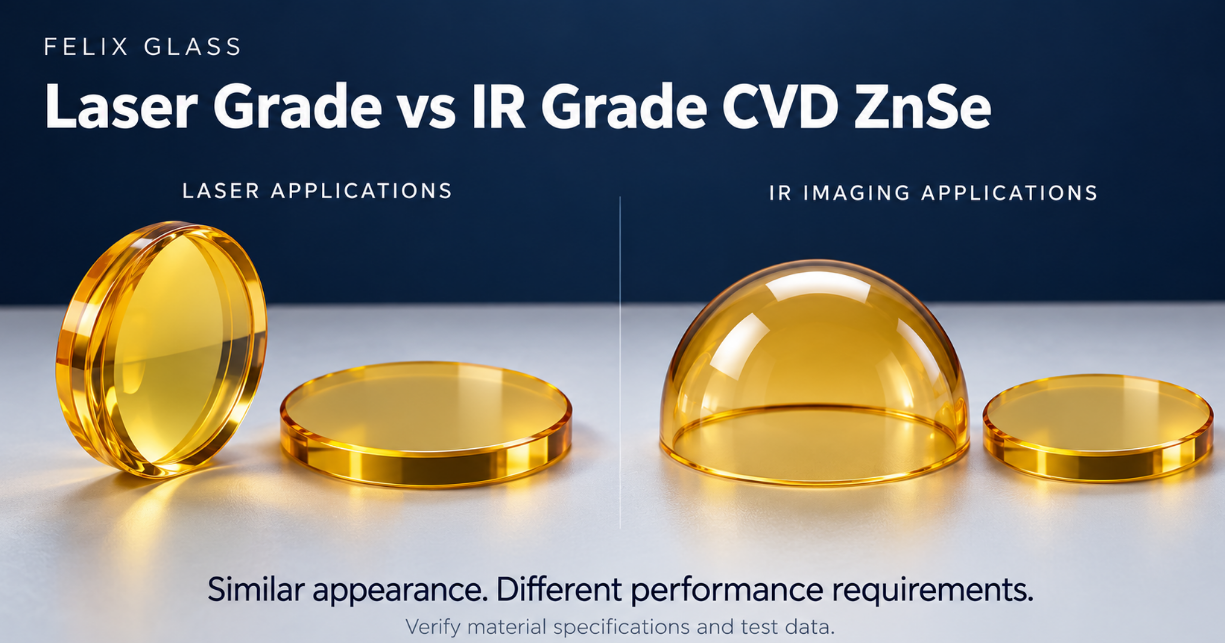
CVD ZnS vs CVD ZnSe: What Are They?
CVD ZnS (Chemical Vapor Deposited Zinc Sulfide) and CVD ZnSe (Chemical Vapor Deposited Zinc Selenide) are the two most widely used polycrystalline infrared optical materials. Both are manufactured via CVD technology and commonly fabricated into infrared domes, flat windows and optical substrates for IR systems. Felix Optical Glass supplies custom CVD ZnS and CVD ZnSe optics with full material certification.
CVD ZnS vs CVD ZnSe: Core Comparison Table
| Property | CVD ZnS | CVD ZnSe |
|---|---|---|
| IR transmission band | 0.4~14 μm | 0.6~16 μm |
| 10.6μm CO₂ laser absorption | Higher | Ultra-low, ideal for high-power CO₂ laser |
| Mechanical hardness | Higher, scratch-resistant | Softer than ZnS |
| Cost level | Lower | Higher |
| Typical applications | Thermal imaging domes, low power IR windows | CO₂ laser optics, high-performance IR windows |
Key Advantages of CVD ZnS
- Better mechanical hardness and impact resistance, suitable for harsh field environments
- Lower raw material cost for volume production
- Wide transmission covering visible to mid-infrared band
- Main choice for thermal camera protective domes and vehicle IR windows
Key Advantages of CVD ZnSe
- Excellent transmittance at 10.6μm for high-power CO₂ laser systems
- Lower bulk absorption to prevent thermal runaway under continuous laser irradiation
- Longer infrared cut-off wavelength for far-infrared applications
- Available in laser-grade version for laser lenses and laser output windows
Coating Compatibility for ZnS & ZnSe
Both CVD ZnS and ZnSe can be coated with anti-reflection AR coatings and DLC hard coatings. DLC coating greatly improves wear and moisture resistance for outdoor use. AR coatings are customized for target wavelength. Note: ZnSe is more sensitive to high laser power, coating design must match laser working conditions.
How to Select Between CVD ZnS and CVD ZnSe
- ✅ Pick CVD ZnS: Thermal imaging, outdoor surveillance IR dome, cost-sensitive mass production, high mechanical impact environment
- ✅ Pick CVD ZnSe: High-power CO₂ laser cutting/marking optics, laser rangefinder, when low absorption at 10.6μm is required
Custom Machining & Tolerance
We can machine hemispherical domes, flanged domes, flat windows and blanks from both CVD ZnS and CVD ZnSe. Provide your outer diameter, wall thickness, curvature, edge requirement, wavelength and coating specs. Our optical engineers evaluate feasibility and quote accordingly. Prototype samples available.
Quality Inspection
All ZnS and ZnSe components go through transmission test, surface scratch-dig inspection and dimensional metrology. Material test certificates are provided with shipments. Laser-grade ZnSe stock is stored separately to avoid cross-contamination.
Request Custom ZnS / ZnSe Optics Quote
Send your drawings or dimension specs, wavelength, coating requirements and quantity for quotation. We support prototype and mass OEM orders for industrial infrared and laser system manufacturers.
FAQ: CVD ZnS vs ZnSe Selection
1. Can CVD ZnS be used for CO₂ laser?
ZnS has higher absorption at 10.6μm. It works only for very low-power CO₂ laser; laser grade ZnSe is recommended for high power CO₂ laser.
2. Which one is better for thermal imaging dome?
CVD ZnS is the standard mainstream material for thermal camera domes with balanced performance and cost.
3. Are samples available for testing?
Yes, prototype samples can be supplied for optical and environmental validation.
View Custom IR Dome Products
• Browse all custom infrared optical dome and window products
• Check IR dome FAQ for OEM buyers