Compare Optical Materials ——Material selection & performance comparison
- Share
- publisher
- Felix Glass Co., Limited
- Issue Time
- Oct 26,2026
Summary
Compare optical glass, fused silica, sapphire, silicon, ZnSe and ZnS for windows, lenses and domes. Choose by wavelength, image quality, environment and cost. Get a quote.
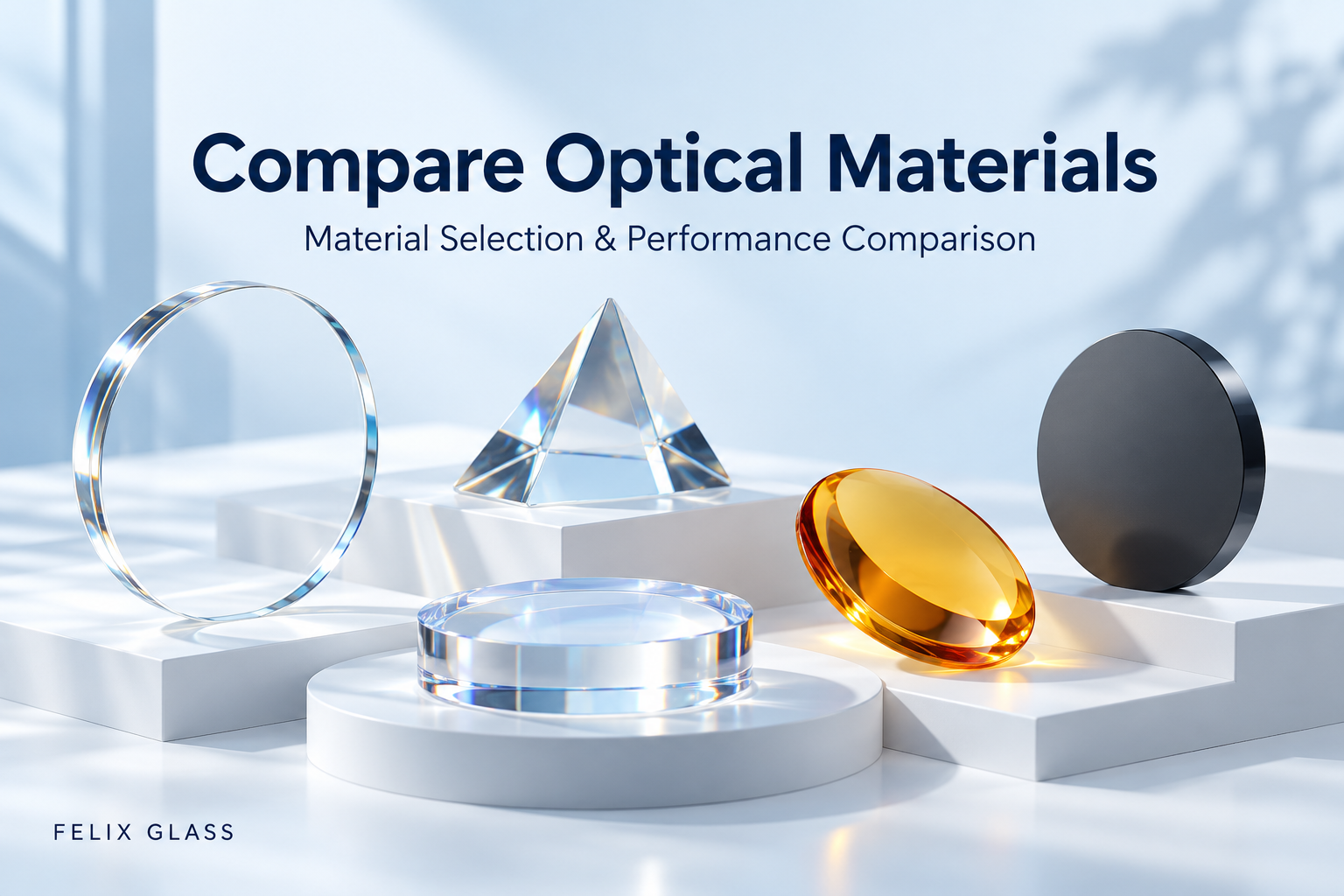
Knowledge Center · Engineering Selection Guide
Compare Optical Materials
Material selection & performance comparison
Compare optical glass, fused silica, sapphire, silicon, ZnSe and ZnS. Build a practical material specification around wavelength, image quality, environment and cost.
View the Selection Table1. Start with the Application, Not a Material Ranking
The right optical material is the one that meets the complete component specification. A hard substrate may be unsuitable for the operating wavelength; a highly transmitting substrate may need protection against handling or weather. Material selection therefore starts with the optical path and service conditions, followed by manufacturing and cost.
Separate mandatory limits from preferences. First eliminate materials that fail the wavelength, temperature, geometry or environmental requirements. Then compare the remaining candidates using the same finished-part criteria. A material name alone does not specify optical quality.
2. Optical Material Selection at a Glance
| Material family | Useful starting applications | Main advantage | Check before selection |
|---|---|---|---|
| N-BK7 / H-K9L crown glass | Visible and selected near-IR lenses, prisms and windows | Practical general-purpose optical glass | Exact grade, index, dispersion and transmission |
| Fused silica / fused quartz | UV, visible and selected near-IR optics | Low thermal expansion; grade-dependent optical purity | OH content, UV behavior, homogeneity and inclusions |
| Borosilicate sheet glass | Industrial windows and thermally exposed covers | Low expansion relative to common soda-lime glass | Optical figure, transmitted wavefront and thickness quality |
| Sapphire | Exposed windows and domes in compatible bands | High surface hardness | Crystal orientation, birefringence and fabrication cost |
| Silicon | Selected near-IR and mid-IR components | Useful IR optical properties | Band-specific absorption, resistivity and temperature |
| ZnSe | IR optics, including qualified CO₂ laser components | Broad IR utility | Absorption grade, coating and surface care |
| ZnS | IR windows and domes; multispectral systems with suitable grades | IR and grade-dependent multispectral capability | Standard versus HIP-treated grade and scatter |
| Strengthenable cover glass | Touch interfaces and display covers | Compatibility with selected strengthening routes | Exact chemistry, processing sequence and display appearance |
3. Define the Wavelength Band First
Use the actual source and detector bands, including tolerances and secondary channels. “Infrared” is too broad: a material suitable for a near-IR sensor is not automatically suitable for a long-wave thermal camera. Visible appearance is also an unreliable guide to IR transmission.
Compare measured spectra at the intended thickness and temperature. Ask whether a curve describes internal transmittance, an uncoated component or a coated component. Band edges are gradual and grade-dependent; a published transmission range is not a minimum-transmission guarantee over every wavelength in that range.
4. BK7-Type Glass vs. Fused Silica
Crown glass is a useful starting point for many visible optical designs. Fused silica becomes attractive when low thermal expansion or a particular UV or laser requirement drives the selection. Its benefits still depend on the selected grade and finished-part quality.
N-BK7 and H-K9L appear in supplier cross-reference families, but they are not identical procurement specifications. Approve substitutions against refractive-index and dispersion data, transmission, homogeneity, inclusions and relevant environmental properties. A lens prescription may require optical revalidation even when two materials have similar nominal index values.
Likewise, “quartz” should be clarified: amorphous fused quartz or fused silica is different from crystalline quartz. Request an identifiable manufacturer grade rather than relying on an informal material label.
5. Choose the Correct Fused Silica Grade
Synthetic fused silica and naturally derived fused quartz can differ in impurities, hydroxyl content and optical uniformity. UV and near-IR applications may require different grades. Heraeus and other material suppliers distinguish low-OH near-IR grades from products optimized for other spectral regions.
For a laser component, specify absorption and relevant damage qualification at the actual wavelength and pulse conditions. For UV sensing, include exposure-related transmission stability or fluorescence where relevant. Do not assume that any material sold as fused silica has the same optical behavior.
6. Borosilicate and Display Cover Glass
Borosilicate sheet glass can be a practical option for industrial viewing panels when thermal expansion and chemical exposure matter. SCHOTT describes BOROFLOAT 33 as a low-expansion borosilicate product; its suitability for a precision optical path still depends on the component specification.
Display covers require a different balance: strength, edge finish, appearance, touch behavior and compatibility with printing or surface treatments. Chemical strengthening is a substrate-dependent process, not a coating. Specify whether the part is chemically strengthened, thermally tempered or annealed, and agree on the manufacturing sequence.
A visually clear sheet is not automatically a precision window. Define transmitted wavefront, wedge or distortion when the cover sits in an imaging path.
7. Sapphire: Hardness with Design Tradeoffs
Sapphire is useful when scratch resistance is a major requirement and the operating band is compatible. Its crystalline nature introduces orientation and birefringence considerations. Polarization-sensitive systems should specify the crystal cut and optical-axis relationship to the beam.
Hardness is not a pressure rating or an impact guarantee. Window or dome thickness, unsupported span, edge defects, mounting and applied loads govern structural behavior. Qualify the finished assembly for pressure or impact requirements rather than assigning a universal depth or load to the material.
Allow for fabrication and inspection effort, especially for curved surfaces, complex edges and tight optical tolerances.
8. IR Choices: Silicon, ZnSe and ZnS
Screen IR materials using spectra for the required band and thickness. Silicon, ZnSe and ZnS serve different design needs; they should not be treated as interchangeable transparent solids. Include absorption, refractive index, thermal behavior and coating compatibility in the comparison.
For ZnSe laser optics, a material intended for imaging is not automatically a substitute for a low-absorption laser grade. Request application-specific absorption evidence and finished-component qualification.
For ZnS, distinguish standard IR material from a qualified multispectral grade. Coherent describes multispectral ZnS as HIP-treated, while Hellma identifies low absorption and scatter as important characteristics of its Cleartran product. Specify the actual grade and the spectral and scatter requirements; trade names are not generic guarantees for every ZnS blank.
9. Compare Image Quality, Not Just Transmission
Transmission measures how much light passes through; image quality also depends on how that light is redirected. Refractive-index uniformity, surface figure, wedge, roughness, stress and inclusions can affect system performance.
| Requirement | Why it matters | How to make it reviewable |
|---|---|---|
| Transmitted wavefront | Captures optical-path distortion through the component | Define wavelength, aperture, setup and mounting state |
| Surface figure | Controls individual surface shape errors | Specify the measurement convention and usable aperture |
| Wedge / centration | Controls beam deviation or alignment | Identify datums and measurement method |
| Surface quality | Limits cosmetic or functional defects | Name the grading system and inspection conditions |
| Scatter / haze | Affects contrast and useful transmitted light | Use a method appropriate to imaging or display use |
10. Temperature and Environment
Assess the temperature range and rate of change, not just a single maximum temperature. Expansion mismatch with a metal mount can create stress; absorbed power can cause thermal gradients. A substrate temperature rating does not establish the limit of the coating, adhesive or assembled device.
For outdoor or underwater components, identify abrasion, cleaning chemistry, humidity, salt exposure and pressure. Include post-exposure optical acceptance limits. Material strength data from a handbook cannot replace an assessment of the finished shape and mounting conditions.
11. Evaluate the Substrate and Coating Together
An AR coating can reduce reflection in its qualified band, but it cannot remove bulk absorption. Protective layers may improve resistance to a defined exposure while changing transmission, stress or cleaning behavior.
Identify the medium touching each face: air, water, adhesive or another optical material. Coatings intended for an air interface may need redesign when bonded or immersed. For curved domes, specify optical performance across the usable aperture because coating thickness and local angle can vary.
For a display panel containing a camera or sensor aperture, define the treatment of that aperture separately if AG texture would degrade imaging.
12. Application-Based Shortlist
| Application | Initial candidates | Decisive verification |
|---|---|---|
| Visible imaging window | Crown glass, fused silica | Wavefront, reflections and mounting stress |
| UV sensing | Appropriate UV-grade fused silica; other qualified UV materials | Transmission and exposure stability at the exact wavelength |
| Scratch-exposed optical cover | Sapphire or qualified protected glass | Optical band, abrasion and assembly durability |
| Thermal imaging window | Band-qualified ZnS, ZnSe or another suitable IR material | Finished-part transmission and environmental survival |
| CO₂ laser optic | Qualified laser-grade ZnSe | Absorption, coating and operating laser conditions |
| Matte touch panel | Suitable display cover glass | Strengthening, AG appearance, AF wear and print compatibility |
This shortlist is a screening aid, not a bill of materials. A final choice needs a drawing and measurable acceptance criteria.
13. Control Cost with a Complete RFQ
Compare quotations at the same grade, dimensions, surface quality, coating, inspection scope and quantity. Blank availability, machining allowance, polishing difficulty, yield and test requirements can dominate the cost of a custom part.
- State exact wavelength bands and optical targets.
- Provide dimensions, clear aperture, datums and tolerances.
- Name the preferred grade and any permitted alternatives.
- Identify surface treatments and assembly conditions.
- Specify environmental tests and required reports.
- Separate prototype and production quantities.
- Approve substitutions and process changes before manufacture.
14. Frequently Asked Questions
Which optical material is best?
There is no universal best material. Start with wavelength compatibility, then evaluate optical quality, environment, manufacturing and cost.
Can H-K9L replace N-BK7?
Potentially, after review. Similar nominal index and dispersion do not establish identical optical or manufacturing performance.
Is all fused silica UV grade?
No. Request an identifiable grade and data for the intended wavelength and exposure.
Is sapphire always the strongest choice?
It has high hardness, but component strength and impact behavior depend on flaws, geometry and mounting.
Can ordinary clear glass be used for long-wave thermal imaging?
Do not assume so. Check its transmission at the actual thermal-imaging wavelengths.
Are standard ZnS and multispectral ZnS equivalent?
No. Require the intended grade and verify transmission and scatter across all operating bands.
Can AR coating fix substrate absorption?
No. AR primarily addresses surface reflection under defined conditions.
What should I send for material selection?
Send the drawing, spectral requirements, optical quality targets, environment, coating needs and quantities.
15. Discuss Your Material Requirements
Send your drawing, operating wavelengths, application environment, prototype quantity and expected production volume to Felix Glass. Identify mandatory requirements and targets that can be adjusted so the material, coating and manufacturing route can be reviewed together.
Dongguan Felix Glass Co., Ltd.
Email: james@felixglass.com