Custom Infrared Dome Selection Guide: Material, Coating & Engineering Specification
- Share
- publisher
- Felix Optical Glass Co., Limited
- Issue Time
- Oct 8,2026
Summary
This engineering selection guide covers custom infrared dome material options including ZnSe, standard ZnS and multispectral ZnS. Learn coating specification, pressure design, prototype workflow and RFQ tips for ROV, AUV and thermal imaging OEM systems.
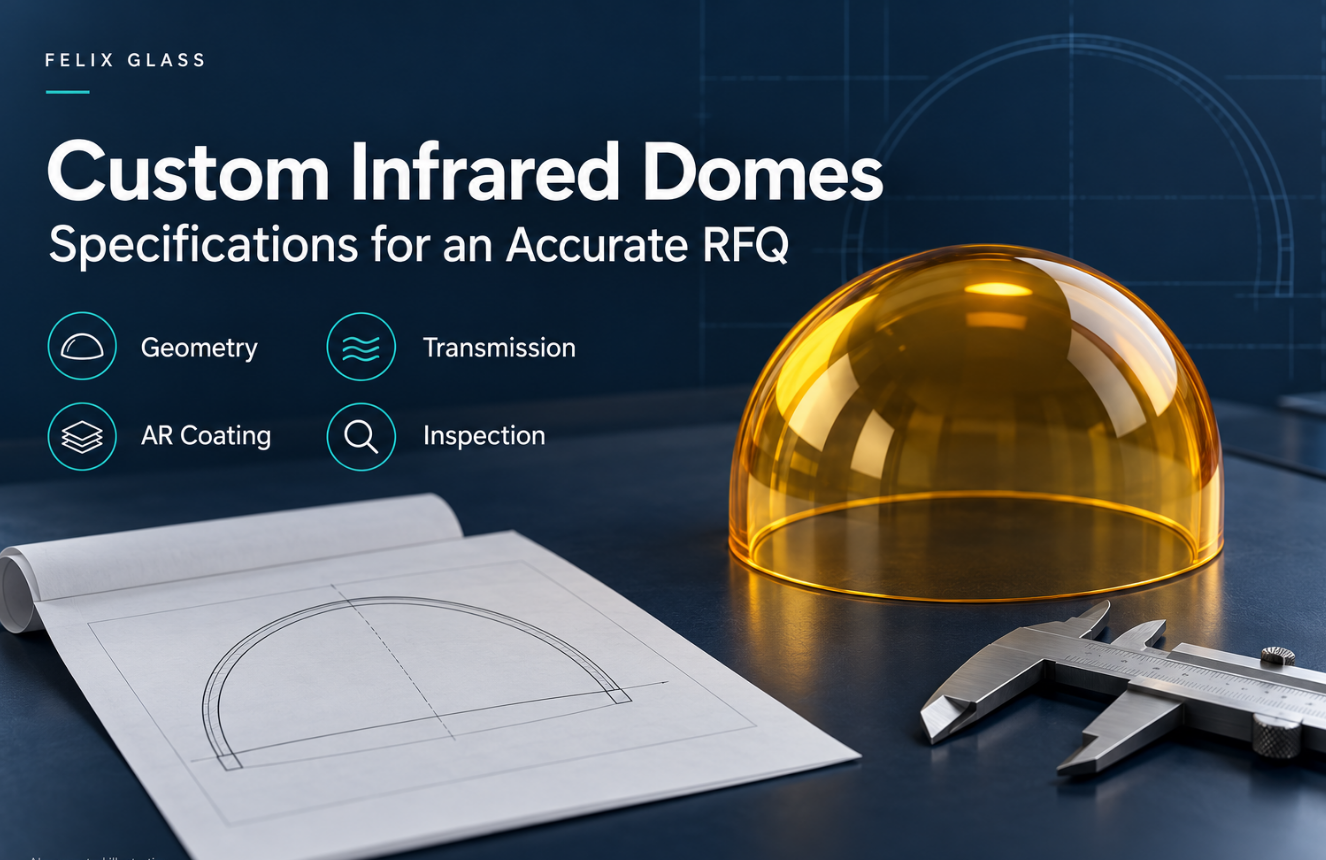
For ROV/AUV subsea monitoring, thermal imaging cameras, LWIR detection, and industrial optical systems, off-the-shelf infrared domes often fail to match unique housing structures, pressure resistance standards, spectral requirements, and environmental durability demands. Custom infrared dome manufacturing solves the compatibility pain points of standard products, delivering fully tailored optical performance, mechanical stability and assembly adaptability. Hong Kong Felix Optical Glass Co., Limited provides one-stop custom infrared dome solutions covering material customization, structural machining, precision coating, pressure simulation testing and finished product inspection. This professional selection guide helps system integrators, OEM engineers and marine project teams quickly lock the optimal custom dome specification and avoid engineering and procurement mistakes. The selection of custom infrared domes cannot rely solely on diameter or material name. Qualified customized optical domes need to balance four core engineering dimensions: infrared spectral transmittance, mechanical structural strength, environmental adaptability, and assembly matching accuracy. Different application scenarios correspond to completely different material grades, wall thickness designs, coating schemes and tolerance standards. Blindly pursuing high hardness or ultra-high transmittance will lead to cost waste or field operation failure. All customized specifications must be confirmed based on actual working wavelength, pressure load, working medium and installation structure. Material substrate is the core factor determining dome optical performance and service life, and is the primary customization item for infrared domes. ZnSe Infrared Dome Applicable scenarios: Indoor precision infrared detection, clean environment thermal imaging, laser optical equipment. Standard ZnS Infrared Dome Applicable scenarios: Shallow water ROV cameras, outdoor thermal monitoring, humid industrial environments. Multispectral ZnS Infrared Dome Applicable scenarios: Dual-band optical systems, military monitoring, multi-spectral detection equipment. To achieve perfect equipment matching and stable optical performance, the following customized parameters must be clearly defined in the RFQ stage, which is also the core basis for quotation and production: For customers without finalized drawings, our engineering team can provide budget quotation based on approximate dimensions and application scenarios, and formal production specifications will be confirmed after technical docking. Coating customization directly determines the final infrared transmittance and environmental durability of the dome, and is an indispensable part of custom dome engineering design. AR Anti-Reflection Coating DLC Diamond-Like Carbon Coating The pressure resistance of custom infrared domes cannot be judged by material alone. We support targeted customized optimization for high-pressure and harsh working conditions: Only the customized design integrating dome substrate, structural size and installation matching structure can meet the long-term stable operation requirements of deep-sea and industrial harsh environments. Different project certification standards correspond to different inspection customization requirements. We support full-process customized inspection items and provide traceable official reports: We will distinguish witness sample test and finished product batch test according to customer requirements to meet OEM batch delivery and project certification standards. We support complete customized processes from prototype trial production to formal mass production: Small-batch prototype orders and large-batch customized mass production are both acceptable, with flexible MOQ and adjustable production cycle according to customization difficulty. Many customers encounter price differences for infrared domes of the same caliber, which comes from multiple hidden customized parameters: different material grades, curvature precision standards, wall thickness tolerance, coating types, inspection scope, tooling cost and testing standards. We insist on quoting based on full customized technical parameters, clearly marking all manufacturing standards and assumed conditions, avoiding low-price single-standard quotation and subsequent performance mismatch risks. Send your dimensional drawings or sketches, working wavelength band, application scenarios and order quantity to our official email: james@felixglass.com Recommended Email Subject: Custom Infrared Dome RFQ — [Material / Diameter / Quantity] Our international sales director and optical engineering team will provide one-on-one technical review, scheme optimization and accurate formal quotation. For more technical questions about material selection, coating customization, pressure resistance standards, MOQ and lead time, please check our exclusive technical page: Infrared Dome Knowledge BaseCustom Infrared Dome Selection Guide: Material, Coating & Engineering Specification
Core Principle of Custom Infrared Dome Selection
Material Grade Selection: ZnSe vs Standard ZnS vs Multispectral ZnS
ZnSe features ultra-wide infrared transmission band of 0.6μm–16μm and extremely low absorption rate for CO₂ laser wavelength. It is the preferred material for high-precision thermal imaging and laser optical systems. Its disadvantage is low mechanical hardness and poor scratch resistance.
Inapplicable scenarios: Deep-sea high pressure, long-term seawater corrosion, high-friction harsh environments.
Standard ZnS balances infrared transmittance and mechanical performance. Compared with ZnSe, it has higher hardness, better impact resistance, abrasion resistance and moisture corrosion resistance. It is the most cost-effective material for industrial and marine conventional infrared systems.
Feature supplement: Slightly higher infrared absorption than ZnSe, which can be fully optimized through professional AR coating.
Multispectral ZnS supports dual-band transmission of visible light + infrared light, meeting the dual imaging requirements of visible light monitoring and long-wave infrared detection. It has stricter manufacturing standards and better comprehensive environmental adaptability.Custom Key Structural & Optical Parameters
Custom Coating Solution Matching Rules
Customized single-layer or multi-layer AR coating according to the target wavelength band, which effectively reduces surface reflection loss and maximizes infrared light transmittance. Customers need to specify coating surfaces, uncoated reserved areas, transmittance upper and lower limits, and light incidence angle range to ensure consistent optical performance of the whole machine.
DLC hard coating is a customized upgrade for harsh environments. It significantly improves the scratch resistance, salt spray corrosion resistance and waterproof moisture resistance of the dome surface, and is specially customized for subsea long-term working infrared domes.Pressure Resistance & Harsh Environment Customization Scheme
Optical Testing & Custom Inspection Report Service
Prototype Customization & Mass Production Process
Why Do Custom Dome Quotations Differ With The Same Diameter?
How To Launch Custom Infrared Dome RFQ
Professional Q&A Support