FLIR Grade ZnS LWIR Optics Design & Drawing
- Share
- publisher
- Felix Optical Glass Co., Limited
- Issue Time
- Oct 19,2026
Summary
Engineering design specs for FLIR grade CVD ZnS domes, windows and lenses. drawing requirements for 8-12μm LWIR thermal imaging
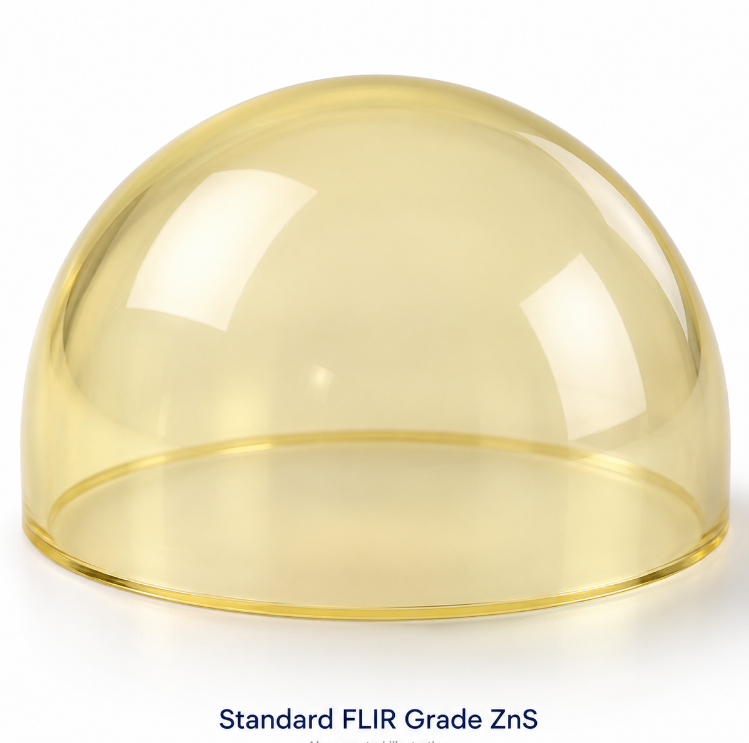
Engineering Overview of FLIR Grade CVD ZnS LWIR Optics
This engineering specification document defines the baseline design, tolerance, optical polishing, coating and inspection standards for standard FLIR grade CVD ZnS hemispherical domes, flat windows and plano-convex lenses, dedicated to 8–12μm LWIR thermal imaging systems. The material is non-HIP CVD polycrystalline ZnS, selected for high fracture toughness and outdoor moisture stability on EO/IR gimbals, UAV turrets and industrial thermal cameras. Open FLIR Grade ZnS product page.
Material Grade Definition & Factory Batch Control
FLIR grade CVD ZnS is defined for LWIR thermal imaging only. Raw blanks, CNC machining and polishing workstations are isolated from other optical material grades to prevent misapplication. Material certificate records CVD growth batch, bulk transmission baseline and hardness test data.
- Material type: Non-HIP polycrystalline CVD ZnS
- Target transmission window: 8–12μm LWIR
- Refractive index n=2.192 @10μm for optical simulation modeling
- Natural yellow tint, opaque in visible spectrum
Mandatory Optical Design Baseline
- Surface quality: 60-40 scratch-dig, standard industrial FLIR thermal grade
- Surface figure: λ/4 @632.8nm full aperture
- Uncoated bulk transmission: ≥72% single substrate
- Dual side LWIR AR coated transmittance: ≥95%
- Low wavefront distortion for uncooled LWIR sensor imaging
Dimensional Tolerance & Machining Standard
| Diameter Tolerance | ±0.06 mm |
|---|---|
| Thickness Tolerance | ±0.03 mm |
| Curvature Radius Tolerance | ±0.15% R |
| Parallelism for Flat Windows | ≤1.2 arcmin |
| Edge Safety Chamfer | 0.1~0.3mm optional |
| Maximum Blank Diameter | Up to 220mm |
LWIR AR & DLC Coating Engineering Limits
- Coating band: 8–12μm LWIR broadband AR
- Incidence angle range: 0°–35°
- Durability: Meet MIL-C-48497 adhesion and humidity test
- Optional DLC hard coating: Rain erosion, scratch and dust protection for outdoor airborne platforms
- Sealing face: Customer can reserve uncoated sealing zone on flange if required
Mechanical & Environmental Operating Limits
- Operating temperature: -55℃ ~ +130℃
- Knoop hardness: 160 HK, good impact resistance
- Thermal expansion coefficient: 6.6×10⁻⁶ /K
- Humidity: Stable under 95% RH, water insoluble
- Vibration: Suitable for UAV and vehicle mounted gimbal dynamic environment
Common Design Pitfalls for FLIR ZnS LWIR Optics
Most field failures come from design specification mismatch rather than material defect.
- Wrong grade selection, using multispectral HIP ZnS when only LWIR FLIR function required, leading to unnecessary cost
- Missing parallelism control on flat window, causing ghost images in thermal sensor
- Ignoring DLC requirement on outdoor UAV dome, surface erosion after long term rain impact
- Coating band mismatch with uncooled LWIR sensor response curve
For grade selection workflow, refer to FLIR Grade ZnS selection guide.
Required Drawing Parameters For Production RFQ
Production drawing must include full engineering data to lock specification before machining:
- Outer diameter, total thickness, radius of curvature, flange dimension and sealing surface
- Mark coated surfaces and reserved uncoated sealing area
- Working LWIR band, sensor type, vibration and temperature environment
- Acceptance standard: scratch-dig, surface figure, spectral transmission requirement
Final Inspection & Traceability Documents
Each finished FLIR grade ZnS component ships with full traceable documentation:
- CVD raw material grade certificate
- Dimensional metrology inspection report
- Scratch-dig and surface figure test record
- 8–12μm spectral transmission curve
- Coating adhesion / durability test report
Engineering RFQ Confirmation Workflow
Submit full engineering drawing, environment condition, coating scheme and order quantity. Optical engineers review optical path feasibility, tolerance optimization and coating compatibility, then lock engineering specification and provide prototype & mass production quotation. Start your engineering RFQ.
FAQ FLIR Grade ZnS Engineering Design
1. Can we reserve uncoated sealing flange area?
Yes, drawing can specify uncoated sealing face on flange, coating will only be applied on optical clear aperture.
2. What is the standard scratch-dig for FLIR ZnS?
Default standard is 60-40 scratch-dig for industrial LWIR thermal imaging, tighter grade can be custom quoted.
3. Does this material pass vibration test for UAV gimbal?
FLIR grade ZnS has high fracture toughness, it is widely adopted for UAV EO/IR turret, full vibration qualification can be validated with prototype sample.