FLIR Grade ZnS LWIR Thermal Imaging specification Guide
- Share
- publisher
- Felix Optical Glass Co., Limited
- Issue Time
- Oct 10,2026
Summary
Learn how to select standard FLIR grade CVD ZnS for 8-12μm LWIR thermal imaging domes, windows and lenses. Material properties, coating and application selection.
What Is Standard FLIR Grade CVD ZnS?
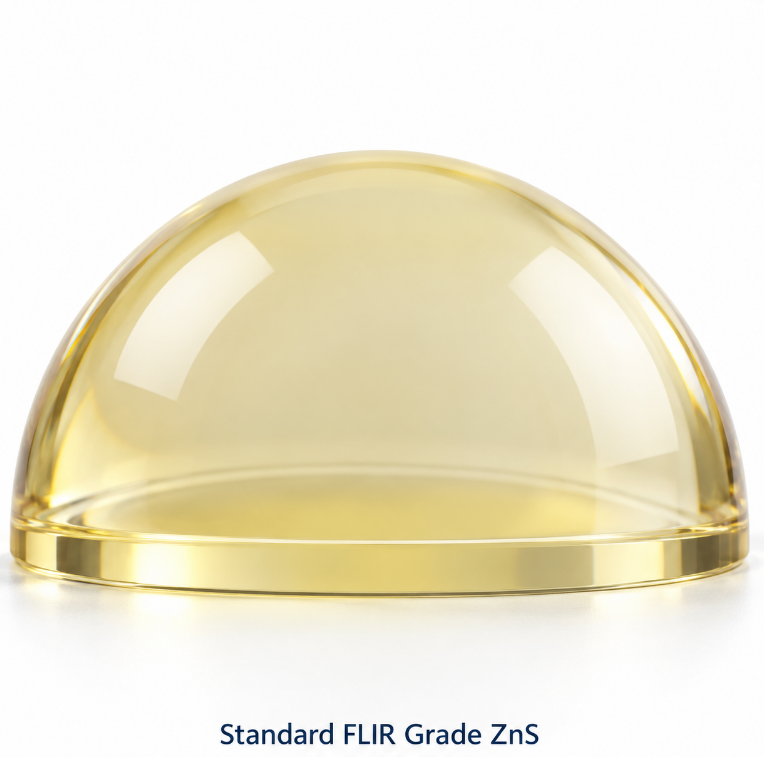
Standard FLIR grade CVD ZnS is polycrystalline zinc sulfide grown by chemical vapor deposition, without HIP hot isostatic pressing post treatment. It is a cost-optimized optical substrate dedicated to 8–12μm LWIR thermal imaging, widely used as front protective dome, flat window and plano-convex lens for FLIR thermal cameras, UAV EO/IR turrets and vehicle mounted gimbals. Hong Kong Felix Optical Glass Co., Limited supplies custom FLIR grade ZnS optics with batch material segregation. View Standard FLIR Grade ZnS product page.
Key Optical & Physical Properties of FLIR Grade ZnS
| Transmission Band | 8–12μm LWIR thermal imaging |
|---|---|
| Refractive Index | 2.192 @10μm |
| Knoop Hardness | 160 HK |
| Thermal Expansion Coefficient | 6.6×10⁻⁶ /K |
| Operating Temperature | -55℃ ~ +130℃ |
| Water Stability | Insoluble, high humidity resistant |
Available Component Shapes of FLIR Grade ZnS
- Hemispherical ZnS dome: Outer protective optical dome for EO/IR gimbal and thermal camera head
- Flat circular ZnS window: Sealed protective cover for fixed thermal sensor modules
- Plano-convex ZnS lens: Infrared focusing element inside LWIR optical train
All shapes support custom diameter, thickness, curvature radius and flange machining for customer housing integration.
FLIR Grade ZnS Coating Selection Guide
Coating selection directly affects thermal image contrast and outdoor service life.
- LWIR broadband AR coating: Optimized for 8–12μm, reduces surface reflection and raises transmittance
- DLC hard coating: Optional upgrade, adds scratch, rain erosion and dust resistance for field deployed thermal sensors
Coating recipes are tuned only for LWIR thermal imaging, not for multispectral transmission applications.
How To Select The Correct FLIR Grade ZnS Optics
Thermal system integrators should confirm these parameters before RFQ:
- Working LWIR band: confirm 8–12μm full band transmission requirement
- Mounting form: dome with flange, plain dome, flat window or focusing lens
- Environment: indoor thermography or outdoor airborne / vehicle vibration platform
- Surface quality requirement: standard 60-40 scratch-dig for industrial FLIR systems
- Coating demand: basic LWIR AR, or AR + DLC dual protection
Typical Applications of FLIR Grade ZnS
- Uncooled LWIR FLIR thermal imaging cameras
- UAV drone EO/IR sensor turret domes
- Vehicle mounted thermal surveillance gimbal optics
- Industrial predictive maintenance thermal imager windows
- Outdoor border security thermal sensor protection
Quality Control & Batch Segregation Policy
FLIR grade CVD ZnS raw material, polishing fixtures and inspection stations are physically separated to avoid cross grade mixing. Every batch provides raw material certificate, spectral transmission curve and dimensional inspection report for engineering traceability. Prototype samples are available for assembly validation before serial production.
Submit RFQ For Custom FLIR Grade ZnS Optics
Prepare your drawings, working wavelength, coating plan, environmental condition and quantity. Our optical engineering team reviews feasibility and issues formal quotation. Request custom quote now.
FAQ FLIR Grade ZnS Material Selection
1. Is FLIR grade ZnS transparent to visible light?
No, standard FLIR grade CVD ZnS has natural yellow tint and is not transparent in visible range, it only works for LWIR thermal imaging.
2. What is the difference between FLIR grade ZnS and HIP ZnS?
FLIR grade ZnS has no HIP treatment, lower cost and optimized only for LWIR thermal imaging. HIP processed ZnS targets multispectral transmission, which is a separate product line.
3. Is prototype order accepted?
Yes, small prototype batches are supported, lead time around 7–10 working days after drawing confirmation.