IR Grade CVD ZnSe Engineering Design Overview for Thermal Imaging Systems
- Share
- publisher
- Felix Optical Glass Co., Limited
- Issue Time
- Oct 9,2026
Summary
Full engineering design overview of IR grade CVD ZnSe for LWIR thermal imaging for custom ZnSe domes, windows and lenses.
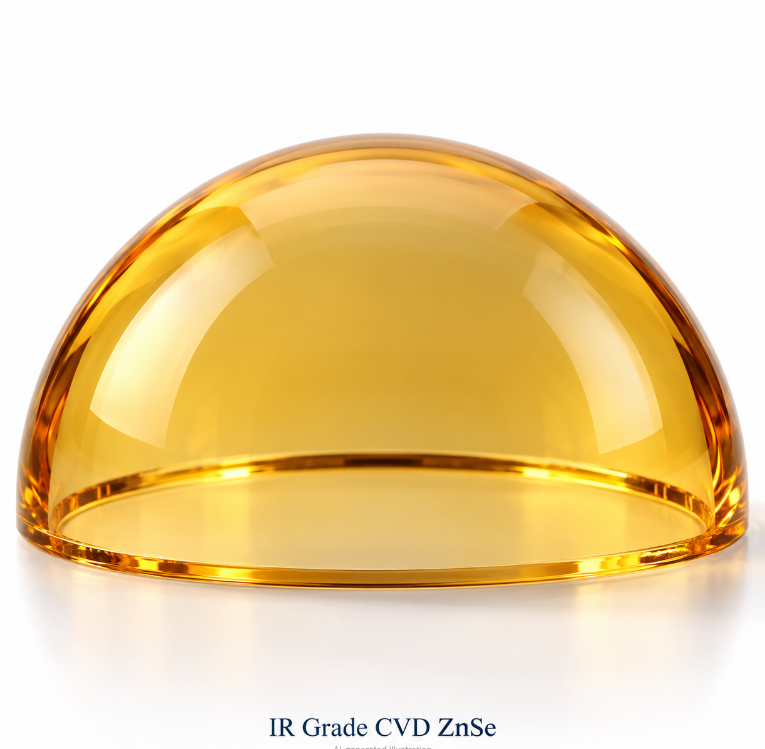
IR Grade CVD ZnSe Engineering Design Overview for Thermal Imaging Systems
IR grade CVD ZnSe is the industry standard substrate for LWIR 8–14μm thermal imaging protection and optical focusing. Unlike laser-grade ZnSe optimized for ultra-low laser absorption, IR-grade material is engineered for consistent broadband infrared transmission, stable environmental performance, and repeatable optical imaging quality for surveillance, gimbal, UAV, and industrial thermography systems. This engineering specification guide covers mechanical tolerance, optical polishing standards, coating limits, environmental rating, and drawing requirements for custom IR ZnSe domes, windows, and lenses. View full IR Grade ZnSe product range.
Official Material Grade Definition & Batch Control Rules
IR grade CVD ZnSe is defined for 0.6–16μm broadband infrared transmission with controlled natural absorption for thermal imaging use only. Factory material management strictly separates IR-grade stock from laser-grade CVD ZnSe to avoid cross-contamination, inconsistent transmission behavior, or misapplication in CO₂ laser equipment.
- Pure CVD growth process without sintered impurities
- Stable LWIR transmission uniformity across full substrate area
- Consistent refractive index 2.403 @10μm for optical simulation
- Batch certification includes spectral curve, density, and hardness test
Mandatory Optical Design Specifications (LWIR Imaging Standard)
All IR grade ZnSe components follow fixed engineering baselines to guarantee stable thermal imaging clarity and minimal image distortion.
- Transmission Band: 0.6μm–16μm, stable 8–14μm LWIR flat spectrum
- Surface Quality: 40-20 scratch-dig (default industrial thermal grade)
- Surface Figure: λ/4 @632.8nm
- Wavefront Uniformity: Controlled for low distortion imaging
- Parallelism: ≤1 arcmin for flat windows
- Surface Roughness: Polished optical grade, no micro-scatter defects
Dimensional Tolerance & Mechanical Machining Standards
Precision mechanical tolerance ensures perfect housing fitting for EO/IR gimbals, sensor turrets, and outdoor thermal camera enclosures.
| Diameter Tolerance | ±0.05 mm |
|---|---|
| Thickness Tolerance | ±0.02 mm |
| Curvature Tolerance | ±0.1% R |
| Edge Chamfer | 0.1–0.3mm optional safety chamfer |
| Flatness | λ/4 full aperture |
| Max Custom Size | Up to 220mm single piece |
LWIR AR Coating Technical Specification & Limits
IR-grade coating formulas are exclusively tuned for thermal imaging bands and are different from laser-grade 10.6μm laser coatings.
- Coating Type: Broadband LWIR anti-reflection coating
- Working Band: 8–14μm long-wave infrared
- Average Transmittance: ≥96% dual-side coated
- Incidence Angle Range: 0°–30°
- Coating Durability: Meet standard MIL-C-48497 adhesion test
- Optional Upgrade: DLC hard coating for dust, scratch, and humidity resistance
Environmental Mechanical Rating & Operating Limits
Engineers must reference these limits during system integration to avoid optical degradation or surface failure in field deployment.
- Operating Temperature: -60℃ to +120℃
- Thermal Expansion Coefficient: 7.6×10⁻⁶/K
- Hardness: 110 Knoop
- Humidity Resistance: Insoluble in water, stable under high RH environment
- Vibration Suitability: Compatible with UAV, vehicle-mounted gimbal vibration environments
Common Engineering Mistakes to Avoid in IR ZnSe Design
Most thermal imaging optical failures originate from incorrect specification matching rather than material quality issues.
- Using laser-grade ZnSe for thermal imaging (over-specified, unnecessary cost increase)
- Using uncoated ZnSe for outdoor LWIR systems (low transmittance, blurry imaging)
- Ignoring parallelism tolerance for window assemblies (ghost image generation)
- Mismatching coating band between sensor response and optical window
- Confusing scratch-dig grade with actual imaging performance
Review our IR ZnSe selection guide for correct grade matching workflows.
Required Drawing Parameters for Formal Production
To generate fully compliant production specs, customer drawings must include all below items:
- Outer diameter, thickness, radius of curvature
- Mounting tolerance and sealing surface requirements
- Coated surfaces / non-coated reserved zones
- Working wavelength and sensor type (uncooled LWIR)
- Environmental operating conditions
- Required inspection reports
Quality Inspection Report Standards for IR Grade Znse
Every finished IR-grade CVD Znse dome, window, and lens is delivered with full traceable documentation:
- Raw material grade certification
- Full dimensional tolerance inspection report
- Surface scratch-dig & surface figure test record
- 8–14μm spectral transmittance curve report
- Coating adhesion and durability test data
RFQ & Engineering Confirmation Workflow
Submit your drawings or dimensional sketches, application environment, coating requirements, and quantity. Our optical engineering team reviews your optical path design, confirms IR-grade suitability, optimizes tolerance and coating scheme, and delivers formal engineering quotation with complete specification lock for mass production.
IR Grade CVD ZnSe Engineering Design Overview for Thermal Imaging Systems
IR grade CVD ZnSe is the industry standard substrate for LWIR 8–14μm thermal imaging protection and optical focusing. Unlike laser-grade ZnSe optimized for ultra-low laser absorption, IR-grade material is engineered for consistent broadband infrared transmission, stable environmental performance, and repeatable optical imaging quality for surveillance, gimbal, UAV, and industrial thermography systems. This engineering specification guide covers mechanical tolerance, optical polishing standards, coating limits, environmental rating, and drawing requirements for custom IR ZnSe domes, windows, and lenses. View full IR Grade ZnSe product range.
Official Material Grade Definition & Batch Control Rules
IR grade CVD ZnSe is defined for 0.6–16μm broadband infrared transmission with controlled natural absorption for thermal imaging use only. Factory material management strictly separates IR-grade stock from laser-grade CVD ZnSe to avoid cross-contamination, inconsistent transmission behavior, or misapplication in CO₂ laser equipment.
- Pure CVD growth process without sintered impurities
- Stable LWIR transmission uniformity across full substrate area
- Consistent refractive index 2.403 @10μm for optical simulation
- Batch certification includes spectral curve, density, and hardness test
Mandatory Optical Design Specifications (LWIR Imaging Standard)
All IR grade ZnSe components follow fixed engineering baselines to guarantee stable thermal imaging clarity and minimal image distortion.
- Transmission Band: 0.6μm–16μm, stable 8–14μm LWIR flat spectrum
- Surface Quality: 40-20 scratch-dig (default industrial thermal grade)
- Surface Figure: λ/4 @632.8nm
- Wavefront Uniformity: Controlled for low distortion imaging
- Parallelism: ≤1 arcmin for flat windows
- Surface Roughness: Polished optical grade, no micro-scatter defects
Dimensional Tolerance & Mechanical Machining Standards
Precision mechanical tolerance ensures perfect housing fitting for EO/IR gimbals, sensor turrets, and outdoor thermal camera enclosures.
| Diameter Tolerance | ±0.05 mm |
|---|---|
| Thickness Tolerance | ±0.02 mm |
| Curvature Tolerance | ±0.1% R |
| Edge Chamfer | 0.1–0.3mm optional safety chamfer |
| Flatness | λ/4 full aperture |
| Max Custom Size | Up to 220mm single piece |
LWIR AR Coating Technical Specification & Limits
IR-grade coating formulas are exclusively tuned for thermal imaging bands and are different from laser-grade 10.6μm laser coatings.
- Coating Type: Broadband LWIR anti-reflection coating
- Working Band: 8–14μm long-wave infrared
- Average Transmittance: ≥96% dual-side coated
- Incidence Angle Range: 0°–30°
- Coating Durability: Meet standard MIL-C-48497 adhesion test
- Optional Upgrade: DLC hard coating for dust, scratch, and humidity resistance
Environmental Mechanical Rating & Operating Limits
Engineers must reference these limits during system integration to avoid optical degradation or surface failure in field deployment.
- Operating Temperature: -60℃ to +120℃
- Thermal Expansion Coefficient: 7.6×10⁻⁶/K
- Hardness: 110 Knoop
- Humidity Resistance: Insoluble in water, stable under high RH environment
- Vibration Suitability: Compatible with UAV, vehicle-mounted gimbal vibration environments
Common Engineering Mistakes to Avoid in IR ZnSe Design
Most thermal imaging optical failures originate from incorrect specification matching rather than material quality issues.
- Using laser-grade ZnSe for thermal imaging (over-specified, unnecessary cost increase)
- Using uncoated ZnSe for outdoor LWIR systems (low transmittance, blurry imaging)
- Ignoring parallelism tolerance for window assemblies (ghost image generation)
- Mismatching coating band between sensor response and optical window
- Confusing scratch-dig grade with actual imaging performance
Review our IR ZnSe selection guide for correct grade matching workflows.
Required Drawing Parameters for Formal Production
To generate fully compliant production specs, customer drawings must include all below items:
- Outer diameter, thickness, radius of curvature
- Mounting tolerance and sealing surface requirements
- Coated surfaces / non-coated reserved zones
- Working wavelength and sensor type (uncooled LWIR)
- Environmental operating conditions
- Required inspection reports
Quality Inspection Report Standards for IR Grade ZnSe
Every finished IR-grade CVD ZnSe dome, window, and lens is delivered with full traceable documentation:
- Raw material grade certification
- Full dimensional tolerance inspection report
- Surface scratch-dig & surface figure test record
- 8–14μm spectral transmittance curve report
- Coating adhesion and durability test data
RFQ & Engineering Confirmation Workflow
Submit your drawings or dimensional sketches, application environment, coating requirements, and quantity. Our optical engineering team reviews your optical path design, confirms IR-grade suitability, optimizes tolerance and coating scheme, and delivers formal engineering quotation with complete specification lock for mass production.
FAQ: IR Grade CVD ZnSe Engineering Design
1. What is the default scratch-dig specification for commercial IR ZnSe domes?
40-20 scratch-dig is our standard for industrial thermal imaging. Higher grades such as 20-10 are available upon request for high-end systems.
2. Can DLC coating be combined with broadband LWIR AR coating on IR ZnSe?
Yes, AR+DLC dual coating is available for outdoor surveillance, UAV and vehicle gimbal domes to boost transmittance plus abrasion protection.
3. What is the maximum single piece size for IR grade CVD ZnSe?
Up to 220mm diameter blank. Contact our engineering team to check feasibility for large dome or window machining.
View Custom IR Dome Products
• Browse all IR Grade CVD ZnSe Optics and window products
• Check IR dome FAQ for OEM buyers