Infrared Dome AR Coatings: Practical Guide for OEM Buyers
- Share
- publisher
- Felix Glass Co., Limited
- Issue Time
- Oct 19,2026
Summary
Learn to specify infrared dome AR coatings. Covers wavelength, incidence angle, transmission targets, coating durability, witness sample rules & inspection requirements for OEM infrared dome projects.
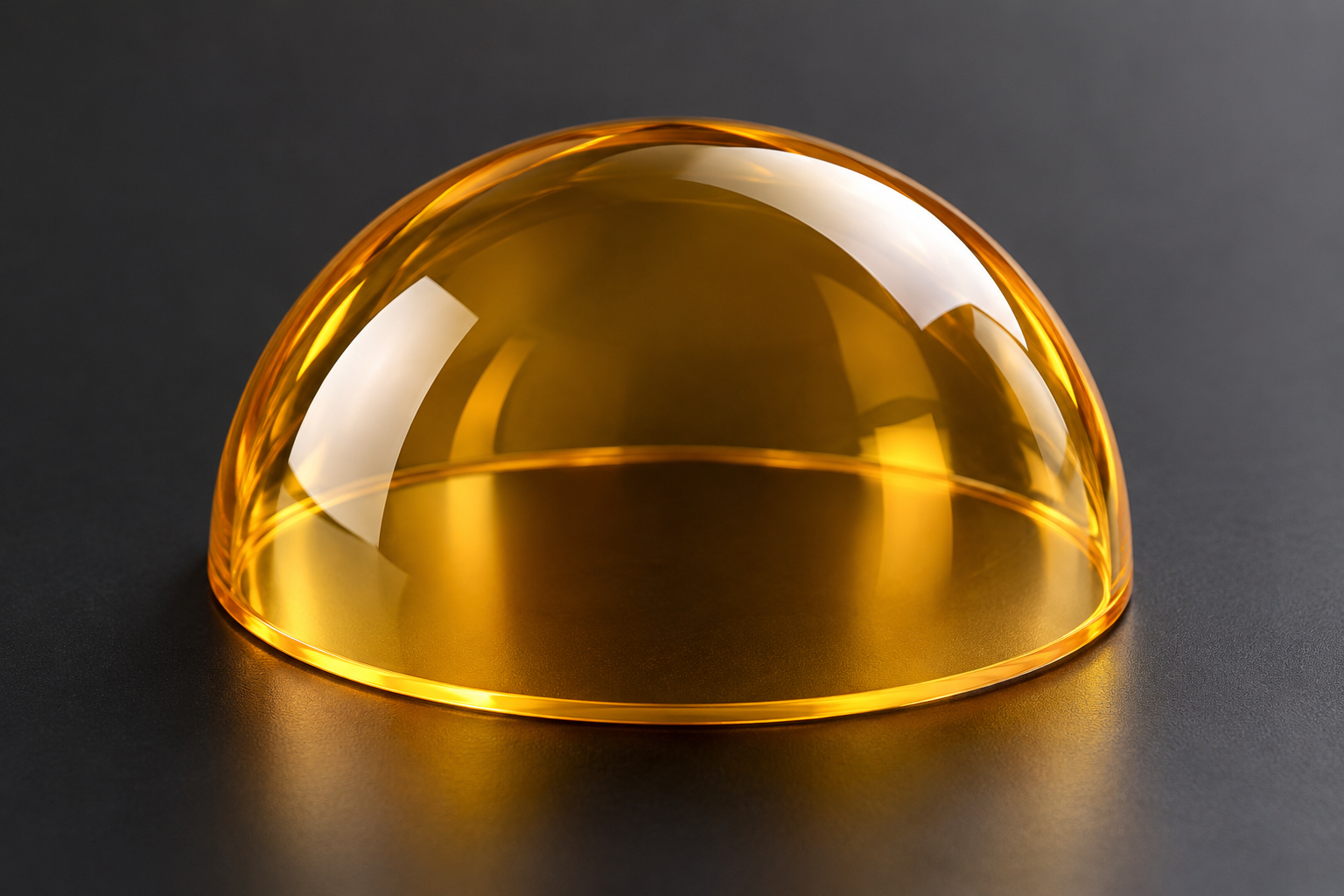
Infrared Dome AR Coatings: How to Define the Right Requirements
An anti-reflection coating is an important part of a custom infrared dome specification. However, requesting “both sides AR coated” does not give a manufacturer enough information to select or evaluate the coating.
The coating must match the operating wavelengths, ray angles, substrate and exposure conditions of the finished component. These requirements should be reviewed together with the dome geometry.
This guide explains the questions OEM buyers should resolve before ordering an AR-coated infrared dome.
What Should an Infrared AR Coating Achieve?
The primary purpose of an AR coating is to reduce reflection at an optical surface within a specified wavelength band and under defined conditions.
For an infrared dome, the practical objective may be to improve useful transmission through the protective optic. The acceptance criteria should therefore describe the performance the system actually needs.
For example, “AR coating for thermal imaging” leaves several questions open:
- What is the operating wavelength band?
- Is the requirement minimum or average transmission?
- At which incidence angles must it be met?
- Does it apply to the finished dome or a coating witness sample?
- Must the external surface withstand cleaning or environmental exposure?
Clear answers make quotations easier to compare.
1. Define the Operating Wavelengths First
Start with the wavelengths used by the sensor or optical system.
A coating for a single laser wavelength has a different design objective from a coating covering a broad imaging band. A shared visible and infrared aperture introduces additional requirements.
| Application requirement | Information to provide |
|---|---|
| Single-wavelength operation | Wavelength and permitted wavelength variation |
| Broadband imaging | Full operating band and transmission limits |
| Multiple separate bands | Each required band and its relative priority |
| Visible alignment plus infrared sensing | Visible and infrared requirements separately |
| Laser operation | Wavelength, power, beam size and operating mode |
Avoid requesting the broadest possible coating band without checking whether the system needs it. A focused specification gives the manufacturer a clearer design target.
2. Explain How Rays Pass Through the Dome
A dome’s curved shape makes incidence angle an important coating consideration.
The angle between a ray and the local surface normal depends on the dome geometry and the optical system’s position. A wide system field of view does not, by itself, define the coating’s incidence-angle range.
Provide the optical layout or ray-angle information where available. If these details are still being developed, ask the optical designer to establish the relevant angles before finalizing the coating specification.
For applications where polarization matters, identify whether performance must be assessed for s-polarized light, p-polarized light or another defined condition.
3. Identify the Substrate and Material Grade
An AR coating should be evaluated for the selected substrate.
The RFQ should state the material and grade, rather than using a general description such as “infrared glass.” For ZnS components, clarify whether standard CVD ZnS or multispectral ZnS is required.
If the material has not been selected, request a combined substrate-and-coating proposal against the same optical requirements.
This helps prevent a mismatch between a suitable substrate and a coating that does not support the intended operating bands.
4. Label the Inner and Outer Surfaces Clearly
Use consistent surface labels on the drawing:
S1: External surface.
S2: Internal surface.
Then state the coating requirement for each surface.
| Surface | Optical requirement | Exposure information |
|---|---|---|
| S1 — External | Defined band, angles and performance limits | Cleaning, moisture, dust or other applicable exposure |
| S2 — Internal | Defined band, angles and performance limits | Internal environment and assembly handling |
Both surfaces may require AR coating, but they do not necessarily need identical specifications. The external surface may have durability requirements that do not apply to the protected internal surface.
Also identify mounting lands, bonding areas or other regions that must remain uncoated.
5. Make Transmission Targets Measurable
“High transmission” should be replaced by an agreed acceptance criterion.
A useful specification distinguishes between minimum transmission, average transmission and transmission at selected wavelengths.
These are different requirements. A high average value does not establish that every wavelength in the band meets the same threshold.
The measurement basis should also be clear:
| Specification item | Question to resolve |
|---|---|
| Spectral limits | What are the start and end wavelengths? |
| Acceptance metric | Minimum, average or selected-wavelength transmission? |
| Test object | Finished dome, witness sample or another agreed sample? |
| Incidence angle | At what angle or angle range is performance required? |
| Measurement area | Which part of the clear aperture is evaluated? |
| Test conditions | What measurement method and conditions apply? |
For preliminary enquiries, ask the supplier to propose achievable limits. Once agreed, include those limits in the controlled specification.
6. Treat Durability as a Separate Requirement
An AR coating’s optical performance does not establish its resistance to abrasion, cleaning or environmental exposure.
Describe the actual service conditions rather than relying only on terms such as “hard coating” or “outdoor grade.”
Relevant questions may include:
- How will the dome be cleaned?
- Which cleaning agents are permitted?
- Will the outer surface encounter dust or abrasive particles?
- Is moisture or salt exposure relevant?
- Are temperature cycles specified?
- Which test procedure and acceptance criteria apply?
If a standard is required, identify the applicable revision, procedure and pass criteria. Agree on whether the test will use the finished component or representative samples.
7. Clarify What a Witness Sample Demonstrates
A coating witness sample can provide useful process information, but it should not automatically be treated as proof of every finished-dome requirement.
The witness sample may differ from the dome in shape, location during coating, substrate or measurement geometry.
Before production, agree on:
- Witness-sample material and geometry.
- Its relationship to the coating batch.
- Tests performed on the witness sample.
- Tests required on the finished dome.
- How the results will be reported and accepted.
This makes the inspection report easier to interpret and avoids uncertainty at delivery.
8. Do Not Identify AR Coatings by Color Alone
A coating may produce visible reflections or a slight color appearance, but photographs do not establish its spectral performance.
Lighting, viewing angle, substrate color and camera settings all affect how a coated dome looks.
For purchasing and quality control, identify the coating through its specification, batch records and agreed test results. Product images can illustrate appearance, but they should not replace optical inspection data.
9. Review Prototype Results Before Production
Prototype evaluation should answer specific questions about the coating and the complete assembly.
A useful review may include transmission results, image quality, fit, cleaning compatibility and any required environmental testing.
Record the sample identification, drawing revision and coating specification alongside the results. If changes are needed, update the controlled documents before placing a repeat order.
This provides a clearer basis for consistent production than referring only to an earlier sample’s appearance.
Infrared Dome AR Coating RFQ Checklist
Before requesting a quotation, prepare the following:
| Category | Required information |
|---|---|
| Substrate | Material and grade |
| Geometry | Drawing, clear aperture and surface labels |
| Spectrum | Wavelength bands and performance targets |
| Ray conditions | Incidence angles and polarization, where relevant |
| Coated areas | S1, S2 and any masking requirements |
| Durability | Service conditions and applicable tests |
| Inspection | Finished-part and witness-sample requirements |
| Quantity | Prototype and expected production quantities |
| Documentation | Required reports and traceability |
Discuss Your Coated Infrared Dome with Felix Glass
For a useful coating review, send your dome drawing together with the operating band, transmission targets and exposure conditions.
If some requirements remain open, identify them in the enquiry so they can be addressed during the feasibility review.
Contact: James Fu
Company: FELIX OPTICAL GLASS
Email: james@felixglass.com
Website: https://www.felixglass.com/