Multispectral ZnS vs Standard FLIR Grade ZnS
- Share
- publisher
- Felix Glass
- Issue Time
- Oct 19,2026
Summary
Compare Multispectral ZnS vs Standard FLIR Grade CVD ZnS for custom IR windows and domes. Learn HIP effects on optical & mechanical performance, key RFQ specs for thermal or common-aperture systems.
Multispectral ZnS vs Standard FLIR Grade ZnS: Which Should You Choose for Infrared Windows and Domes?
Choosing zinc sulfide for an optical window or dome involves more than specifying “ZnS” on a drawing.
Standard FLIR-grade ZnS is commonly considered for thermal infrared applications. Multispectral ZnS is especially relevant when visible and infrared channels must operate through the same optical component.
However, multispectral material is not automatically the best choice for every project. The decision should account for the required wavelengths, optical performance, environmental exposure and finished-part acceptance criteria.
For buyers sourcing custom ZnS windows and hemispherical domes, understanding these differences helps prevent both unnecessary specifications and unsuitable material substitutions.
What Is Standard FLIR Grade ZnS?
FLIR stands for Forward-Looking Infrared. In material descriptions, FLIR-grade ZnS refers to an infrared optical material rather than a camera brand certification.
Standard CVD ZnS is produced by chemical vapor deposition and used without the additional hot isostatic pressing treatment associated with multispectral material.
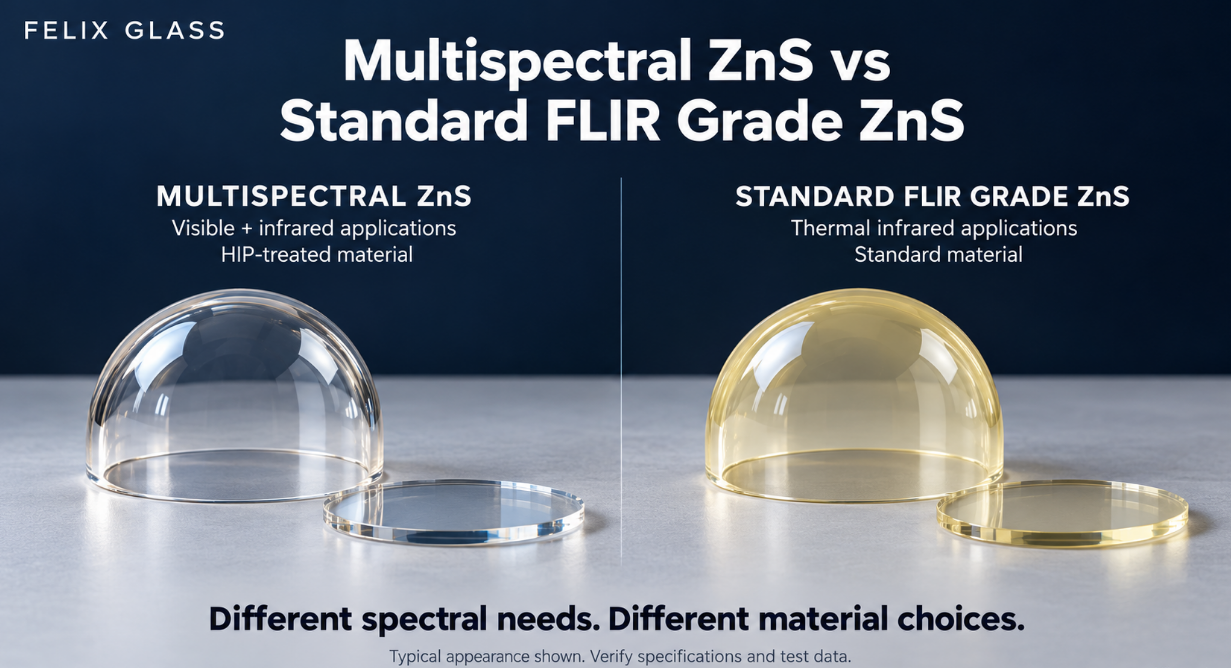
It typically appears pale yellow and translucent in visible light. This appearance does not mean it is defective: Crystran describes standard FLIR-grade ZnS as a material for thermal infrared windows and lenses, including front optics exposed to demanding environments.
The practical question is whether it meets the required infrared performance—not whether it looks clear to the human eye.
What Is Multispectral ZnS?
Multispectral ZnS, often abbreviated ZnS-MS, undergoes hot isostatic pressing, or HIP, to improve its optical properties.
This treatment reduces scattering associated with the material’s internal structure and produces a much clearer appearance in visible light. Coherent describes its multispectral ZnS as water-clear material suitable for common-aperture systems operating across visible and infrared wavelengths. Its published application range is 0.4–12 μm.
This makes multispectral ZnS particularly useful when several sensing channels need to share one protective window or dome.
The value is not simply a clearer-looking component. It is the ability to support a broader set of optical requirements.
Multispectral ZnS vs Standard FLIR Grade ZnS
| Comparison | Standard FLIR Grade ZnS | Multispectral ZnS |
|---|---|---|
| Material processing | Typically used in the as-deposited condition | Receives additional HIP treatment |
| Typical visible appearance | Pale yellow and translucent | Water-clear or substantially clearer |
| Main selection focus | Thermal infrared transmission and front-optic requirements | Visible-to-infrared operation and reduced scattering |
| Visible imaging through the component | Generally unsuitable for clear visible imaging | A candidate for visible imaging, subject to finished-part specifications |
| Typical applications | Thermal imaging windows and infrared protective optics | Shared-aperture windows, multispectral imaging optics and domes |
| Mechanical comparison | Supplier data may show greater hardness or strength | Improved spectral performance does not automatically mean greater strength |
| Procurement priority | Confirm infrared performance and environmental requirements | Confirm performance in every required optical band |
These are selection guidelines. Supplier-specific data and the agreed component specification should control acceptance.
Can You See the Difference?
Unlike laser-oriented and imaging-oriented ZnSe labels, these two ZnS material forms often show a noticeable difference in visible appearance.
A polished standard FLIR-grade ZnS window may look yellowish or hazy. A polished multispectral ZnS window can look much clearer.
However, appearance is only an indication—not proof of grade or optical performance.
Thickness, surface finish, coatings and illumination influence how a part looks. A photograph cannot verify its spectral transmission, wavefront quality or processing history.
For incoming inspection, use traceable material documentation and the agreed optical tests.
Does Multispectral ZnS Transmit Better at Every Wavelength?
Do not assume a uniform improvement across the entire infrared spectrum.
The benefit depends on wavelength. For example, Crystran lists substantially different absorption coefficients for standard and multispectral ZnS at 3.8 μm, while its published values at 10.6 μm are the same for both material pages. This illustrates why “multispectral” should not be interpreted as a fixed transmission improvement at every wavelength.
Published transmission ranges also vary between suppliers. Crystran lists approximately 1.0–13 μm for standard FLIR ZnS and 0.37–13.5 μm for multispectral ZnS. These ranges describe material behavior; they are not guarantees of uniformly high transmission throughout those intervals.
If your system requires operation across 8–14 μm, request transmission data extending to 14 μm at the proposed thickness. Do not accept a nominal “LWIR-compatible” description as a substitute for the required curve.
Is Multispectral ZnS More Durable?
Greater visible clarity does not automatically mean greater mechanical durability.
Crystran explicitly describes standard FLIR-grade ZnS as harder than its multispectral counterpart. This is a reason to evaluate the mechanical trade-off rather than treat multispectral material as an upgrade in every respect.
Hardness alone also does not establish the service life of a finished dome or window. Define the actual exposure:
- Abrasive dust or sand.
- Rain and moisture.
- Cleaning frequency and method.
- Temperature changes.
- Pressure differential.
- Mounting loads and sealing conditions.
Where durability is critical, specify the required test and acceptance criteria. The material name alone does not establish rain-erosion resistance, impact resistance or pressure capability.
Which Grade Makes Sense for Your Application?
A Thermal Imaging Window
If the component serves only a thermal infrared channel, standard FLIR-grade ZnS is a candidate to evaluate first.
Compare its transmission at the intended thickness with the system requirement. Then assess optical quality, environmental exposure and coating needs.
Multispectral material may still offer a useful benefit, but that benefit should be demonstrated at the relevant wavelengths.
A Shared Visible and Infrared Window
When a visible camera and infrared sensor must look through the same aperture, multispectral ZnS is the more relevant candidate.
Coherent identifies this common-aperture arrangement as a key application for ZnS-MS.
The finished component must nevertheless meet each channel’s requirements. A substrate with broad transmission does not guarantee that a selected coating performs well in every band.
A Custom Infrared Dome
For a dome, material selection is only one part of the design.
Specify the inner and outer radii, wall thickness, clear aperture, flange geometry and optical tolerances. Include the field of view and relevant incidence angles so coating performance can be evaluated under the intended conditions.
A dome should be assessed as a finished optical component, not simply as a curved piece of a selected material.
Coatings: Specify the Bands You Actually Need
Avoid requesting only “broadband AR coating.”
For a multispectral component, identify each required band separately. A coating designed around thermal infrared operation should not be assumed to preserve visible-channel performance.
Your specification should state:
- Required wavelength bands.
- Minimum or average transmission in each band.
- Incidence-angle range.
- Whether both surfaces require coating.
- Any polarization requirements.
- Environmental durability requirements.
- Whether acceptance applies to the actual component or a representative witness sample.
Ask the supplier to distinguish measured results from calculated coating performance.
What to Include in a ZnS Window or Dome RFQ
A complete RFQ should provide:
- Application: thermal imaging, visible/IR imaging or another optical use.
- Material: standard FLIR ZnS, multispectral ZnS, or both options for evaluation.
- Drawing: dimensions, tolerances, clear aperture and mounting features.
- Spectral requirements: operating bands and transmission targets.
- Optical quality: surface quality, surface figure and applicable transmitted wavefront requirements.
- Coating: coated surfaces, wavelength bands and incidence angles.
- Environment: temperature, pressure and exposure conditions.
- Quantity: prototypes, initial order and expected repeat demand.
- Documentation: material identification, dimensional inspection and optical test reports.
If the grade is not yet decided, ask for alternatives against the same performance requirements. This produces a more useful comparison than requesting two prices based on material names alone.
Frequently Asked Questions
Is standard FLIR-grade ZnS a low-quality version of multispectral ZnS?
No. It serves different priorities and may offer mechanical advantages. Suitability depends on the optical bands and service requirements.
Can an AR coating turn standard ZnS into multispectral ZnS?
No. An AR coating reduces surface reflection. It does not replace HIP treatment or remove the internal scattering responsible for the material’s visible appearance.
Does water-clear ZnS guarantee high visible transmission?
No. Visible clarity is useful, but acceptance should specify transmission, thickness, wavelength and optical quality.
Does multispectral ZnS always guarantee high transmission from 0.4 to 14 μm?
No. Published ranges vary, and performance depends on wavelength, thickness and coating. Request data covering every required band, especially near the long-wavelength limit.
Which grade should I choose for a hemispherical dome?
Start with the sensing bands. For thermal-only operation, evaluate standard FLIR ZnS against the required performance. For shared visible and infrared operation, evaluate multispectral ZnS. Confirm geometry, optical quality and environmental suitability before finalizing the selection.
Request a Custom ZnS Optics Evaluation
Planning a standard FLIR-grade or multispectral ZnS window or dome?
Send Felix Glass your drawing, operating bands, transmission requirements and quantities. Include any environmental tests or inspection documents required for acceptance.
If you are comparing both grades, request a quotation that identifies the proposed material, coating, testing scope and any remaining technical assumptions.
James | Felix Glass
Email: james@felixglass.com
Website: https://www.felixglass.com/