Optical Grade vs Industrial Grade Quartz Glass: How to Choose the Right Quality Level
- Share
- publisher
- Felix Glass
- Issue Time
- Jan 23,2026
Summary
Learn the differences between optical grade and industrial grade quartz glass on purity, defects, transmission and usage. Choose proper quartz for optics, lab and high-temperature industry.
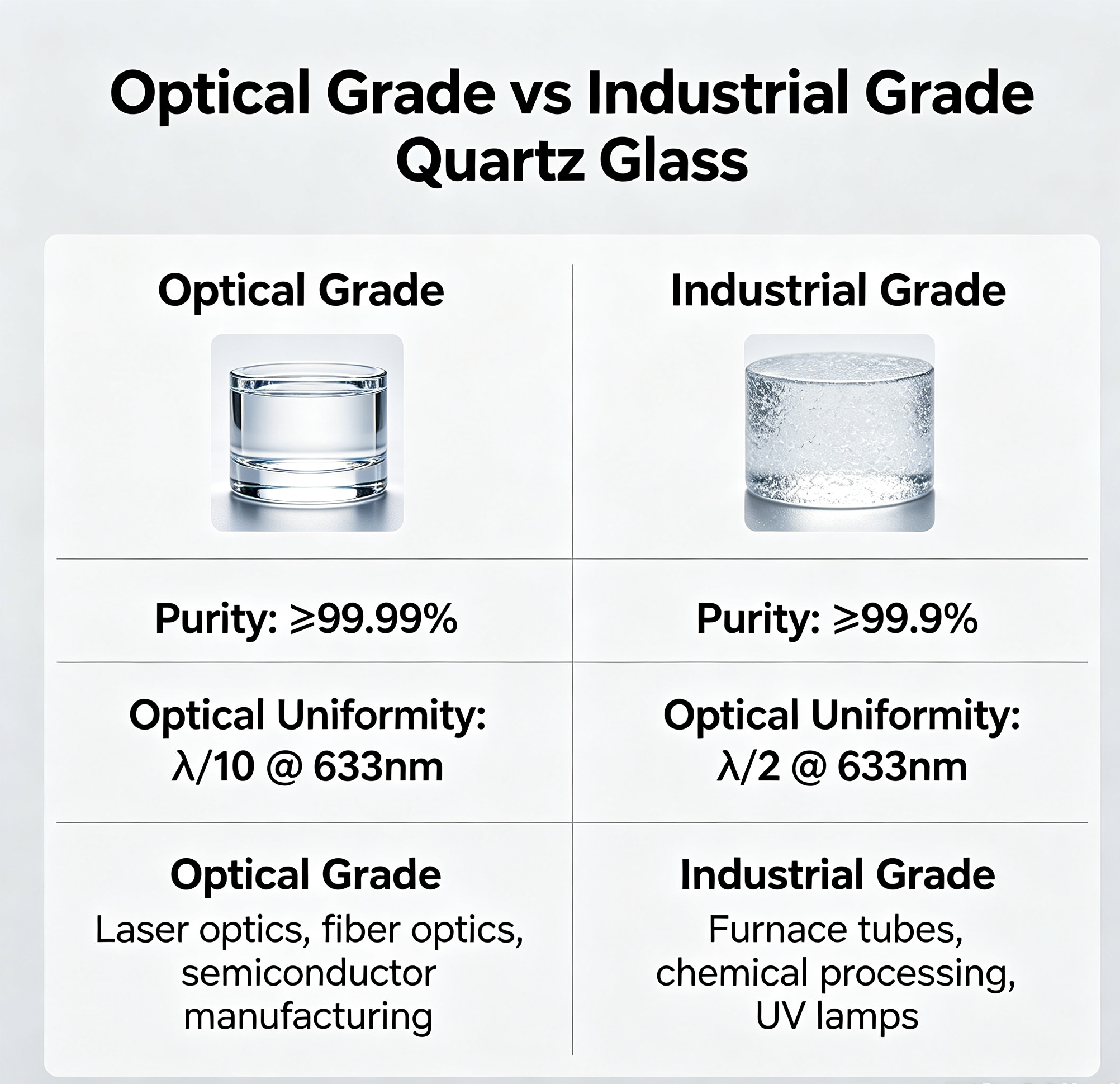
Optical Grade vs Industrial Grade Quartz Glass: How to Choose the Right Quality Level
Quartz glass is divided into optical grade and industrial grade according to purity, internal defects, optical uniformity and processing precision. The two categories differ greatly in raw material standards, production processes, performance parameters and applicable scenarios.
Misclassification will cause poor imaging quality, light attenuation, equipment failure or unnecessary cost waste. This guide details their core differences, quality standards, selection rules and typical use cases, helping technical teams and purchasers make accurate decisions.
Reviewed by: Senior Optical & Materials Engineer
Last Updated: June 2026

1. Core Performance & Quality Comparison
| Parameter | Optical Grade Quartz Glass | Industrial Grade Quartz Glass |
|---|---|---|
| Material Purity | Ultra-high purity, low metal impurity content | Standard purity, acceptable trace impurities |
| Bubbles & Inclusions | Almost invisible under microscope, extremely low density | Allowed tiny bubbles and inclusions within standard range |
| Optical Uniformity | Excellent, minimal refractive index variation | General uniformity, not for high-precision optics |
| Internal Stress | Fully stress-relieved | Residual minor internal stress |
| Surface Finish | High-precision polishing, ultra-low roughness | Ordinary grinding/polishing, industrial surface |
| UV Transmission | Stable & high transmittance across full UV band | Slight absorption in deep UV area |
| Dimensional Tolerance | Tight precision tolerance | Loose industrial tolerance |
| Relative Cost | High | Economical |
Core Summary
- Optical Grade: Designed for optical transmission, imaging and precision systems; strict defect control and superior optical performance.
- Industrial Grade: Designed for high-temperature, thermal insulation and general industrial use; focuses on physical & thermal performance with cost advantages.
2. Key Quality Standard Details
Optical Grade Quartz Glass
1. Defect Control
Zero visible large bubbles, stones or streaks. Micro-defects are strictly limited to meet optical path requirements, avoiding light scattering and image distortion.
2. Optical Uniformity
Uniform refractive index throughout the material, suitable for lenses, windows, prisms and other core optical elements.
3. Stress Relief
Complete annealing process to eliminate internal stress, prevent deformation or cracking under light irradiation and temperature changes.
4. Spectral Performance
Stable high transmittance from deep UV to near infrared, consistent performance in long-term optical operation.
Industrial Grade Quartz Glass
1. Defect Control
Compliant with industrial standards. Tiny bubbles and minor inclusions are permitted, which do not affect heat conduction and structural stability.
2. Optical Performance
Mainly guarantees visible light transmission. Deep UV transmittance is reduced, not applicable for high-precision optical systems.
3. Physical Performance
Prioritizes high temperature resistance, thermal shock resistance and structural strength to adapt to industrial furnace, pipeline and heating environments.
4. Processing Standard
Meets conventional dimensional requirements, no need for ultra-precision polishing and strict stress elimination.
3. Typical Application Scenarios
Choose Optical Grade Quartz Glass for:
- UV optical components: UV lenses, optical windows, spectral cells, light guides
- Laboratory analytical instruments, fluorescence spectroscopy and detection equipment
- Semiconductor optical inspection, photolithography and optical path parts
- High-precision observation windows for scientific research devices
- Products requiring strict light transmission and imaging effect
Choose Industrial Grade Quartz Glass for:
- High-temperature furnace tubes, heating tubes and protective sleeves
- Industrial thermal insulation plates, furnace doors and structural parts
- Ordinary chemical pipeline components and high-temperature containers
- General observation windows without optical precision requirements
- Large-size quartz structural parts for cost-sensitive industrial projects
4. Grade Matching with JGS Series
- Optical Grade: Mainly corresponds to JGS1, JGS2
JGS1 for deep UV precision optics; JGS2 for conventional UV optical systems.
- Industrial Grade: Mainly corresponds to JGS3
Focuses on high temperature resistance, widely used in industrial heating and thermal equipment.
5. Common Selection Mistakes & Solutions
Mistake 1: Using industrial grade quartz for UV optical equipment
Problem: Low UV transmittance, light scattering, reduced equipment working efficiency.
Solution: Replace with optical grade JGS1 or JGS2 quartz glass.
Mistake 2: Purchasing optical grade for ordinary high-temperature furnace parts
Problem: Sharply increased procurement cost with no performance improvement.
Solution: Select cost-effective industrial grade JGS3 quartz glass.
Mistake 3: Ignoring internal stress of optical grade products
Problem: Optical element deformation after installation, affecting optical path stability.
Solution: Confirm full annealing treatment before delivery for optical grade parts.
6. Custom Quartz Solutions from Felix Glass
We supply both optical grade and industrial grade quartz glass in full specifications:
- Optical grade JGS1/JGS2: UV optical windows, lenses, prisms, spectral components
- Industrial grade JGS3: Quartz tubes, plates, furnace parts and industrial structural components
- Precision cutting, grinding, polishing, edge processing and anti-reflection coating
- Support prototype, small batch and mass production for optical, laboratory, semiconductor and industrial sectors
7. Frequently Asked Questions
Q: Can industrial grade quartz be used for optical systems?
A: Not recommended. Bubbles, inclusions and uneven transmittance will interfere with optical performance.
Q: What is the biggest difference between the two grades?
A: The core difference is defect control and optical uniformity. Optical grade focuses on light transmission; industrial grade focuses on high temperature resistance and structure.
Q: Is optical grade quartz always better?
A: It has better optical performance but higher cost. Select according to actual functional requirements, not simply pursue higher grade.
Q: Does optical grade quartz have better heat resistance?
A: Their maximum working temperature is basically the same. The difference lies in optical performance rather than thermal performance.
Related Articles
- JGS1 vs JGS2 vs JGS3 Quartz Glass: UV & Thermal Performance Guide
- Fused Silica vs Borosilicate Glass: High-Temperature & UV Performance Guide
- Quartz vs Sapphire: Key Differences for High-Temperature & Corrosive Environments
- Quartz Glass Tubes: Manufacturing Process & Key Specifications
Related Products
- Quartz Glass Tubes
- Quartz Glass Plates
- UV Quartz Optics
- Industrial Quartz Components
Get a Custom Quote
Tell us your application, spectral requirements, working temperature and precision standard. Our engineers will recommend the most suitable quartz grade and provide customized solutions.