Optical Quartz Grades JGS1 JGS2 JGS3 – Spectral Performance & Application Guide
- Share
- publisher
- Felix Glass
- Issue Time
- Dec 10,2025
Summary
Compare JGS1, JGS2, JGS3 optical quartz on transmittance and OH content, learn how to select grades for UV, visible and IR applications.
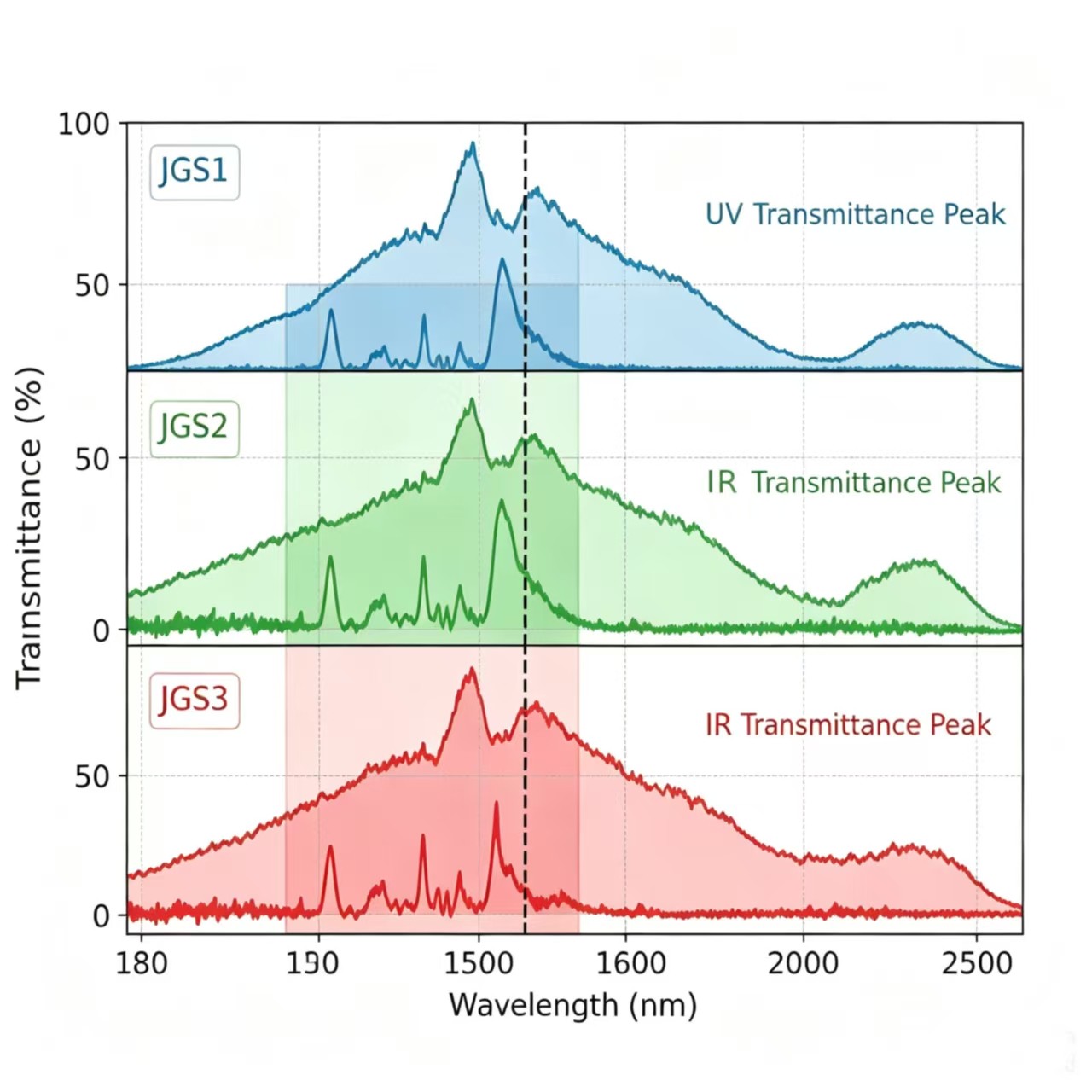
Optical Quartz Grades JGS1 JGS2 JGS3
JGS1, JGS2 and JGS3 are three standard classification grades for optical fused quartz glass, widely adopted by global optical and optoelectronic industries. The classification is mainly based on hydroxyl (OH) content and spectral transmission range. Different grades correspond to different ultraviolet, visible and infrared working bands. Selecting the correct JGS grade is the premise to ensure the stability and accuracy of optical equipment. This article details the performance features and matching scenarios of each grade
2. What Are JGS1 JGS2 JGS3 Optical Quartz
JGS series is a unified grade standard for optical quartz glass. All three grades are high-purity transparent quartz glass, with excellent high temperature resistance and chemical stability. The core distinction lies in spectral transmission range and hydroxyl content, which determine their respective dominant application fields.
3. Key Properties
| Grade | Transmission Range | OH Content | Core Feature |
|---|---|---|---|
| JGS1 | 160nm ~ 2500nm | Ultra-low | Excellent deep UV transmittance, anti-UV aging |
| JGS2 | 220nm ~ 2500nm | Low | Balanced UV & visible light performance, cost-effective |
| JGS3 | 260nm ~ 3500nm | Medium | Low infrared absorption, superior infrared transmission |
4. Manufacturing Process
All JGS series optical quartz adopt high-purity raw materials and strict melting & annealing processes. For JGS1, extra dehydroxylation treatment is added during production to reduce OH groups, ensuring deep UV transmission. JGS3 focuses on controlling infrared absorption factors to enhance long-wave infrared performance. Finished products will go through spectral testing one by one before delivery.
5. Core Advantages
JGS1 Advantages
- Transmit far ultraviolet light below 220nm
- No performance attenuation under long-term UV irradiation
- High optical stability for long-term precision operation
JGS2 Advantages
- Cover conventional UV and visible light bands
- Stable comprehensive performance and moderate price
- Large supply, easy for bulk procurement
JGS3 Advantages
- Outstanding transmittance in infrared band
- Low thermal radiation loss under high temperature
- Adapt to infrared detection and thermal imaging systems
6. Application Scenarios
JGS1 Applications
- Deep UV lithography equipment, UV precision spectrometers
- Aerospace UV optical windows, high-end UV detection instruments
- Laboratory deep UV experimental devices
JGS2 Applications
- Ordinary UV sterilization lamps, UV curing equipment
- General laboratory optical instruments, industrial optical lenses
- Civil UV optoelectronic products
JGS3 Applications
- Infrared thermal imaging cameras, infrared detection systems
- High-temperature infrared observation windows, infrared optical lenses
- Industrial infrared temperature measurement equipment
7. Material Comparison & Selection Guide
Spectral Comparison Summary
JGS1 = Dominant for Far Ultraviolet
JGS2 = Dominant for Conventional UV + Visible Light
JGS3 = Dominant for Infrared Band
Selection Rules
- If your equipment needs to work below 220nm deep UV → Choose JGS1
- Conventional UV equipment without deep UV demand → Choose JGS2
- Mainly used for infrared transmission and thermal imaging → Choose JGS3
8. FAQ
FAQ Schema Content
Q1: What is the biggest difference between JGS1 and JGS2?
A1: JGS1 can transmit far ultraviolet light below 220nm, while JGS2 cannot.
Q2: Which grade is used for infrared thermal imaging?
A2: JGS3, which has excellent infrared transmittance.
Q3: Is JGS1 more expensive than JGS2?
A3: Yes. JGS1 requires special dehydroxylation process, so the cost is higher.
Q4: Can JGS2 replace JGS1 for deep UV experiments?
A4: No. JGS2 will block deep UV light and affect experimental results.
9. Conclusion
JGS series optical quartz grades are divided according to spectral characteristics. Confirm your equipment’s working light band first, then select the matching grade to maximize optical performance and control procurement cost. JGS1 for deep UV, JGS2 for conventional UV, JGS3 for infrared systems.
👉 Related Knowledge & Products: What Is Quartz Glass? | Quartz Glass Thermal Properties | Optical Quartz Components
Author: Felix Glass Optical Engineering Team
Reviewed By: Senior Optical Material Engineer
Last Updated: June 2026
References: Optical Quartz Glass JGS Series Standard, UV-IR Optical Material Manual