Quartz Glass | Crystal Quartz, Fused Silica & Synthetic Fused Silica Guides

Quartz Glass | Crystal Quartz, Fused Silica & Synthetic Fused Silica Guides

Summary

Clear differentiation between crystal quartz, fused silica and synthetic fused silica; optical transmission, thermal expansion and high-temperature performance comparison.
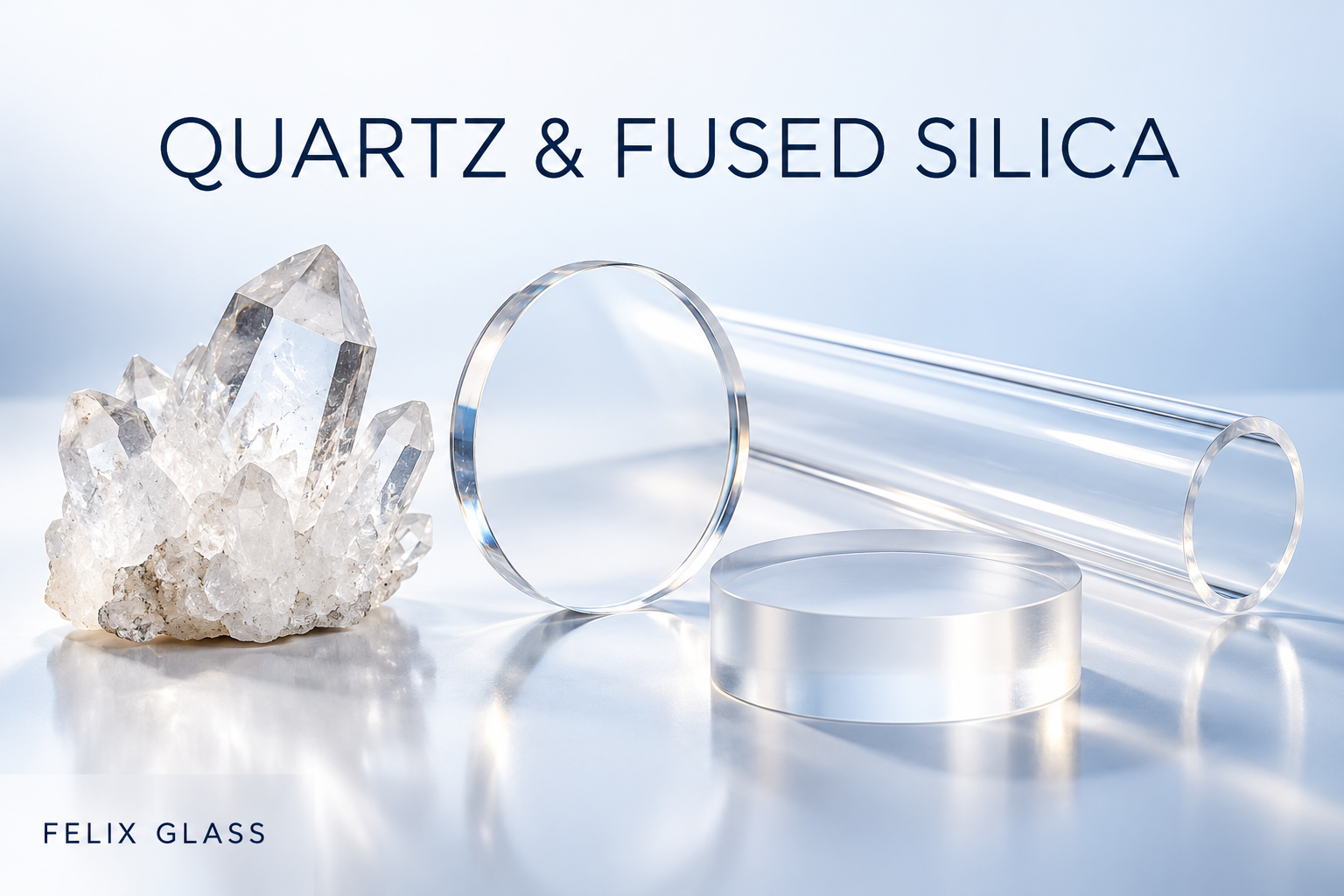
Quartz Glass | Crystal Quartz, Fused Silica & Synthetic Fused Silica Guides

Quartz Glass

This category clarifies three quartz material types, their optical & thermal differences, thermal shock performance and application limits for furnace viewports and UV optics.

Technical Articles In This Category


Crystal Quartz: High-Temperature Mechanical Performance

Overview

Crystal quartz is single-crystal α-SiO₂ with birefringent optical properties and directional mechanical strength. Unlike amorphous fused silica, crystalline quartz undergoes a sharp phase change at 573°C, which creates critical thermal stress risks for high-temperature furnace windows, laser waveplates and thermal instrumentation parts. Felix Glass strictly controls heating/cooling cycles to avoid cracking caused by solid-state phase inversion.

Core Risk: α–β Phase Transition at 573°C

  • At 573°C, α-quartz rapidly transforms into β-quartz, accompanied by a sudden 0.45% volumetric expansion.
  • Fast temperature cycling across this threshold generates severe internal residual stress, leading to spontaneous cracking even without external mechanical load.
  • Industrial operation rule: Heating and cooling speed must be limited below 5°C/min between 540°C and 620°C to reduce phase-change stress.

High-Temperature Mechanical Strength Degradation

  1. Elastic Modulus & Tensile Strength Drop When temperature rises from room temperature to 800°C, tensile strength declines by more than 34%, while elastic modulus falls by 7%~13%. The crystal lattice is weakened by elongated Si–O bonds under continuous heat exposure.
  2. Creep Deformation Above 870°C Above 870°C, β-quartz gradually converts to tridymite; prolonged high-temperature load will produce permanent creep deformation, making crystal quartz unsuitable for long-term load-bearing service above 900°C.
  3. Thermal Shock Resistance Limit Without phase transition, crystal quartz withstands moderate thermal shock. However, rapid quenching across 573°C will almost always induce fractures, which is the biggest difference from amorphous fused silica.

Mechanical Parameter Specifications for RFQ

  • Maximum continuous working temperature: ≤ 550°C for cyclic heating; ≤ 850°C for short-term static high-temperature use.
  • Allowable temperature change rate: ≤5°C/min through the 573°C phase transition zone.
  • Crystal orientation: Mechanical strength is anisotropic; c-axis orientation provides the highest tensile strength for structural components.
  • Edge quality: Unpolished microcracks will propagate rapidly under thermal cycling; all edges must be fine-ground and polished to eliminate surface defects.

Typical Applications & Material Substitution Advice

Crystal quartz is preferred for birefringent optical elements such as waveplates and polarizers. For high-temperature viewports with frequent thermal cycling, synthetic fused silica is a better alternative because it has no phase transition and maintains stable mechanical performance up to 1100°C without abrupt volume change.


Fused Silica & Synthetic Fused Silica Optical Differences

Overview

Fused silica (natural fused quartz) is melted from natural quartz ore, while synthetic fused silica is produced via gas-phase hydrolysis of SiCl₄ with ultra-high chemical purity. The two materials share nearly identical thermal expansion coefficients and mechanical properties, but differ sharply in UV transmittance, impurity levels and OH absorption bands, which directly determines their suitability for deep-UV laser optics, semiconductor lithography and UV spectroscopy windows.

Raw Material & Purity Gap

  • Natural Fused Silica (Fused Quartz) Raw material: natural crystalline quartz ore; contains trace metal impurities (Al, Fe, Ti). It has a strong UV absorption band at 243 nm, so transmission drops sharply below 250 nm. Cost is low, ideal for visible light and near-infrared applications.
  • Synthetic Fused Silica Manufactured from high-purity chemical feedstock with metal impurity levels below ppb grade; no 243 nm UV absorption peak. Deep-UV transmission extends down to 185 nm or lower, meeting 193 nm ArF laser and 248 nm KrF laser requirements.

Spectral Transmission Comparison (10 mm thickness)

  1. Deep UV (185–250 nm) Synthetic fused silica (JGS1 grade): high transmittance >90% at 254 nm, stable transmission down to 190 nm. Natural fused silica (JGS2 grade): strong absorption below 220 nm; cannot be used for deep-UV laser or UVC optical windows.
  2. Visible & Near-Infrared (400–2200 nm) Both grades have excellent transmission. The only difference comes from hydroxyl (OH) absorption bands: high-OH synthetic silica has strong absorption near 1385 nm and 2730 nm; low-OH dry synthetic silica eliminates these IR absorption peaks for broadband infrared optics.

Laser Damage Threshold & Homogeneity

  • Synthetic fused silica has far fewer inclusions and bubbles, with superior refractive index homogeneity; its laser damage threshold is significantly higher than natural fused silica, making it the standard material for high-energy UV laser lenses and windows.
  • Natural fused silica contains tiny mineral inclusions from raw ore; under high laser power, local hot spots easily form and cause optical breakdown.

Grade Selection Guide for Engineering Drawings

1. Deep-UV laser (193 nm / 248 nm), UV spectroscopy: select synthetic fused silica (JGS1), specify low metal impurity content and transmission at target UV wavelength. 2. UVC germicidal lamp windows, 254 nm UV applications: choose high-OH synthetic fused silica for low cost while maintaining UVC transmission. 3. Visible light optics, furnace viewports, near-infrared observation windows: natural fused silica (JGS2) fully meets requirements and controls material cost. 4. Broadband UV–IR transmission without infrared absorption: specify low-OH dry synthetic fused silica with OH content below 1 ppm.


Custom Quartz Glass Machining & Polishing

We supply crystal quartz, natural fused silica and ultra-pure synthetic fused silica components, including ultra-precision polishing, AR coating, edge chamfering and strict spectral transmission inspection for UV lasers, furnace viewports and optical instruments.

Submit Your Quartz Optical Specs