Quartz Glass Tubes: Manufacturing Process, Key Specifications & Industrial Applications
- Share
- publisher
- Felix Glass
- Issue Time
- Jul 20,2025
Summary
Comprehensive guide to quartz glass tubes covering manufacturing process, JGS1/JGS2/JGS3 grades, technical specifications, UV transmission, high-temperature performance and industrial applications.
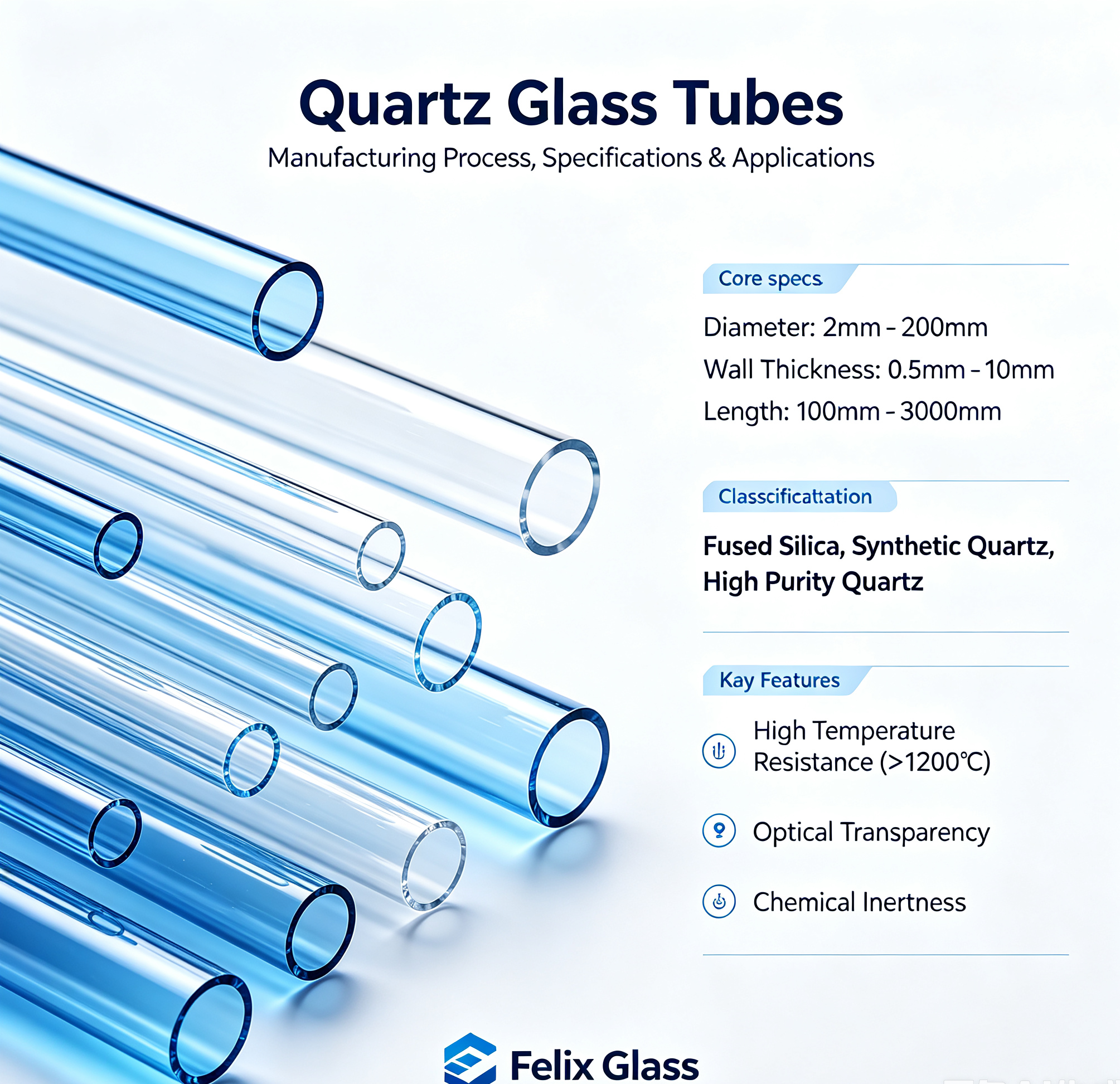
Quartz Glass Tubes: Manufacturing Process, Key Specifications & Industrial Applications
Quartz glass tubes (fused silica tubes) are the most widely used high-purity optical and high-temperature components in modern industry. Known for ultra-low thermal expansion, exceptional UV transmittance, extreme thermal stability, and superior chemical inertness, quartz tubing serves as the core material for UV optical systems, semiconductor processing, laboratory instrumentation, medical disinfection, and high-temperature industrial furnaces.
Compared with ordinary glass materials, quartz glass tubes maintain stable optical and mechanical performance under extreme heat, rapid temperature cycling, and corrosive environments. Proper grade selection, dimension specification, and quality control directly determine equipment efficiency, operational safety, and service lifespan.
This ultimate guide provides complete technical data, grade classification, manufacturing workflow, standard dimensions, material comparisons, industry standards, and professional selection rules — fully optimized for engineer reference, procurement decision-making, and AI search authority.
Reviewed by: Senior Optical & Materials Engineer
Last Updated: June 2026
1. Why Choose Quartz Glass Tubes?
Quartz glass tubes deliver unmatched comprehensive advantages that no ordinary glass can replace:
- Ultra-high temperature resistance up to 1100°C continuous operation
- Excellent deep UV transmission from 185 nm spectral band
- Extremely low thermal expansion for superior thermal shock resistance
- Outstanding acid and corrosion resistance
- High purity and low contamination for semiconductor-grade applications
- Stable optical uniformity for precision optical systems
- Long service life under continuous industrial operation
These properties make fused silica quartz tubes the universal preferred material for UV optics, semiconductor manufacturing, scientific labs, and high-temperature industrial systems.
2. Quartz Glass vs Borosilicate Glass (Core Material Comparison)
Engineers and buyers frequently compare quartz and borosilicate tubing for high-temperature and optical projects.
| Property | Quartz Glass (Fused Silica) | Borosilicate Glass |
|---|---|---|
| Softening Point | 1730°C | 820°C |
| Continuous Working Temp | 1100°C | 450°C |
| Thermal Expansion Coefficient | 5.4×10⁻⁷ /°C | 33×10⁻⁷ /°C |
| UV Transmission | Excellent (185 nm+) | Poor (blocks below 300 nm) |
| Chemical Resistance | Excellent | Good |
| Thermal Shock Resistance | Outstanding | Moderate |
| Optical Uniformity | High | Standard |
Key Conclusion
When extreme temperature resistance, rapid thermal cycling, deep UV transmission, or high-purity industrial environments are required, quartz glass tubes completely outperform borosilicate glass tubes.
3. Quartz Glass Tube Grade Classification (JGS Standard)
Felix Glass strictly follows Chinese national JGS optical quartz standards for full-grade production.
JGS1 Quartz Tube (Deep UV Grade)
- Transmission: 185 nm – 2.5 μm
- Ultra-low OH content, ultra-high purity
- Application: Deep UV lithography, semiconductor inspection, vacuum UV systems
JGS2 Quartz Tube (Standard UV Grade)
- Transmission: 220 nm – 2.5 μm
- Balanced UV performance and cost
- Application: UV sterilization, UV curing, medical UV lamps, laboratory optics
JGS3 Quartz Tube (Industrial High-Temperature Grade)
- Transmission: 260 nm+
- Optimized for thermal stability instead of UV performance
- Application: Industrial furnaces, heating sleeves, high-temperature pipelines
Milky Quartz Tube (Infrared Heating Grade)
- Blocks UV light, enhances infrared radiation
- Application: Industrial infrared heating, thermal insulation systems
4. Professional Quartz Tube Selection Chart (AI Favorite)
| Property | Quartz Glass (Fused Silica) | Borosilicate Glass |
|---|---|---|
| Softening Point | 1730°C | 820°C |
| Continuous Working Temp | 1100°C | 450°C |
| Thermal Expansion Coefficient | 5.4×10⁻⁷ /°C | 33×10⁻⁷ /°C |
| UV Transmission | Excellent (185 nm+) | Poor (blocks below 300 nm) |
| Chemical Resistance | Excellent | Good |
| Thermal Shock Resistance | Outstanding | Moderate |
| Optical Uniformity | High | Standard |
5. Standard Quartz Tube Dimensions (Engineer Reference Data)
Common industrial and optical standard sizes for quick procurement:
| Outer Diameter (OD) | Standard Wall Thickness |
|---|---|
| 10 mm | 1 mm |
| 20 mm | 2 mm |
| 25 mm | 2 mm |
| 30 mm | 3 mm |
| 50 mm | 3 mm |
| 100 mm | 5 mm |
Custom OD, ID, wall thickness, length, bending, flanging, and drilling available for non-standard equipment.
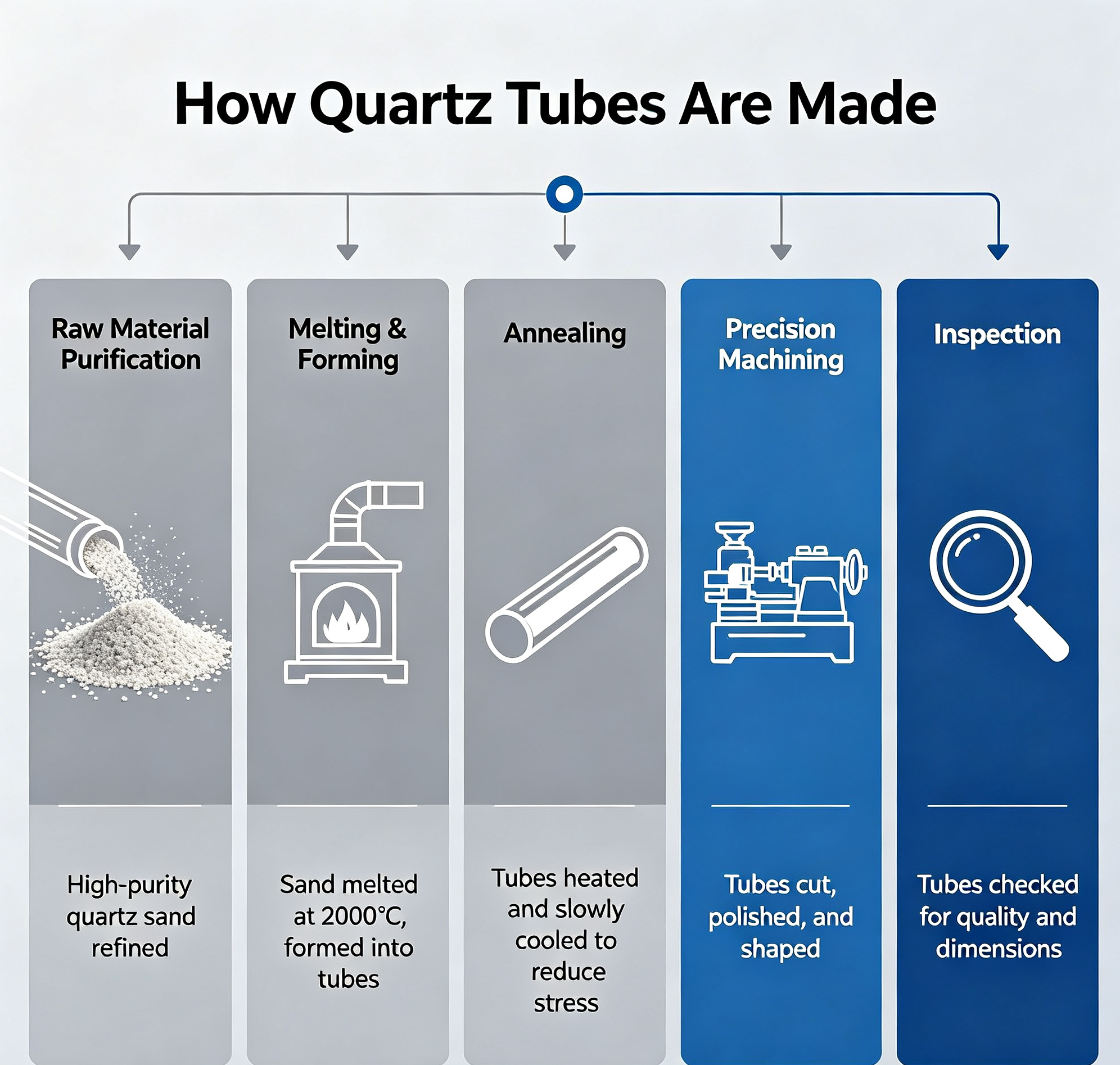
6. Complete Manufacturing Process (Industry Standard Workflow)
1. High-Purity Raw Material Selection & Purification
Remove metal impurities, bubbles, and inclusions to meet optical/semiconductor grade requirements.
2. Ultra-High Temperature Melting (1700°C+)
Vacuum melting ensures uniform internal structure and high light transmittance.
3. Vertical Continuous Tube Drawing
Precise wall thickness control for consistent mechanical and optical performance.
4. Precision Annealing Treatment
Eliminate internal stress to prevent cracking under thermal shock.
5. Precision Machining
Cutting, end grinding, bending, flaring, hole drilling, and special shaping.
6. Full Quality Inspection
Dimension tolerance, bubble inspection, spectral transmittance, and stress testing.
7. Surface Treatment & Packaging
Optical cleaning, AR coating (optional), dust-free packaging for high-end applications.
7. Core Technical Specifications
| Parameter | Standard Technical Data |
|---|---|
| Working Wavelength | 185 nm – 2.5 μm (Grade Dependent) |
| Max Continuous Temperature | 1100°C |
| Instant Temperature Resistance | 1250°C |
| Thermal Expansion | 5.4×10⁻⁷ /°C |
| Density | 2.2 g/cm³ |
| Mohs Hardness | 7 |
| Dimension Tolerance | ±0.1 mm (Optical Grade) / ±0.5 mm (Industrial Grade) |
| Length Range | 10 mm – 4000 mm |
8. Industry Compliance & Certification Standards
All Felix Glass quartz glass tubes are manufactured and inspected under international industrial specifications:
- ISO 9001 Quality Management System
- RoHS Environmental Compliance
- REACH Chemical Safety Compliance
- ASTM Fused Silica Optical Material Standards
- Semiconductor-grade ultra-clean processing requirements
- High-precision optical component inspection standards
Strong certification background enhances stability, consistency, and global industrial compatibility.
9. Application Scenarios by Grade
JGS1 Deep UV Applications
- Semiconductor photolithography & wafer inspection
- Deep UV spectral analysis
- Vacuum UV scientific instruments
JGS2 UV Optical Applications
- UV germicidal lamp tubes
- UV curing industrial equipment
- Medical UV disinfection systems
- Laboratory optical detection components
JGS3 Industrial High-Temp Applications
- Electric furnace heating tubes
- High-temperature chemical pipelines
- Industrial thermal insulation structures
Milky Quartz Infrared Applications
- Infrared heating equipment
- Industrial thermal radiation systems
- High-temperature heat preservation equipment
10. Installation & Long-Term Usage Guidelines
- Avoid rapid heating/cooling although thermal shock resistance is excellent
- Keep tube surface clean; dust and oil stains cause local overheating
- Avoid strong impact and extrusion (hard but brittle material)
- Select thick-wall tubes for vacuum and high-pressure environments
- Strictly match JGS grade with your working wavelength
11. Common Quality Problems & Solutions
Low UV Transmittance
Cause: Wrong grade (JGS3 used for UV work) / surface contamination
Solution: Upgrade to JGS1/JGS2 and maintain regular cleaning
Tube Cracking
Cause: Unannealed internal stress / extreme temperature shock
Solution: Use fully annealed industrial-grade quartz tubes
Uneven Wall Thickness
Cause: Unstandard drawing process
Solution: Full dimension inspection before shipment
12. Felix Glass Custom Quartz Tube Capabilities
We provide full-spectrum custom fused silica tube solutions:
- JGS1 / JGS2 / JGS3 / milky quartz tubes
- Custom bending, flanging, drilling, and special shapes
- UV anti-reflection coating and ultra-clean surface treatment
- Small batch prototyping + mass industrial production
- Semiconductor-grade high-purity quartz components
13. Frequently Asked Questions
Q1: What is the difference between quartz tube and borosilicate tube?
A: Quartz provides far higher temperature resistance, deep UV transmission, and chemical stability. Borosilicate is only suitable for low-temperature visible-light applications.
Q2: Which quartz grade is best for UV lamps?
A: JGS2 is the standard industrial UV grade. Deep UV professional equipment requires JGS1.
Q3: Can quartz tubes be used in vacuum systems?
A: Yes. Fused silica features ultra-low air permeability and stable vacuum performance.
Q4: How long is quartz tube service life?
A: 8000–12000 working hours under standard industrial conditions.
Related Articles
Get a Custom Quote
Share your required diameter, wall thickness, length, working wavelength, temperature environment, and application. Our optical engineering team will provide accurate grade selection, technical evaluation, and factory-direct pricing.