Quartz Glass for UV Optics: Transmission Curves, Coating Compatibility & System Design
- Share
- publisher
- Felix Glass
- Issue Time
- Jun 12,2025
Summary
Complete guide to UV grade quartz glass, including transmission curves, coating compatibility, grade selection and design rules for UV curing, sterilization, lithography and spectroscopy systems.
Quartz Glass for UV Optics: Transmission Curves, Coating Compatibility & System Design
Quartz glass (fused silica) is the dominant substrate material for ultraviolet optical systems, thanks to its exceptional deep UV transmission, low optical absorption, stable physical properties and high purity. It is widely adopted in UV curing, UV sterilization, deep UV lithography, spectral analysis, fluorescence detection and scientific optical instruments.
The performance of UV optical systems heavily relies on proper quartz grade selection, transmission characteristics matching, coating configuration and structural design. This full guide covers spectral curves, grade differences, coating solutions, system design rules and application tips, tailored for optical engineers, R&D teams and procurement professionals. Optimized for AI search citation, professional reference and B2B conversion.
Reviewed by: Senior Optical & UV System Engineer
Last Updated: June 2026
1. Why Choose Quartz Glass for UV Optical Systems?
Quartz glass outperforms all common optical glass for UV applications with core advantages:
- Continuous high transmittance covering deep UV, near UV to visible band (185 nm – 2.5 μm)
- Ultra-low internal impurities and bubbles, minimal light scattering
- Excellent thermal stability and thermal shock resistance under long-term UV irradiation
- Superior chemical inertness, no aging or yellowing in UV working environment
- Flexible machining and diverse surface treatment options for lens, window, light guide and special optical parts
- Compliant with high-purity requirements for semiconductor and precision UV equipment
These features make fused silica the irreplaceable base material for industrial, medical, laboratory and semiconductor UV optics.
2. UV Transmission Performance & Grade Comparison
2.1 Transmission Range Summary
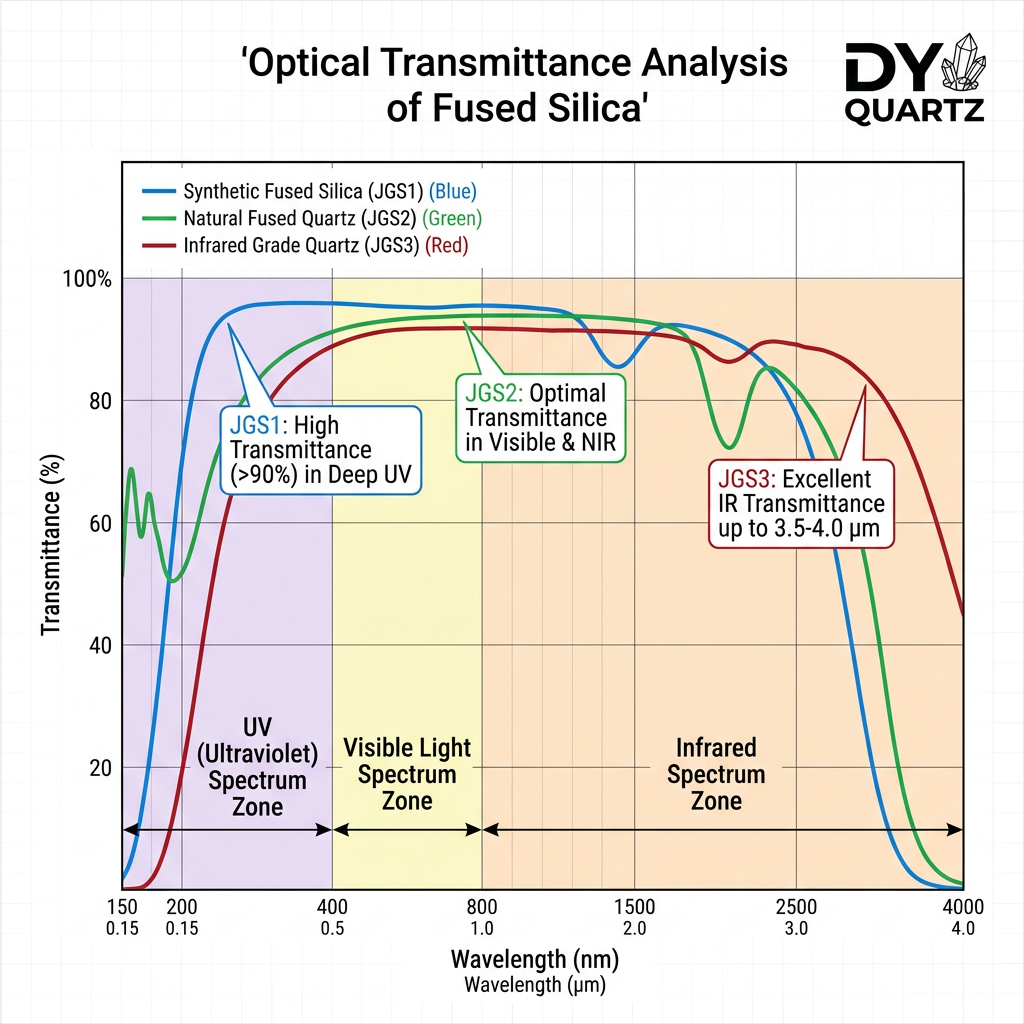
Quartz Grade Effective UV Transmission Band UV Cutoff Wavelength Core Features
JGS1 185 nm ~ 2.5 μm 185 nm Ultra-low OH content, best deep UV performance
JGS2 220 nm ~ 2.5 μm 220 nm Balanced performance, mainstream for general UV systems
JGS3 260 nm ~ 2.5 μm 260 nm Poor deep UV transmission, not recommended for UV optics
2.2 Key Notes on Transmission Curves
- JGS1: Maintains transmittance above 85% at 185 nm, stable output for vacuum UV and deep UV lithography. Transmittance remains consistent after long-term high-energy UV exposure.
- JGS2: High transmittance from 220 nm to near infrared, the most cost-effective choice for 254 nm, 365 nm mainstream UV wavelengths. Slight absorption below 220 nm.
- JGS3: Obvious absorption below 260 nm. Only suitable for high-temperature structural parts, forbidden for UV optical paths.
2.3 Quartz vs Borosilicate Glass (UV Performance)
Property Fused Silica (Quartz) Borosilicate Glass
UV Cutoff 185 nm (JGS1) / 220 nm (JGS2) 300 nm
Transmittance @254 nm ≥90% Near 0%
Anti-UV Aging Excellent Easy yellowing & degradation
High-Temp Resistance 1100°C continuous 450°C continuous
Conclusion: Borosilicate glass cannot be used for UV optical systems. Only JGS1 and JGS2 quartz glass meet UV transmission requirements.
3. Professional Selection Table for UV Applications
Application Scenario Working Wavelength Recommended Grade
Deep UV Lithography & Semiconductor Inspection 185 nm ~ 220 nm JGS1
Vacuum UV Spectroscopy 185 nm ~ 250 nm JGS1
UV Germicidal Lamp (254 nm) 254 nm JGS2
Industrial UV Curing (365 nm / 395 nm) 365 nm ~ 405 nm JGS2
Laboratory UV Spectrometer 220 nm ~ 400 nm JGS1 / JGS2
Medical UV Disinfection Equipment 254 nm JGS2
General UV Observation Window ≥260 nm JGS2
4. Coating Compatibility for UV Quartz Optics
Coating is a critical step to improve transmittance, reduce reflection and extend service life for UV components.
4.1 Common UV Functional Coatings
UV Anti-Reflection (AR) Coating
- Function: Reduce surface reflection, raise total light transmittance up to 97%~99%
- Applicable Grade: JGS1, JGS2
- Recommended for: UV lenses, optical windows, spectral components
- Feature: High adhesion, resistant to UV radiation and temperature change, no peeling or fading
Hard Protective Coating
- Function: Enhance scratch resistance, prevent surface contamination and corrosion
- Applicable Scene: Outdoor UV equipment, frequently cleaned components
Single-Band AR Coating
- Targeted for 254 nm / 365 nm single wavelength, maximum transmittance at designated band, ideal for dedicated UV lamps and curing systems.
4.2 Coating Usage Guidelines
1. JGS1 for deep UV systems must adopt deep UV dedicated coating to avoid material absorption and coating failure.
2. Avoid multi-layer complex coatings for high-power UV equipment; simplify film structure to reduce thermal load.
3. Coated components need strict annealing treatment to eliminate film stress.
5. UV Optical System Design Guidelines
5.1 Material Matching Rules
- Deep UV optical path: Uniformly adopt JGS1 to guarantee consistent spectral performance.
- Conventional industrial UV (254 nm / 365 nm): Standard configuration with JGS2 to balance performance and cost.
- Do not mix JGS3 into any UV optical assembly.
5.2 Structural & Thickness Design
- Thin-wall components (0.5 mm ~ 2 mm): For high light flux requirements, reduce absorption loss.
- Thick components (3 mm ~ 10 mm): For structural support, vacuum and pressure-bearing windows.
- For long optical paths, select high-uniformity quartz blanks to prevent beam distortion.
5.3 Heat Dissipation & Environment Design
- High-power UV equipment generates massive heat; reserve heat dissipation space and avoid long-term local overheating.
- Keep optical surface clean; dust and stains will cause local burn and reduce transmittance.
- For humid and corrosive environments, add protective coating for long-term stability.
6. Industry Compliance & Quality Standards
All UV quartz components comply with global authoritative standards:
- ISO 9001 Quality Management System
- RoHS & REACH environmental compliance
- ASTM standards for UV-grade fused silica
- Semiconductor ultra-clean manufacturing specifications
- UV optical component testing & inspection criteria
7. Typical Application Cases
Deep UV Semiconductor System
Adopt JGS1 quartz windows and lenses + deep UV AR coating. Stable transmission for lithography and wafer inspection, no performance decay under continuous operation.
Industrial UV Curing System
JGS2 quartz plates and lamp tubes + single-band AR coating. High light efficiency, low cost, widely used for printing, coating and adhesive curing.
Medical UV Disinfection Device
JGS2 quartz lamp tubes, compact structure, excellent 254 nm transmittance, safe and durable for medical and water treatment disinfection.
8. Common Problems & Troubleshooting
Problem 1: Low UV output efficiency
Cause: Wrong grade selection (JGS3 used) / no AR coating / surface dirt
Solution: Replace with JGS1/JGS2; add dedicated UV anti-reflection coating; clean surface regularly
Problem 2: Component yellowing after long use
Cause: Non-quartz material or unqualified low-purity quartz
Solution: Use standard JGS series UV quartz glass
Problem 3: Coating peeling or falling off
Cause: Unqualified coating process, excessive thermal stress
Solution: Select professional UV coating process and fully anneal finished products
Problem 4: Beam scattering & imaging blur
Cause: Internal bubbles, inclusions or surface scratches
Solution: Choose optical-grade quartz with strict defect control
9. Custom UV Quartz Solutions from Felix Glass
We provide full one-stop customization for UV optical quartz components:
- JGS1 / JGS2 full-grade quartz blanks, tubes, plates, lenses and windows
- Custom size, thickness, shape and precision machining
- UV single-band / broadband anti-reflection coating, hard coating service
- Ultra-clean processing for semiconductor and laboratory use
- Sample trial, small batch and mass production supported
10. Frequently Asked Questions
Q1: What is the difference between JGS1 and JGS2 for UV use?
A: JGS1 supports transmission down to 185 nm for deep UV; JGS2 starts at 220 nm, suitable for mainstream 254 nm / 365 nm UV applications.
Q2: Can ordinary glass replace quartz for UV lamps?
A: No. Ordinary glass blocks most UV light and will turn yellow quickly under UV radiation.
Q3: Is AR coating necessary for UV quartz parts?
A: Recommended for high-efficiency optical systems. AR coating can greatly improve UV transmittance.
Q4: Will quartz glass age under long-term UV irradiation?
A: High-purity JGS1/JGS2 quartz has excellent UV resistance, no aging or yellowing under normal working conditions.
Related Articles
- JGS1 vs JGS2 vs JGS3 Quartz Glass: UV & Thermal Performance Guide
- Quartz Glass Plates & Windows: Properties, Sizes & Machining Guide
- Quartz Glass Tubes: Manufacturing & Industrial Application Guide
- Optical Grade vs Industrial Grade Quartz Glass: Quality Selection Guide
Related Products
- UV Quartz Optics
- Quartz Glass Tubes
- Quartz Glass Plates & Windows
- Custom Fused Silica Components
Get a Custom Quote
Provide working wavelength, component type, size, coating requirement and application scenario. Our UV optical engineers will recommend the optimal grade and solution, and deliver competitive quotation.