Quartz vs Sapphire: Which Optical Material to Choose | Felix Glass
- Share
- publisher
- Felix Optical Glass Co., Limited
- Issue Time
- Nov 13,2026
Summary
Compare fused silica and sapphire on UV transmission, hardness, thermal shock and cost, and pick the right material for your window or dome.
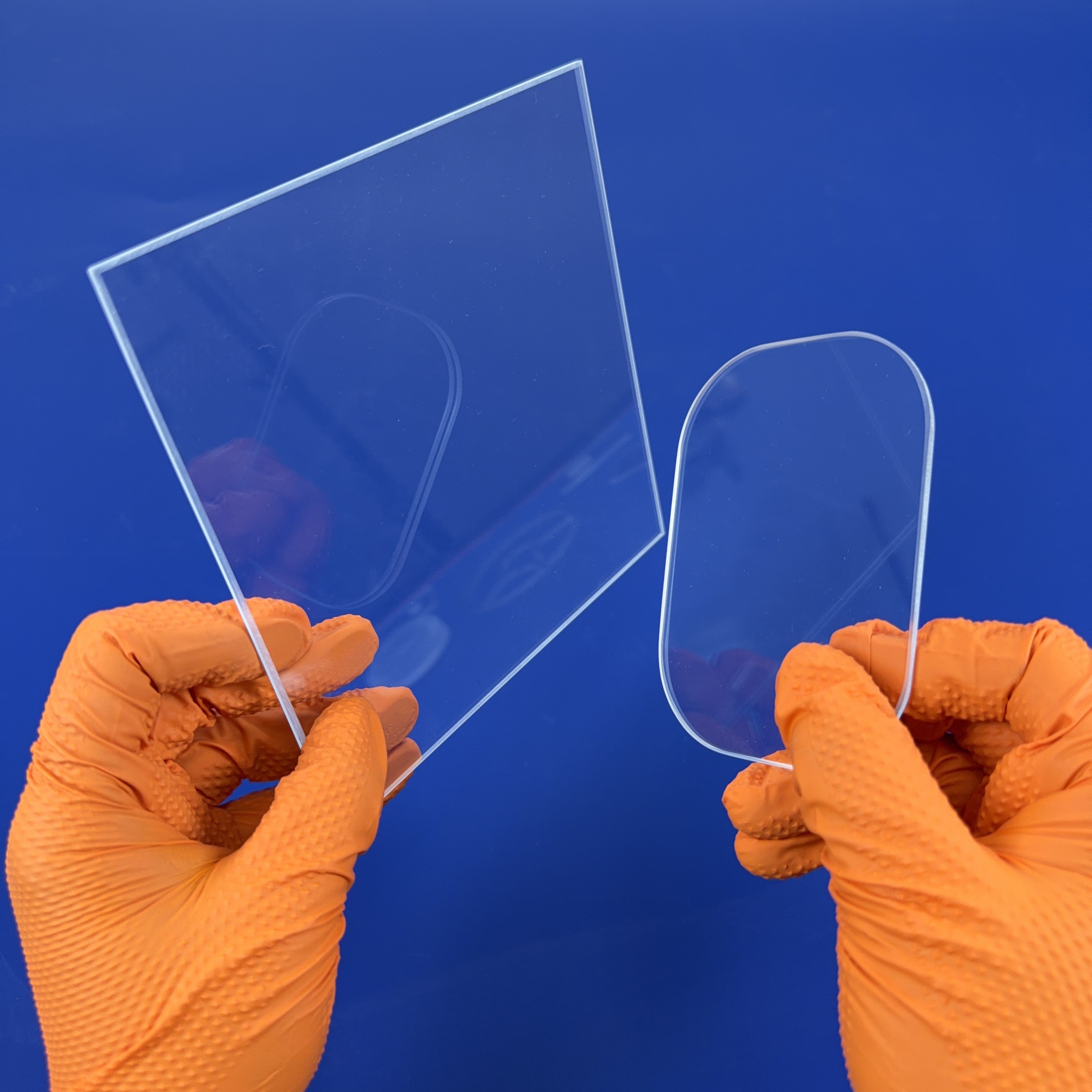
Quartz vs Sapphire: the choice that decides your optical window's lifetime
Quartz (fused silica) and sapphire are the two materials most often specified for demanding optical windows, domes and viewports. They look similar on a drawing, and both transmit from the ultraviolet into the infrared — but they behave very differently once a window meets sand, salt spray, thermal cycling or a deep-sea pressure differential.
The short answer: choose fused silica when you need deep UV transmission, the lowest thermal expansion and the best cost per part. Choose sapphire when abrasion resistance, hardness or infrared reach out to 5 µm matter more than budget. The rest of this page explains where that line sits, with the numbers behind it.
1. Optical transmission: where each material actually works
Fused silica transmits from roughly 180 nm in the deep ultraviolet through the visible and near infrared, with excellent uniformity and very low absorption. That makes it the default for UV curing windows, laser delivery optics, spectroscopy cells and any application where 193–250 nm energy passes through the part.
Single-crystal sapphire transmits from about 0.2 µm to roughly 5 µm uncoated. It covers the visible and the 3–5 µm mid-wave infrared band comfortably, which is why sapphire domes appear on thermal imagers and missile seekers. Beyond 5 µm the transmission falls away: for the 8–12 µm long-wave infrared window, sapphire is the wrong choice and ZnS, ZnSe or germanium is specified instead.
Rule of thumb: if your wavelength is below 250 nm, fused silica wins by default. If it sits between 3 and 5 µm and the part will be sand-blasted or scratched, sapphire wins.
2. Hardness and abrasion: the reason sapphire exists in harsh environments
Sapphire is single-crystal aluminium oxide and ranks 9 on the Mohs scale — second only to diamond. Fused silica sits around 7. That two-point gap is the difference between a window that survives years of blowing sand on a desert installation and one that goes hazy in a season.
This is also where most specification errors happen. Mohs hardness and the "9H" pencil-scale rating used for touch cover glass are two different scales and cannot be converted into each other. A sapphire window is not "9H Mohs"; it is Mohs 9, full stop. And sapphire is never chemically strengthened or thermally tempered — the single crystal is already at maximum hardness, and tempering would only introduce stress birefringence.
Fused silica can be polished to a very fine surface and is perfectly adequate for indoor instruments, laboratory benches and clean assembly lines, where the abrasion threat is negligible.
3. Thermal shock: the hidden failure mode
| Property | Fused silica | Sapphire (single crystal) |
|---|---|---|
| Coefficient of thermal expansion | Very low, around 5.5 × 10⁻⁷/K | Around 5.3 × 10⁻⁶/K, roughly ten times higher |
| Thermal shock resistance | Excellent — survives rapid heating and quenching | Good, but the higher expansion puts more stress on the mount |
| Maximum service temperature | High, limited mainly by the coating | Very high, and chemically inert to most acids |
If the window sees a hot plume on one face and ambient air on the other, fused silica is far more forgiving. If the mount is rigid and the part is large, sapphire's expansion has to be accommodated in the mechanical design or the window will crack at the seal.
4. Cost, size and fabrication
Fused silica is produced in large boules and plates, so cost per square centimetre stays low and large apertures are routine. Sapphire is grown as single-crystal boules with a limited diameter; large domes and oversized windows require long growth cycles and specialised shaping, and the price reflects it.
Sapphire also resists diamond turning and grinding less willingly than fused silica, and its hardness wears tooling faster. For a 200 mm window, expect fused silica to be dramatically cheaper; for a 20 mm harsh-environment viewport, the absolute difference may be small enough that sapphire's durability settles the decision.
5. A decision table you can hand to your engineer
| Requirement | Choose |
|---|---|
| Wavelength below 250 nm (UV curing, excimer laser, spectroscopy) | Fused silica |
| 3–5 µm mid-wave infrared imaging | Sapphire |
| 8–12 µm long-wave infrared | Neither — specify ZnS, ZnSe or germanium |
| Blowing sand, salt spray, regular wipe-down with abrasive cloth | Sapphire |
| Large aperture on a budget, indoor instrument | Fused silica |
| Rapid thermal cycling, hot face against cold face | Fused silica |
| Deep-sea viewport with a high pressure differential | Sapphire dome, with the housing designed for it |
| High-power laser delivery | Fused silica, with the coating matched to the wavelength |
6. Coatings change the answer
Neither material is usually supplied bare. An anti-reflective coating raises transmission by several percent per surface, and a durable AR stack can also carry some of the abrasion load. A hydrophobic or anti-fingerprint layer helps in touch and display applications. What matters is that the coating is specified for the actual wavelength band, not a generic "AR coated" note — a broadband AR designed for visible light will not help a 355 nm window.
Our standard approach is to freeze the drawing and the coating specification together before quoting, because the coating choice often changes the substrate decision. Lead time is typically 18 to 25 working days once both are frozen.
Send your drawing for a quartz or sapphire quotationRelated reading
- Fused silica optical windows for UV and laser systems
- Sapphire optical windows and viewports
- Optical domes in sapphire, fused silica and BK7
Dongguan Felix Glass Co., Ltd. has supplied custom optical windows, domes and viewports for 19 years. If you are still deciding between quartz and sapphire, send the wavelength, the environment and the aperture and we will tell you which material we would quote — and which one we would avoid.