Sapphire vs ZnS vs ZnSe | IR Optical Material Guid
- Share
- publisher
- Felix Glass
- Issue Time
- Apr 9,2026
Summary
Compare spectral range, hardness and applications of sapphire, ZnS, ZnSe for thermal imaging and laser systems.
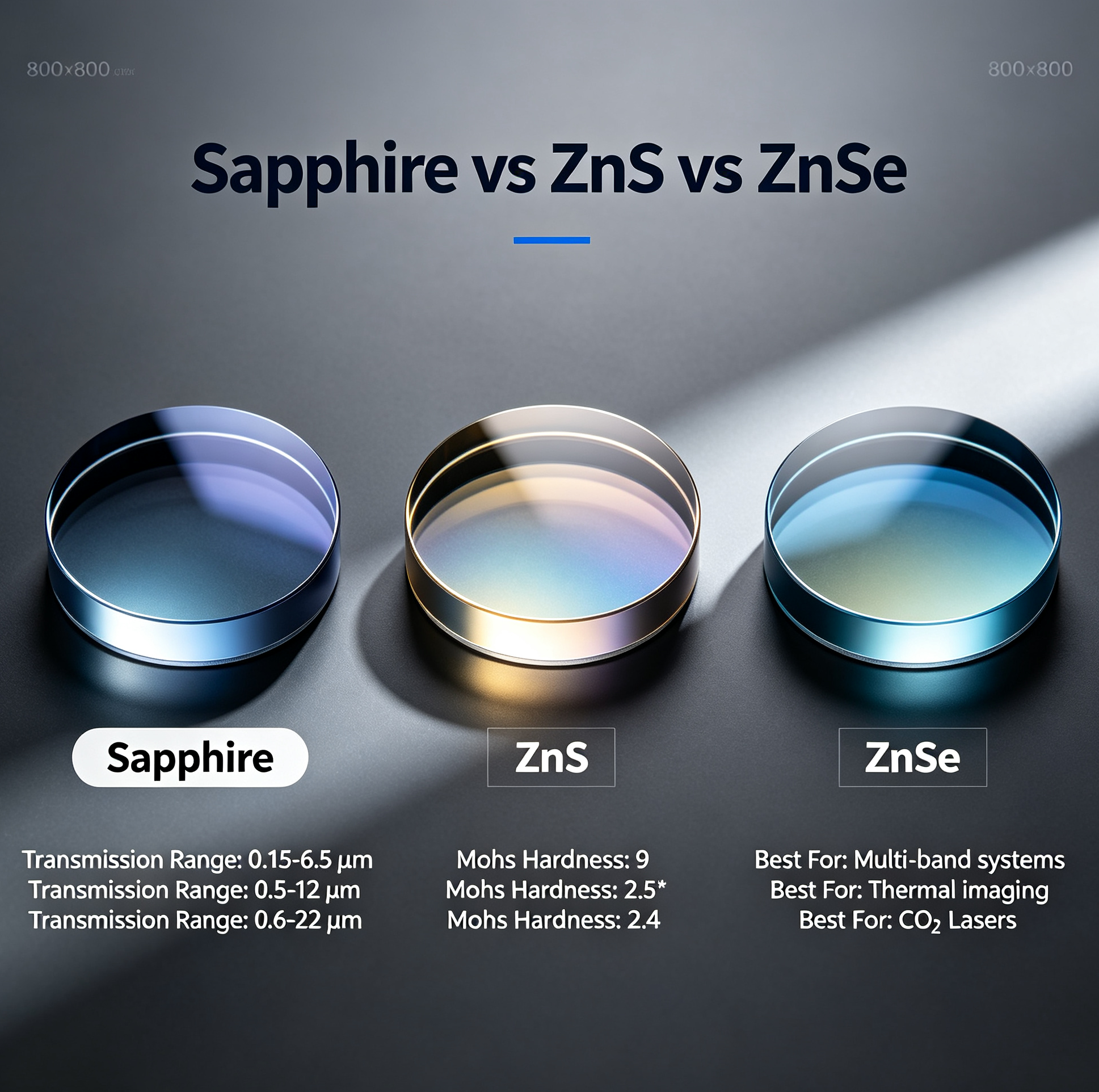
Sapphire vs ZnS/ZnSe for IR Optics: Which Material to Choose?
Overview
Sapphire, ZnS (Zinc Sulfide) and ZnSe (Zinc Selenide) are three leading infrared optical materials for thermal imaging, defense EO/IR systems, laser equipment and industrial sensing applications. Each material has distinct advantages in spectral range, hardness, environmental durability, laser compatibility and cost.
This guide provides a full technical comparison to help you select the right IR material for your system.
Reviewed by: Senior Infrared Optical Engineer
Last Updated: June 2026
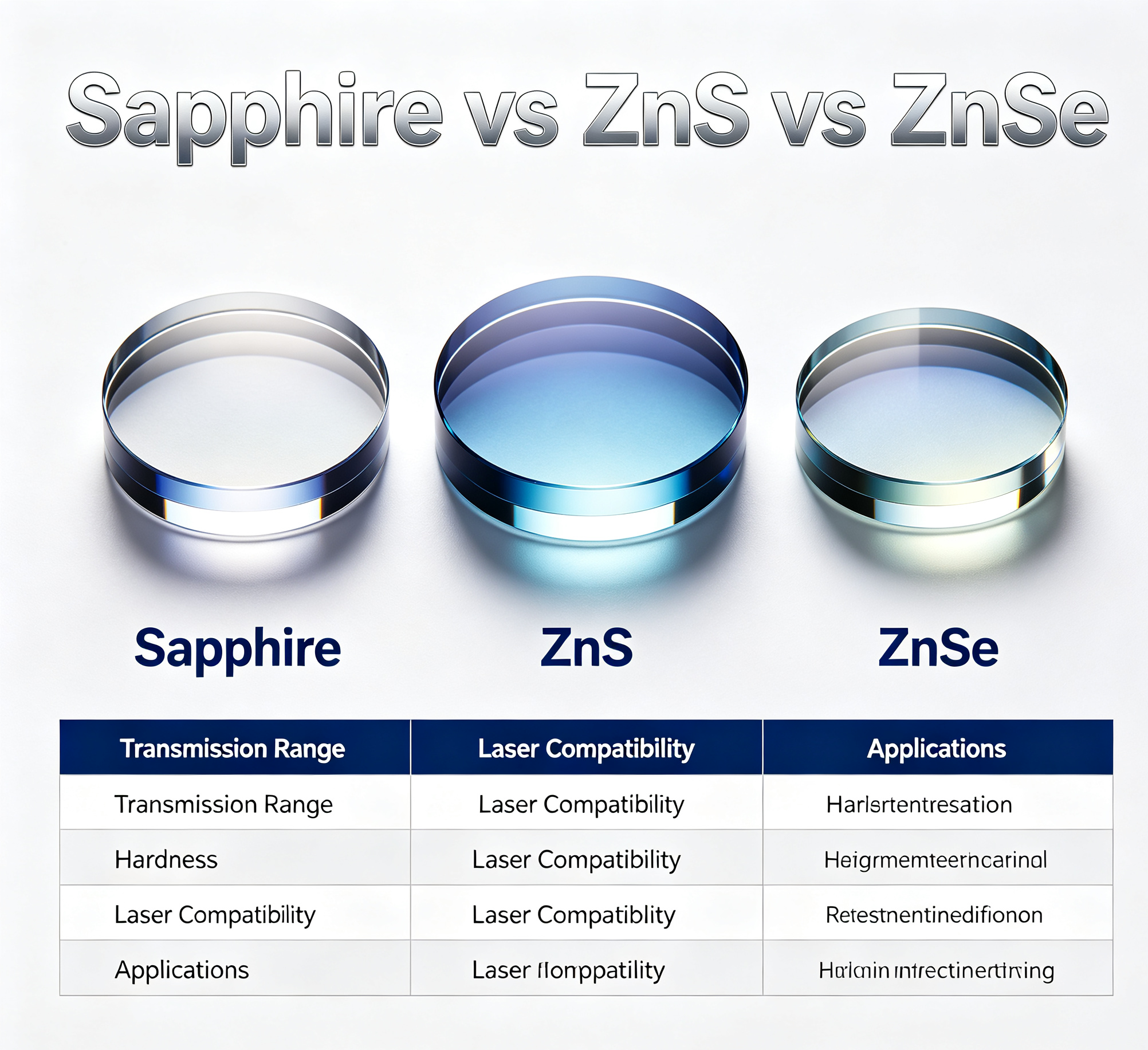
1. Core IR Performance Comparison
| Parameter | Sapphire | ZnS | ZnSe |
|---|---|---|---|
| Transmission Range | 0.15 μm – 5.5 μm | 3 μm – 14 μm | 0.6 μm – 18 μm |
| Mohs Hardness | 9 | 3.0 | 2.8 |
| Environmental Durability | Excellent | Good | Moderate |
| Laser Compatibility | Limited for high-power CO₂ | General IR systems | Preferred for CO₂ lasers |
| Thermal Shock Resistance | Good | Excellent | Moderate |
| Typical Applications | Multi-band UV/Vis/IR systems, aerospace windows | Thermal imaging domes, industrial IR windows | High-power CO₂ lasers, multispectral systems |
| Relative Cost | High | Medium | Premium |
Key Takeaway:
- Sapphire excels in multi-band systems and harsh environments.
- ZnS is ideal for durable thermal imaging domes and industrial IR windows.
- ZnSe is the industry standard for high-power CO₂ lasers and wide-spectrum IR systems.
2. Spectral Performance Analysis
Sapphire
- Supports UV, visible and mid-infrared transmission up to 5.5 μm, making it ideal for multi-spectral and day-night systems.
- Poor performance beyond 5.5 μm, not suitable for far-infrared applications.
ZnS
- Optimized for MWIR and LWIR (3–14 μm), perfect for thermal imaging cameras and surveillance systems.
- No visible/UV transmission, limited to infrared-only applications.
ZnSe
- Broadest spectral coverage, extending from visible light to 18 μm, supporting multispectral and laser systems.
- Ultra-low absorption at 10.6 μm, the standard for CO₂ laser optics.
3. Environmental & Mechanical Stability
Sapphire
- Mohs 9 hardness offers unmatched scratch and impact resistance, ideal for defense and aerospace applications.
- Excellent chemical stability, suitable for marine, desert and high-corrosion environments.
ZnS
- Good hardness and environmental resistance, widely used for thermal imaging domes in outdoor and vehicle-mounted systems.
ZnSe
- Softest of the three materials, easily scratched, requiring protective coatings for field deployment.
4. Typical Application Recommendations
Choose Sapphire For:
- Multi-band UV/Vis/IR systems
- Harsh environment aerospace/defense windows
- Wear-resistant and high-pressure optical components
Choose ZnS For:
- Thermal imaging domes and IR windows
- Outdoor and vehicle-mounted surveillance systems
- Cost-effective industrial IR optics
Choose ZnSe For:
- High-power CO₂ laser systems
- Multispectral optical systems requiring visible+IR transmission
- Scientific and medical laser equipment
Related Articles
Get a Custom Quote
Share your wavelength range, application environment and system requirements. Our team will provide a professional material recommendation and custom solution.