Select Coatings & Surface Treatments ——AR/HR coatings & anti-glare surface processing
- Share
- publisher
- Felix Glass Co., Limited
- Issue Time
- Oct 26,2026
Summary
Select AR, HR, AG and AF surface treatments for custom optical windows, lenses, domes and display glass. Match each to its function, then specify compatibility and durability. Get a quote.
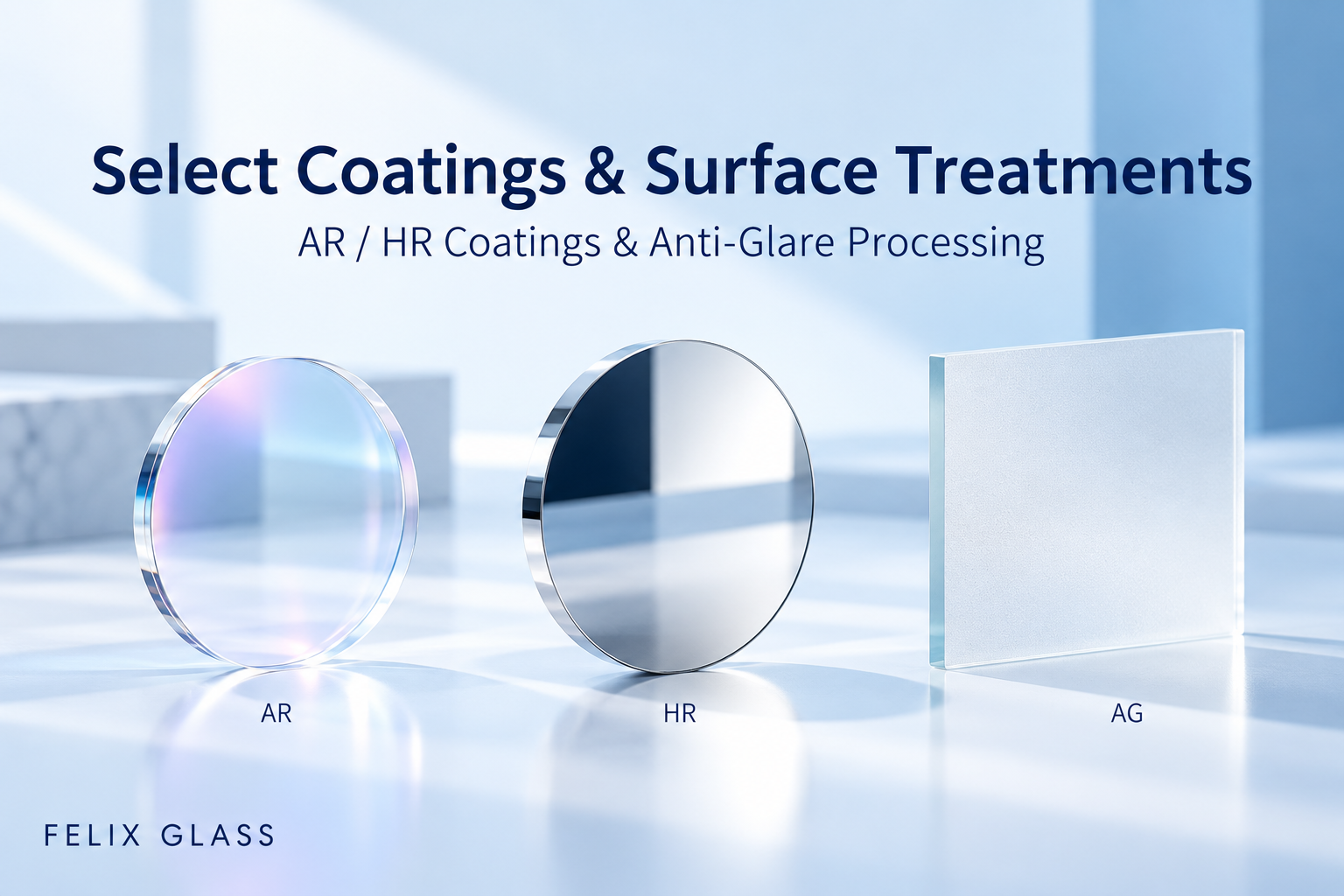
Knowledge Center · Engineering Selection Guide AR/HR coatings & anti-glare surface processing Select AR, HR, AG and AF treatments for custom optical components and display glass. Define surface functions, coating compatibility, inspection and durability requirements. Start by identifying what the surface must do: transmit light, reflect a beam, soften a visible reflection, improve cleaning or survive environmental exposure. AR, HR, AG and AF describe different functions and should not be selected from appearance alone. This guide converts those functions into practical specifications for optical windows, lenses, domes, mirrors and display covers. The goal is to select and qualify a complete surface system, including the substrate and any later printing, bonding or assembly steps. Provide the substrate grade, dimensions, thickness, clear aperture and treated faces before finalizing a coating. Layer design depends on the optical properties of the material beneath it. Process temperature, stress and adhesion also constrain the manufacturing route. Define wavelengths, incidence angles, polarization and the medium touching each face. A flat witness sample may not represent every point on a curved dome. Include the range of local incidence angles and the functional aperture for curved components. If the surface will be bonded or immersed, identify that condition explicitly. A design optimized for air is not automatically suitable for adhesive or water. Anti-reflection coatings reduce surface reflection through an engineered optical structure, commonly a thin-film layer stack. Select the design bandwidth to match the source and detector, including wavelength tolerances. A low reflection value at one wavelength does not establish broadband performance. Specify finished-component transmission separately when absorption and scatter must also be controlled. A high-reflection coating redirects useful light. Dielectric stacks can be designed for demanding reflection targets in selected bands; metallic mirrors can serve broad spectral needs depending on the metal and protective layers. Neither approach is universally superior. For each mirror, specify wavelength, angle and polarization, along with acceptable absorption, scatter and reflected wavefront error. For lasers, include beam size, pulse duration, repetition rate or continuous power, and the required test conditions. A damage threshold from a different laser regime may not be transferable. Protective or enhancing layers on metal mirrors can improve handling and change spectral performance. Compare the completed coating stack, not the bare-metal name. AG treatment modifies the surface texture to redistribute reflected light. It may be created by etching the glass or by an applied textured layer. “Anti-glare” therefore does not always mean a deposited optical film. The benefit is a softer reflected image, but the tradeoff can include reduced clarity, raised black-level appearance and sparkle on displays. AGC’s display-glass guidance identifies these competing effects. Evaluate candidate finishes on the actual screen at realistic viewing distance and ambient illumination. Do not specify only “matte.” Agree on gloss measurement geometry, haze method, clarity requirements and an approved appearance sample. Texture uniformity across the panel is also important. AR and AG can be combined, but the finished combination needs qualification. A coating measured on polished glass cannot simply be assumed to perform identically over an etched texture. AF or oleophobic treatments change the interaction between contaminants and a surface. Their value is often easier cleaning or modified fingerprint appearance. They do not guarantee that a surface will remain free of marks. Specify representative contamination, cleaning method and acceptable appearance after cleaning. Water contact angle can be one measurement, but it does not by itself establish oil resistance or fingerprint removability. Include performance after wear, repeated cleaning and chemical exposure. Commercial combinations such as SCHOTT’s AR plus anti-fingerprint cover glass show that functions can be integrated, but the exact stack and durability remain product-specific. A protective coating, chemical strengthening and thermal tempering are different treatments. A hard surface film does not create the same residual-stress profile as a strengthened glass substrate. Conversely, strengthening does not automatically improve coating scratch resistance. Define the actual exposure: wiping, abrasive particles, cleaning chemicals, humidity or other environmental conditions. Require optical and cosmetic limits after the exposure, together with an adhesion criterion where appropriate. For IR components, a DLC-based stack may be considered when compatible with the substrate and band. Its optical response must be qualified; the word “DLC” is not a universal transparency or durability specification. Mark S1 and S2 on the drawing and describe their installed orientation. Identify coating exclusions, bonding zones, printed regions, electrical contacts and edge treatment. Mixed-function components need a clear boundary between optical apertures and cosmetic or contact areas. A display cover might use AG+AF on the touched face and black printing on the rear. A protected IR window may use different coating systems on its external and internal faces. These are possible configurations, not universal layer recipes. Agree on the process sequence with the manufacturer. Strengthening, etching, coating, printing and curing can affect one another; qualifying individual operations does not qualify every possible sequence. Evaporation, ion-assisted deposition and sputtering are manufacturing routes, while AR and HR are optical functions. More than one route may achieve a given requirement. Process selection should account for layer materials, uniformity, stress, substrate temperature, geometry, throughput and inspection. Ask the supplier to explain how the proposed route meets the acceptance criteria. Do not substitute a prestigious process name or a larger layer count for measurable performance. Where a process is mandatory, document the reason and any change-control requirements. Use representative prototypes for application validation. Approve the combined optical, mechanical and cosmetic result before releasing production. Keep an approved reference where visual judgment forms part of acceptance. A useful RFQ describes function, conditions and verification rather than only listing coating abbreviations. Use the following structure and replace every bracket with a project requirement. For display projects, also provide the screen type, pixel density, optical bonding arrangement and appearance sample when relevant. For mirrors or lasers, add the operating beam parameters and reflected-wavefront requirements. AR is designed to reduce reflection; HR is designed to provide high reflection under specified optical conditions. No. AG primarily changes the distribution of light through surface texture. Its appearance must be assessed separately from total reflection. They can be combined in suitable designs, but compatibility and finished-stack performance need qualification. Only if the application calls for it. Face environment, optical function and handling can differ. No. Include contamination removal, wear and cleaning tests appropriate to the use case. No. Coating protection and substrate strengthening address different mechanisms. It can support process monitoring, but its relevance to curved-surface uniformity and angle-dependent performance must be established. Approve the drawing, substrate, face assignments, optical limits, durability conditions, representative samples and inspection plan. Send your drawing, operating wavelengths, application environment, prototype quantity and expected production volume to Felix Glass. Identify mandatory requirements and targets that can be adjusted so the material, coating and manufacturing route can be reviewed together. Dongguan Felix Glass Co., Ltd.Select Coatings & Surface Treatments
1. Define the Surface Function
2. Coating and Surface-Treatment Selection Table
Need
Candidate treatment
Primary acceptance criteria
Key caution
Reduce surface reflection
AR / BBAR / narrowband AR
Reflection and transmission over specified wavelengths and angles
Does not correct substrate absorption
Reflect a beam
Dielectric HR or metallic mirror
Reflectance, loss and wavefront under operating conditions
Angle and polarization matter
Soften distracting glare
AG etching or a qualified textured coating
Gloss, haze, clarity, sparkle and appearance
Scattering can reduce image quality
Improve cleaning
AF / oleophobic surface treatment
Contamination removal and retention after wear
Does not eliminate fingerprints permanently
Protect an exposed surface
Application-qualified hard or protective coating
Optical performance after defined exposure
Hardness alone does not prove durability
Add conductivity
ITO or another qualified conductive layer
Sheet resistance, transmission and contact design
Electrical and optical requirements interact
3. Specify the Substrate and Operating Conditions
4. Select the Appropriate AR Design
AR approach
Useful starting point
What to specify
Single-layer AR
Moderate reflection reduction where the design is adequate
Residual reflection throughout the required band
Narrowband / V-coat
A defined laser line or narrow sensing band
Nominal wavelength, tolerance and angular range
BBAR
A continuous imaging or illumination band
Maximum and average reflection over the full band
Dual-band / multiband AR
Separated optical channels
Requirements in each band and any necessary blocking between them
5. Select HR or Metallic Reflection
6. Understand Anti-Glare Surface Processing
7. AR vs. AG: Choose by the Optical Task
Question
AR
AG
What changes?
Amount of reflected light within a designed optical range
Angular distribution of light through surface texture
Can it preserve a clear polished appearance?
Usually the intended outcome
A matte or diffuse appearance is generally intentional
Typical concern
Spectral or angular limits and residual color
Scatter, display sparkle and image softness
Imaging aperture suitability
Often useful when correctly specified
Requires careful assessment of scattering effects
8. Add AF Where Handling and Cleaning Matter
9. Treat Protection and Strengthening Separately
10. Plan Face Assignments and Process Compatibility
11. Choose a Manufacturing Route by Requirements
12. Validate the Finished Component
Test area
Define before approval
Optical spectrum
Minimum, maximum or average limits; wavelength interval; angle; polarization; measurement resolution
AG appearance
Gloss geometry, haze method, clarity, sparkle and reference viewing conditions
AF behavior
Contamination and cleaning procedure; initial and post-wear acceptance
Durability
Exposure conditions, cycles and allowed changes in optics or appearance
Geometry and uniformity
Usable aperture, face identification, coating exclusions and curved-surface sampling
Evidence
Simulation versus measured data; witness coupon versus finished-part data; sampling plan
13. Build a Clear Coating RFQ
14. Frequently Asked Questions
What is the difference between AR and HR?
Does AG reduce reflection in the same way as AR?
Can AR, AG and AF be combined?
Should both faces receive the same coating?
Is water contact angle enough to approve AF?
Does a hardcoat replace glass strengthening?
Can a flat coating coupon approve a dome?
What should be approved before production?
15. Discuss Your Coating and Surface Requirements
Email: james@felixglass.com