CUSTOMER CASE STUDY | CO₂ LASER OPTICS
CVD ZnSe CO₂ Laser Protective Windows: A North American OEM Case Study
For an equipment manufacturer, approving a new optical component supplier is only the beginning. Repeat purchasing requires a workable path from a defined specification to ongoing production supply.
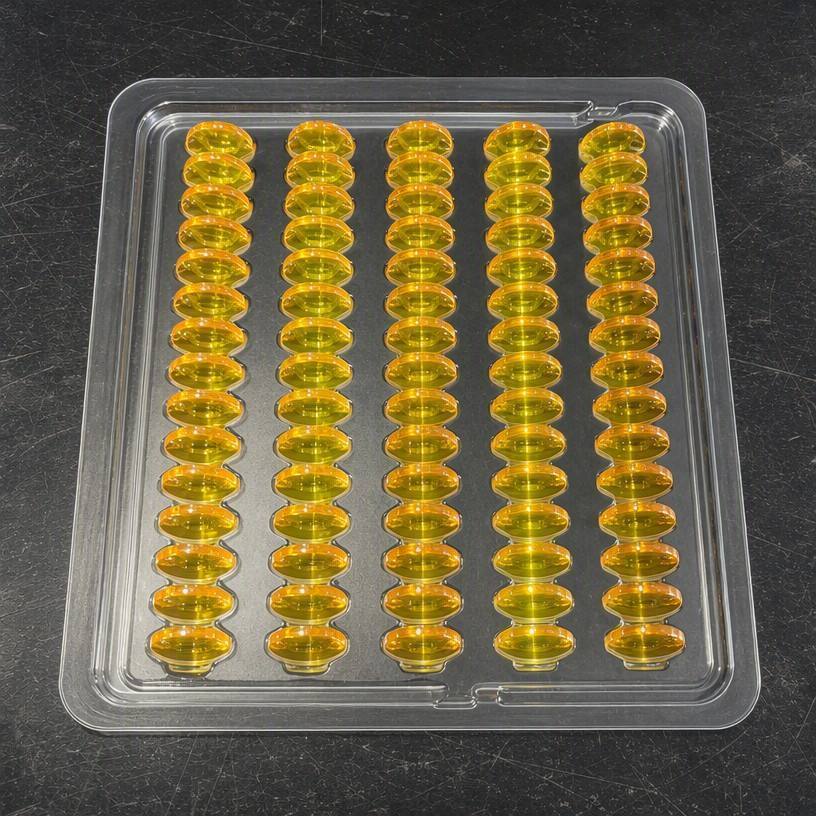
This FELIX GLASS project involved custom CVD ZnSe protective windows for a North American CO₂ laser equipment manufacturer. The initial production order comprised 1,200 pieces, followed by three repeat orders.
Application: CO₂ laser equipment
Component: Custom CVD ZnSe protective window
Design wavelength: 10.6 μm
Customer: North American equipment OEM; identity withheld
Order history: 1,200-piece initial production order, followed by three repeat orders
1. Project Snapshot
The project centered on supplying ZnSe protective windows to an OEM manufacturing CO₂ laser equipment. The initial 1,200-piece order and subsequent three repeat orders establish the commercial outcome of this case: the purchasing relationship continued beyond the first production batch.
Customer-identifying details and proprietary drawings are not reproduced here. The case distinguishes the order history from technical acceptance criteria, which must be defined for each specific component.
2. Client Background
The customer is a North American OEM in the CO₂ laser equipment sector. For this type of manufacturer, a protective window must fit the assembly, meet the specified optical requirements and be supplied against a controlled drawing revision.
Production purchasing also requires clear communication about batch quantities, inspection evidence, packaging and delivery dates. These requirements provide the context for evaluating an optical component supply relationship.
3. The Procurement Challenge
The procurement task was to establish repeat supply of a custom optical component. The following control points are relevant to that task; they are not presented as measured failures of a previous supplier.
Optical Requirements
Define the operating wavelength and the acceptance requirements for the coated window, including measurement conditions.
Mechanical Consistency
Control dimensions, clear aperture, edge details and surface requirements against the released drawing.
Inspection Evidence
Agree which reports are required and whether they represent individual parts, sampled parts or a coating batch.
Repeat-Order Control
Confirm drawing revisions, quantities, packaging and delivery commitments for every purchase order.
4. Technical Specification Framework
The component described in this project is a CVD ZnSe protective window for 10.6 μm CO₂ laser equipment, with AR coating on both optical faces. The table below separates the application description from requirements that must be resolved in the manufacturing drawing and purchase specification.
| Parameter | Project / Application Description | Specification Control |
|---|---|---|
| Material | CVD zinc selenide (ZnSe) | Define material grade and any source or traceability requirements. |
| Operating wavelength | 10.6 μm | Do not treat the substrate transmission range as the coating acceptance band. |
| Coating | Double-sided AR coating for the operating wavelength | Identify S1/S2, angle of incidence and polarization where relevant. |
| Transmission | Acceptance value specified by the order | Define finished-part transmission and test conditions; this article does not publish a verified numerical result. |
| Dimensions | Custom drawing | Specify diameter, thickness, clear aperture, parallelism or wedge, and tolerances. |
| Optical surface quality | Drawing-specific | State scratch-dig requirements, applicable interpretation standard and surface-form requirements. |
| Laser exposure | System-specific | Define power, beam size, operating mode and any required absorption or damage testing. |
| Order quantity | Initial production order: 1,200 pieces | Three subsequent repeat orders; their quantities are not disclosed. |
5. FELIX GLASS Solution Approach
A repeatable supply arrangement starts with a clear component definition. For customers planning a similar project, the following review sequence provides a practical basis for quotation and production approval.
- Review the drawing: identify critical optical surfaces, mounting dimensions, coating requirements and unresolved tolerances.
- Agree the quotation scope: confirm the part revision, quantities, inspection package, packaging and delivery terms.
- Define prototype acceptance: establish what the OEM will inspect and test before authorizing production.
- Release production: manufacture against the approved specification and communicate any proposed change before implementation.
For a new project, the exact sequence and deliverables should be confirmed in writing. This workflow is guidance for comparable orders, not a substitute for the confidential project records.
6. Coating and Optical Performance
ZnSe has a refractive index of approximately 2.40 at 10.6 μm. At normal incidence, the Fresnel reflection estimate for one uncoated air–ZnSe interface is approximately 17%. AR coatings are therefore important for reducing surface reflection at the design wavelength.
That single-interface estimate is not the transmission loss of a complete two-surface window. Finished-part transmission also depends on the coating, absorption, scattering, thickness and measurement conditions. A material datasheet cannot establish the performance of a particular production batch.
For a CO₂ laser application, transmission, absorption and laser-damage resistance are separate acceptance considerations. A transmission measurement alone does not demonstrate low absorption or suitability at every laser power.
Material reference: Crystran — Zinc Selenide (ZnSe) material data. Reference data are not FELIX GLASS batch test results.
7. Quality Assurance and Inspection Documentation
Inspection requirements should be agreed before production. Depending on the purchase specification, the documentation package may include:
- Dimensional inspection results tied to the applicable drawing revision.
- Surface quality inspection results using the agreed acceptance criteria.
- Coating transmission data with wavelength, measurement geometry and sample identification.
- Material identification and batch traceability documentation.
- Additional coating qualification or environmental reports where explicitly required and agreed.
Confirm whether spectral data are recorded per piece, by sampling or on a witness sample. Qualification tests and routine production inspections should also be identified separately. This case does not claim that every window received individual FTIR testing or destructive coating testing.
Any requested certification or compliance documentation must be reviewed for the actual product and supplied scope. It should not be assumed from a general company or material description.
8. Collaboration Milestones
| Milestone | Published Information |
|---|---|
| Application | Custom protective windows for a North American CO₂ laser equipment OEM. |
| Technical specification and approval | Detailed drawings, approval dates and qualification records are not published in this case. |
| Initial production order | 1,200 pieces. |
| Continued purchasing | Three repeat orders after the initial production order. |
| Future project scheduling | Prototype and production lead times are confirmed in the specific quotation. |
The milestones describe the disclosed order history. They do not establish a standard sample lead time or production lead time for other designs.
9. Production Results and Commercial Outcome
Initial Production Order
1,200 pieces
Custom CVD ZnSe protective windows for the OEM application.
Continued Purchasing
3 repeat orders
The customer continued purchasing after the initial production order.
Repeat orders provide a concrete record of an ongoing commercial relationship. They do not, by themselves, quantify a reduction in defects, an improvement in laser output or an on-time delivery rate. No such numerical performance improvements are asserted here.
10. Customer Relationship and Feedback
The customer relationship continued through three repeat orders. This is the reported purchasing outcome of the project.
No direct customer quotation is reproduced in this version. The case also makes no claim of exclusivity, formal annual strategic-partner status or expansion into other product categories.
11. Working with FELIX GLASS
FELIX GLASS welcomes drawing-based inquiries for custom optical components. For a ZnSe window project, the useful first step is a review of the operating wavelength, component geometry, optical requirements and intended order quantities.
- Define the scope: distinguish required specifications from preferences that can be discussed.
- Plan verification: identify the evidence needed for incoming inspection and system qualification.
- Prepare for repeat orders: keep drawing revisions, approved requirements and order documentation consistent.
Contact James to discuss your project and obtain a quotation with the applicable technical and commercial terms.
12. Related Optical Components and Resources
Custom ZnSe Infrared Optical Components Infrared Optics Product Range FELIX GLASS Knowledge Center About FELIX GLASS13. Frequently Asked Questions
Are the 1,200-piece order and three repeat orders real project data?
Does this case guarantee 99% transmission for every custom window?
What is the lead time for a similar order?
What inspection reports can be included?
Is 1,200 pieces the minimum order quantity?
What information is needed for a quotation?
14. Explore More Case Studies
Explore other FELIX GLASS customer projects and optical component resources. Each project's requirements and results should be evaluated in its own application context.
Browse Customer Case Studies Visit FELIX GLASS15. Start Your ZnSe Window Project
Send your drawing and required quantities to discuss custom CVD ZnSe protective windows for your CO₂ laser equipment.
Helpful RFQ details: diameter and thickness; clear aperture; 10.6 μm coating requirements; laser power and beam size; surface quality; inspection scope; prototype and production quantities.
James | International Sales Director
Dongguan Felix Glass Co., Ltd.
james@felixglass.com