Q1: What optical materials do you use for custom components?
- Share
- Issue Time
- Jun 30,2026
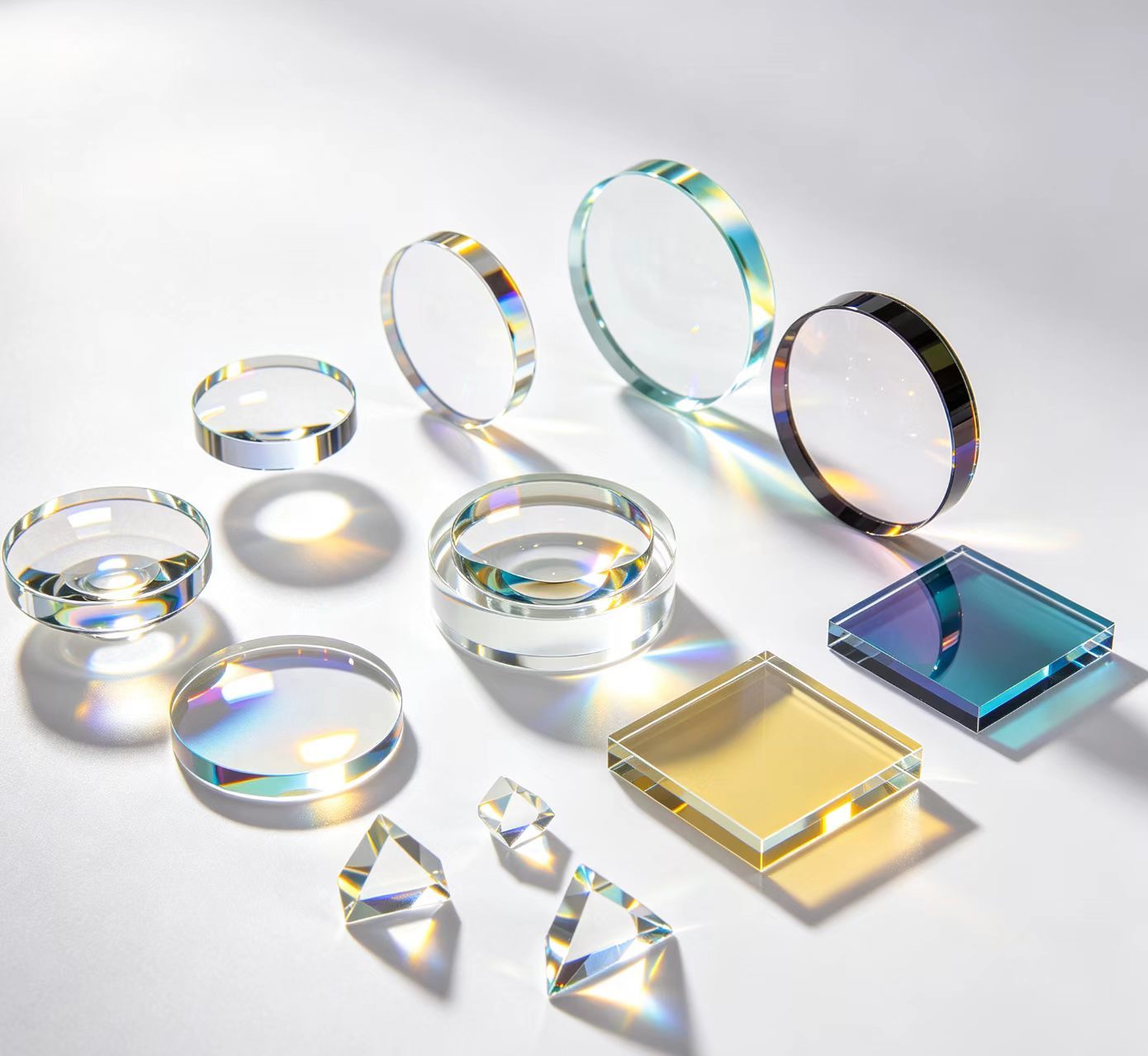
A: Felix Glass processes custom optical components from a full range of optical-grade substrate materials, covering visible, near-IR, mid-IR and UV spectral bands. Our engineering team helps customers select the most suitable material based on working wavelength, environmental conditions, mechanical load, thermal cycling requirements and budget, so that every optical dome, window, prism, lens or mirror performs reliably in its real operating environment.
Visible & general optics — BK7 / Borosilicate Crown Glass BK7 (equivalent to SCHOTT N-BK7 and H-K9L) is our most commonly used crown optical glass for visible and near-infrared applications. It offers excellent optical homogeneity, low internal striae, good polishability and cost-effective pricing. Typical components include visible-band windows, precision prisms, lenses and relay optics for machine vision, inspection equipment and industrial sensors. Borosilicate crown glass is selected when higher thermal shock resistance is required for outdoor or temperature-fluctuating environments.
UV & high-temperature optics — Fused Silica (Fused Quartz) For ultraviolet transmission, deep-UV lithography, UV curing and high-temperature optical systems, we use synthetic or natural fused silica. Fused silica delivers outstanding deep-UV transmission down to 185nm, ultra-low coefficient of thermal expansion, and excellent resistance against thermal shock and chemical corrosion. It is the standard choice for UV optical windows, excimer laser optics, high-temperature viewports and space-qualified visible/UV components.
Harsh-environment & wear optics — Sapphire Sapphire single-crystal (Al₂O₃) is processed for components facing extreme abrasion, high pressure, seawater, high temperature or chemical attack. With Mohs hardness 9, sapphire domes and sapphire windows are widely used in ROV subsea viewports, military EO/IR sensor windows, high-pressure gauge glasses and high-wear protective covers. We supply both c-axis and a-axis oriented sapphire substrates per customer drawing.
Infrared laser & thermal imaging — ZnSe, ZnS, Germanium, Silicon For CO₂ laser systems (10.6μm), thermal imaging and FLIR infrared applications, we process zinc selenide (ZnSe), zinc sulfide (ZnS, multispectral CVD), germanium (Ge) and silicon (Si) optical blanks. ZnSe is the standard window and lens material for high-power CO₂ laser cutting and welding optics. ZnS (multispectral) is used for broadband IR sensor windows and domes. Germanium is the primary material for 8–12μm long-wave thermal imaging lenses. Silicon is selected for 3–5μm mid-wave IR systems where weight is a concern.
Full material traceability & quality assurance All substrate raw materials are sourced from qualified optical glass manufacturers (SCHOTT, Heraeus, Corning, Kyocera and equivalent). Every incoming batch is accompanied by material certificates, and we retain mill certs and batch records for full traceability. Before machining, our QC team verifies material identification by spectral transmission check, refractive index reading and visual inspection for internal bubbles, inclusions and striae. After CNC cutting, grinding, polishing and coating, each component passes dimensional, surface quality and optical performance inspection. We support third-party witness inspection for bulk OEM orders.
If you are unsure which substrate fits your system, simply send us your working wavelength range, environment specs and drawing. Our optical engineers will recommend 2–3 material options with a clear trade-off comparison, then produce prototype samples for your validation.