Custom CVD ZnSe Hemispherical Dome
- Share
Custom CVD ZnSe Hemispherical Dome Manufacturer
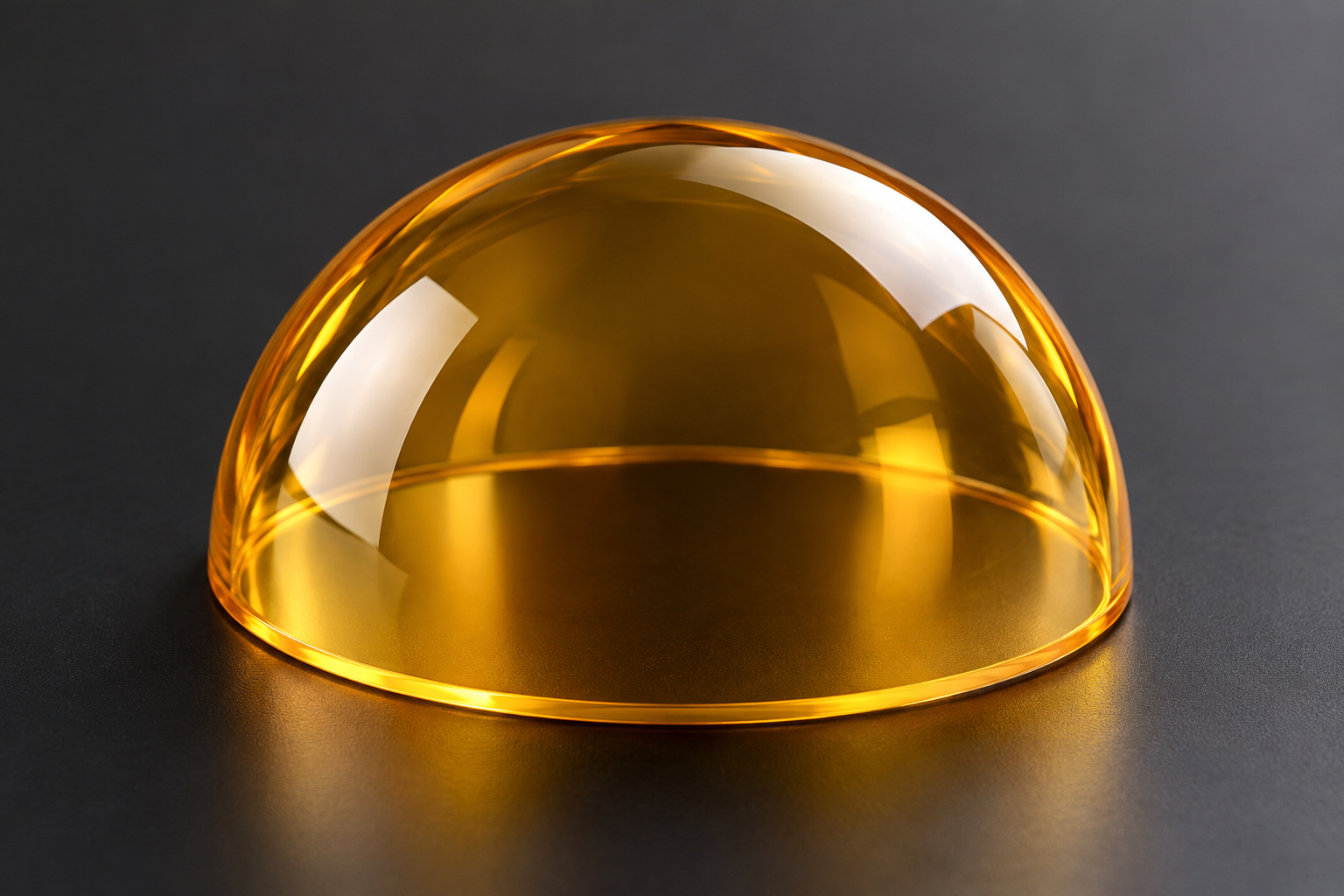
Source custom CVD zinc selenide hemispherical domes from Felix Glass for your defined optical application. Specify dome geometry, material requirements and coated surfaces in one RFQ. Choose the dedicated laser or infrared imaging route below so performance requirements stay separate.
Key Parameters
Common Pain Points When Sourcing CVD ZnSe Hemispherical Domes
Real-world challenges faced by optical engineers, procurement managers, and project teams.
A grade name is not an acceptance specification.
Two amber-yellow ZnSe domes can look similar while their documented absorption, optical quality and intended use differ. Identify the required material performance before comparing prices.
A dome that fits may still miss the optical requirement.
Radii, wall thickness, concentricity, clear aperture and coating incidence angles affect how a dome works in the assembly. Provide the optical and mechanical requirements together.
Unclear inspection scope creates avoidable rework.
Agree what will be inspected, how it will be measured and what documentation is included. Separate dimensional checks, spectral tests and any laser-specific verification.
Targeted Engineering Solutions
A drawing-led review connects your application requirements to a clearly defined dome specification.
Keep laser and imaging projects separate
State Laser-Grade or IR-Grade in your inquiry. Laser projects need beam and absorption requirements; imaging projects need spectral, field-of-view and image-quality requirements.
Benefit: a relevant technical reviewMake the drawing the source of truth
Define outer and inner radii, wall thickness, overall height, clear aperture, rim or flange, and mounting datums. Resolve any conflicting dimensions before approval.
Benefit: fewer dimensional assumptionsSpecify the finished coated dome
Identify S1 and S2, wavelength bands, incidence angles and transmission criteria. Confirm inspection scope and any witness-sample arrangements in the quotation.
Benefit: comparable quotations and acceptance criteria
Five Engineering Decisions for Your ZnSe Dome
Five core engineering dimensions that define CVD ZnSe Hemispherical Domes performance and reliability.
CVD ZnSe substrate
Identify the material designation, supplier specification and any source-documentation requirements.
Hemispherical geometry
Specify outer and inner radii, wall thickness, concentricity, height, rim and clear aperture.
Optical surfaces
Define S1 / outer and S2 / inner surface quality, figure and any transmitted wavefront criteria.
Coating design
Keep laser and imaging coating requirements distinct; identify bands and incidence angles.
Acceptance evidence
Agree inspection methods, reporting and sampling before manufacturing release.
Choose Your ZnSe Dome Application Route
Laser-Grade and IR-Grade requirements are kept separate. Select the route that matches your optical system.
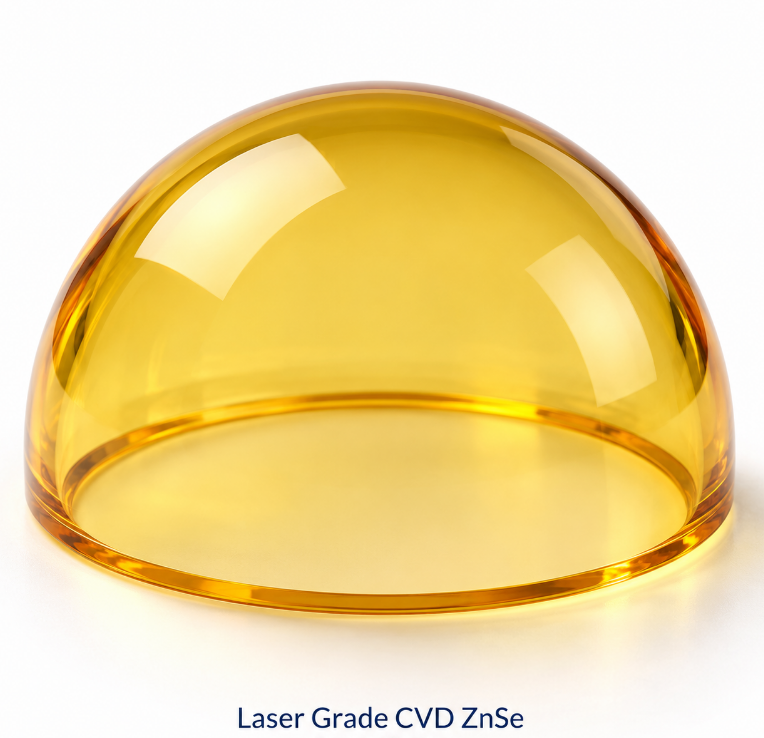
Laser-Grade CVD ZnSe Hemispherical Dome
For a specified laser-transmission application requiring material and finished-optic review.
- Provide wavelength, CW / pulsed mode and power or pulse energy.
- Define beam diameter, incidence angles and absorption acceptance.
- Specify polishing, coating and any laser damage test conditions.
- A laser-grade substrate does not qualify the finished dome by itself.
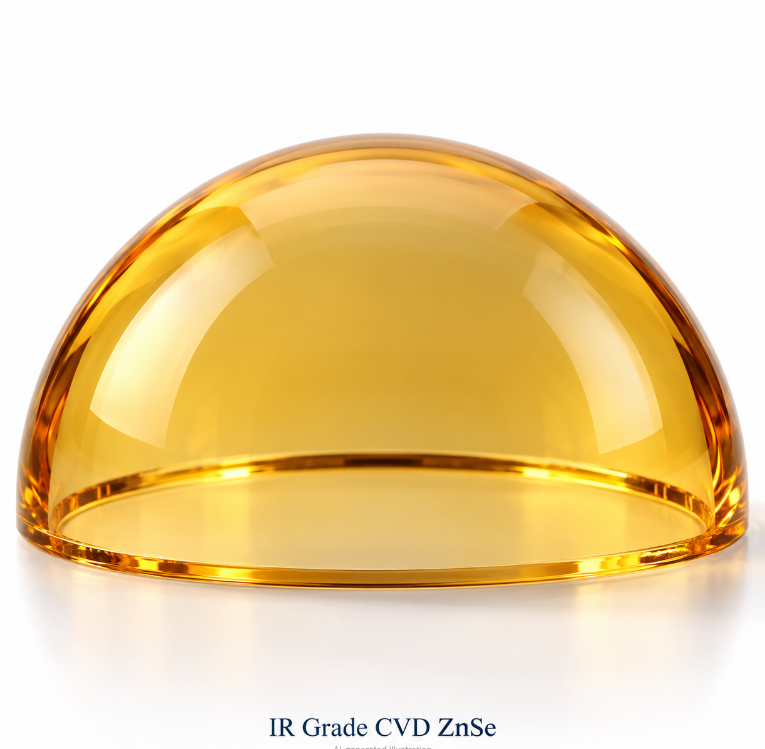
IR-Grade CVD ZnSe Hemispherical Dome
For thermal infrared imaging and sensing with a defined spectral and imaging requirement.
- Provide the complete working band, such as the required MWIR or LWIR interval.
- Specify minimum or average finished-part transmission.
- Define field of view, wavefront and environmental requirements.
- IR-grade terminology follows the agreed material specification.
Technical Specifications
Define your acceptance requirements using the fields below. Achievable values and inspection scope are confirmed in the project quotation.
| Parameter | Value / Specification |
|---|---|
| Product | Custom hollow hemispherical CVD zinc selenide dome; geometry and acceptance to approved drawing. |
| Material designation | Laser-Grade and IR-Grade are separate application routes on this page. The quotation must identify the actual supplier material specification. |
| Outer / inner geometry | Specify outer diameter or radius, inner diameter or radius, wall thickness, overall height and allowable concentricity error. |
| Rim / mounting interface | Define rim width, flange if required, datums, edge chamfer and permitted non-optical zones. Mechanical feasibility is reviewed for the drawing. |
| Clear aperture | Identify the optical zone on S1 and S2, including any field-angle requirement. |
| Dimensional tolerances | Submit required tolerances for each critical dimension; no blanket manufacturing limit is implied. |
| Surface quality | State the scratch-dig or other applicable specification and inspection conditions for each optical surface. |
| Surface figure / transmitted wavefront | Define PV or RMS, reference wavelength, test aperture and setup. Dome measurement must use an agreed configuration. |
| Uncoated or AR-coated | Specify S1 / outer and S2 / inner surfaces independently. Laser and infrared imaging coatings are reviewed against their separate requirements. |
| Spectral transmission | State the exact band, minimum or average target, wall thickness, incidence angle and whether the target applies to the finished coated dome. |
| Laser route only | Provide wavelength, CW / pulse parameters, beam diameter, absorption limit and any required laser-damage verification conditions. |
| IR imaging route only | Provide sensing band, field of view, wavefront or image-quality requirement and environmental exposure. |
| Inspection deliverables | Agree dimensional, surface, spectral and optical reports, material documentation and any specialized test charges. |
| MOQ / tooling / lead time | Project-specific. Quote prototype and repeat quantities against the same drawing revision; identify one-time costs separately. |
Typical Applications
Separate application requirements for laser transmission and infrared imaging.
IR-grade · Thermal camera dome
A protective hemispherical optical interface for an infrared sensor housing. Select the required band and evaluate the dome within the complete imaging system.
IR-grade · Industrial infrared sensing
Custom dome geometry for instruments where clear aperture, thermal transmission and housing interfaces must be defined together.
Laser-grade · Application-specific laser dome
A custom geometry for a laser optical path, subject to beam, absorption, wavefront and coating review. A dome is not automatically interchangeable with a flat laser window.

Manufacturing Capabilities
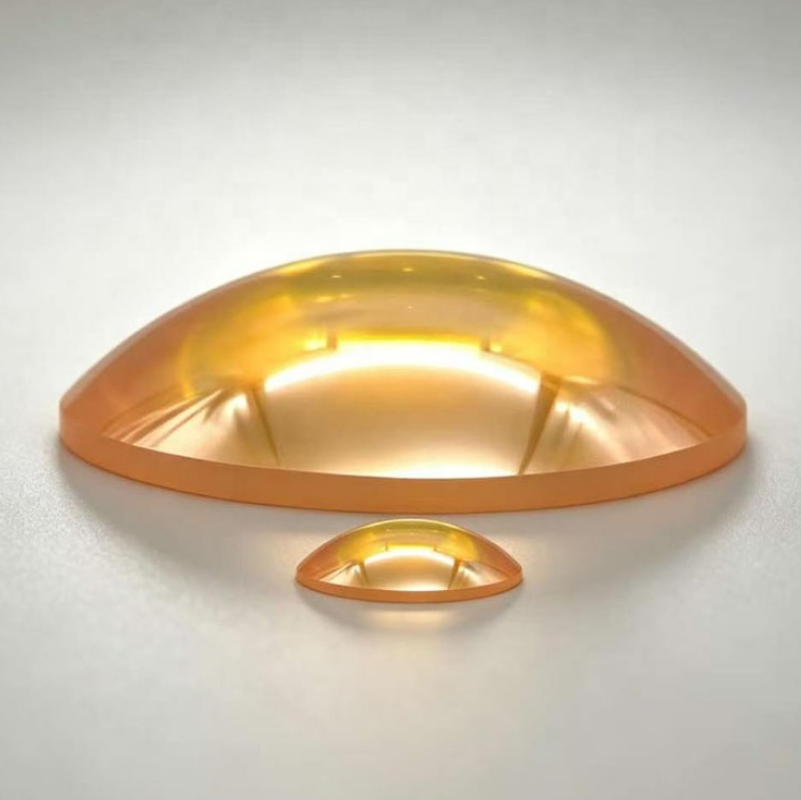
Review dome fabrication, coating and inspection requirements with Dongguan Felix Glass Co., Ltd. Images below are product illustrations, not factory evidence.
Dome Production & Inspection


- Manufacturer contactDongguan Felix Glass Co., Ltd. Contact James with your drawing, application and target quantity.
- Material specificationConfirm the CVD ZnSe designation and documentation required for the selected laser or imaging route.
- Geometry reviewResolve spherical dimensions, wall thickness, mounting interfaces and tolerances before production release.
- Surface requirementsDefine outer and inner polishing quality and applicable optical acceptance criteria.
- Coating reviewAgree S1 / S2 treatment, spectral requirements and any environment-specific testing.
- Inspection scopeRequest a quotation that states the included measurements and reports. Specialized tests require explicit confirmation.
Delivery Workflow
Standard project steps for custom optical orders, from initial RFQ through final shipment.
Send RFQ
Drawing, application, bands and quantities.
Resolve details
Confirm open technical and inspection items.
Review quote
Material, scope, tooling and lead time.
Approve drawing
Release the agreed revision for manufacture.
Inspect & ship
Complete agreed checks and protective packing.
Sample / Prototype
Timing confirmed after drawing and scope review.
Bulk / Mass Production
Schedule confirmed for the approved quantity.
Expedited Service
Feasibility and any extra charges require confirmation.
Material & Production Workflow
Define the substrate and order-specific production route before manufacturing release.
CVD ZnSe substrate
CVD describes the substrate production method. Amber-yellow appearance is typical, but does not establish a laser-grade absorption limit or finished-dome performance.
Laser and imaging specifications
Maintain separate coating and acceptance requirements for each application. The final material and component specification controls what is supplied; a marketing label does not replace it.
Drawing release
Confirm the selected material route, dimension set and inspection plan.
Blank & shaping
Review material suitability and prepare the dome geometry.
Grinding & polishing
Develop the outer and inner surfaces to the agreed specification.
Coating if specified
Use the approved S1 / S2 coating scope for the intended application.
Inspection & packing
Complete agreed checks and protect optical surfaces for shipment.
Dedicated ZnSe Dome Requirements
Continue through the application route relevant to your system.
Frequently Asked Questions
Common questions from engineers and procurement teams sourcing CVD ZnSe Hemispherical Domes.
CVD means chemical vapor deposition, the method used to produce the zinc selenide substrate. The blank is then fabricated into the specified optical geometry. CVD alone does not define the finished dome’s absorption, coating or optical tolerances.
Choose the route by application. A laser project needs laser operating conditions and material absorption requirements. An imaging project needs spectral transmission, field of view and imaging quality. Grade names may vary across suppliers, so agree the actual specification.
No. Both routes can have a similar amber-yellow appearance. Material documentation and the agreed measurements determine acceptance, not color or a product photograph.
Send outer and inner dimensions, wall thickness, height, rim or flange details and tolerances. Feasibility, tooling, price and schedule are reviewed against the complete drawing.
State the required treatment for S1 and S2 separately. For AR coating, specify wavelength bands, incidence angles and transmission or reflection criteria. Availability and test scope require project confirmation.
The complete spectral requirement must be evaluated at the specified wall thickness and incidence angles. Request data covering the full band, including its long-wavelength end. A nominal IR material range is not a finished-part transmission guarantee.
No. Performance depends on substrate, polishing, coating, cleanliness and operating conditions. Specify any required damage test with wavelength, pulse or CW conditions and beam parameters. Test availability and cost must be confirmed.
A dimensioned PDF drawing is useful for the acceptance specification; a STEP model can support geometry review. Include drawing revision, clear aperture, optical tolerances, coating requirements and quantity.
MOQ and timing depend on blank size, geometry, tolerance, coating and inspection. Submit the desired prototype quantity and repeat-order demand so these can be quoted together.
Identify dimensional, surface-quality, spectral and any wavefront reports, as well as material documentation. Do not assume that specialized absorption or laser-damage testing is included unless listed in the quotation.
The page concerns a custom optical component. Pressure capability, sealing, mounting loads and environmental qualification require review of the complete assembly and the specified test conditions.
Send your drawing, Laser-Grade or IR-Grade route, application, coating requirements and quantities. If the specification is incomplete, identify which parameters are fixed and which are open for review. Contact James at james@felixglass.com.
Still have questions? Our engineering team is ready to help.
Contact Our TeamREQUEST A CUSTOM QUOTE
Send your drawing, application route, operating wavelengths and quantity. James will coordinate the specification and quotation review.