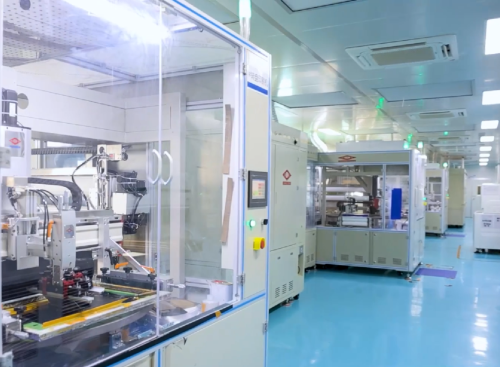
Services · Glass Finishing and Strengthening
Lapping / Fine Grinding / Tempering
Controlled abrasive finishing and material-specific strengthening
Define the geometry, surface condition and strengthening requirements for custom optical and display glass through a coordinated drawing review.
Compare the Processes1. Abrasive Finishing and Glass Strengthening for Custom Projects
Felix Glass supports drawing-based reviews of lapping, fine grinding and glass-strengthening requirements for optical and display components. These operations address different needs: abrasive finishing controls geometry and surface condition, while strengthening changes the stress state of suitable glass.
They are not a mandatory three-step sequence. The material, shape, optical function and subsequent coating or assembly determine which operations are appropriate. Specify the required final condition before selecting a process name.
2. Process Selection at a Glance
| Process | Primary function | What to define |
|---|---|---|
| Lapping | Controlled abrasive removal to refine geometry and surface condition | Thickness, flatness or parallelism, finish and polishing allowance |
| Fine grinding | Refine geometry and surface texture after earlier shaping | Dimensional limits, roughness basis and remaining finishing steps |
| Thermal tempering | Create a strengthening stress distribution through controlled heating and cooling | Compatible glass, geometry, optical limits and qualification |
| Chemical strengthening | Create surface compression through ion exchange in compatible glass | Composition, stress-profile requirements and verification |
| Optical polishing | Produce specified optical surface properties | Figure, roughness, defects and clear aperture |
Thermal tempering and chemical strengthening are separate routes. Neither is universally applicable to every optical material or geometry.
3. Lapping Services
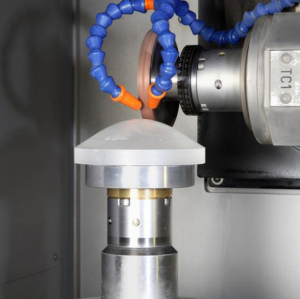
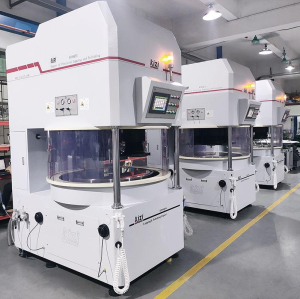
Lapping uses an abrasive process to remove material in a controlled manner. It can support thickness, flatness or parallelism requirements and prepare a surface for later polishing, depending on the chosen tooling and process.
State the geometry, delivery finish and required allowance. A lapped surface should not be assumed to have the optical clarity or roughness of a polished surface. The term lapping alone does not define a tolerance or an acceptance method.
4. Fine Grinding Services
Fine grinding refines the surface and geometry left by earlier shaping. The chosen abrasive, tooling and processing conditions must suit the material, part stiffness and finishing objectives.
Define the surface texture metric and measurement basis when these affect the next operation. Appearance alone does not establish subsurface condition. If further polishing is required, retain adequate material and identify the final dimensions separately from the intermediate grinding dimensions.
5. Thickness, Flatness and Parallelism
Thickness, total thickness variation, parallelism and surface flatness describe different geometric properties. State which ones matter, the measurement locations and reference datums. Avoid treating a single center-thickness reading as proof of uniformity across a part.
If optical performance is specified in waves, include the wavelength and whether the result is surface departure or wavefront error. A mechanical geometry check on a ground blank does not establish final transmitted optical performance.
6. Plan the Transition to Optical Polishing
Polishing removes material and can change thickness, curvature and edge geometry. The abrasive finishing plan should allow for the required final correction and surface condition.
Agree on which party performs each operation and where acceptance occurs. For a preform supplied to another polishing process, document the intermediate limits, remaining allowance and incoming-condition requirements. Do not assume the same removal allowance suits all materials or earlier processes.
7. Thermal Tempering: A Separate Strengthening Route
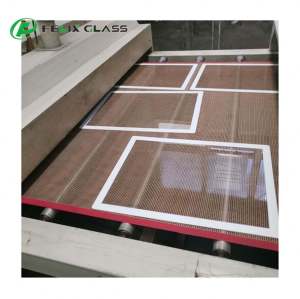
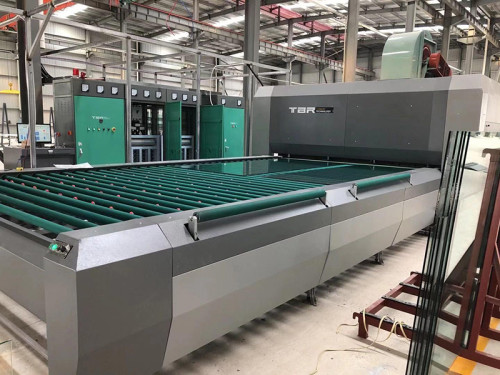
Thermal tempering uses a controlled heating and cooling process to create surface compression balanced by internal tension in suitable glass. Feasibility depends on composition, thickness, shape and process capability.
Specify the intended mechanical function and any applicable qualification requirements. Distortion, bow and stress-related optical effects may matter for windows and displays. Evaluate the finished component rather than treating the word tempered as a complete strength or optical specification.
Complete required cutting, holes and edge processing before tempering under an agreed route. Subsequent material removal can disturb the stress state or cause breakage and must not be assumed acceptable.
8. Chemical Strengthening and Ion Exchange
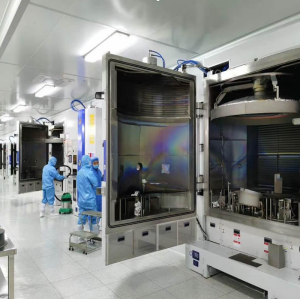
Chemical strengthening uses ion exchange in a compatible glass composition to introduce surface compression. The available treatment depends on the substrate chemistry; it is not simply a lower-temperature version of thermal tempering for any material.
Where required, specify surface compressive stress, depth-related parameters and the measurement method. Define exactly which depth metric is intended, because terminology and measurement methods can differ.
These parameters describe the stress state, not a universal drop, pressure or impact rating. The finished part still needs qualification for its geometry, edge condition, mounting and service environment.
9. Choose the Route by Material and Application
Suitable display-cover and other glass compositions may be considered for strengthening. The selected route must be reviewed for the exact grade and thickness. Sapphire and fused silica should not be assumed to follow ordinary soda-lime glass tempering or ion-exchange practice.
For precision optical parts, consider whether strengthening is needed and compatible with the optical tolerance. For display covers, review mechanical performance alongside appearance, touch integration and assembly. An application label alone does not establish the correct treatment.
10. Optical Effects and Final-Part Acceptance
Surface figure, bow, wedge and stress birefringence can influence optical use. Their relevance depends on whether the part serves as a display cover, imaging window, polarization-sensitive element or another component.
Define optical acceptance after the operations that can affect it. Measurements made before strengthening do not automatically represent the strengthened part. If mounting or bonding changes performance, include the required assembly condition in qualification.
11. Edges, Holes and Mechanical Interfaces
Specify bevels, corner radii, hole positions, edge distances and chip limits. Edge condition and local geometry influence both processing and service behavior. Identify sealing lands, contact surfaces and areas that must remain protected.
Avoid assuming that strengthening repairs an unsuitable edge or makes a flawed part unbreakable. Mechanical evaluation should represent the actual support, fastening and load conditions. Required destructive tests and the disposition of tested samples need agreement.
12. Coating, Printing and Assembly Compatibility
Identify planned AR, AG or AF treatments, printing, conductive layers and adhesives during the initial review. Etching, heat exposure and material removal can interact with the chosen strengthening route and surface condition.
Agree on a complete process sequence, including the state in which each critical property is tested. Some layers or printed features may not tolerate a proposed treatment. Do not add a strengthening step to an already approved coated component without compatibility review.
13. Inspection, Documentation and RFQ Checklist
Inspection may include dimensions, thickness variation, flatness, edge condition, surface texture and agreed stress or optical measurements. Confirm methods, sampling, reports and traceability before ordering.
Send the drawing, substrate grade, incoming condition, desired delivery finish and downstream processes. Include the mechanical function, optical requirements, qualification conditions, prototype and production quantities, destination and timing.
Paid prototypes, tooling, minimum order and lead time are confirmed for the reviewed design. Packaging should protect surfaces and edges and prevent movement; inspection and packing requirements should reflect whether the part is an intermediate blank or a finished component.
14. Frequently Asked Questions
Are lapping, fine grinding and tempering the same process?
No. Lapping and fine grinding remove material; tempering is a separate strengthening treatment for suitable glass.
Does fine grinding automatically produce an optical finish?
No. Optical polishing may still be needed, with separate figure, roughness and defect requirements.
Does every optical part need tempering?
No. Strengthening is application- and material-dependent and may introduce optical constraints that require review.
Can chemically strengthened glass be called thermally tempered?
They are different processes. Name the required route explicitly and specify the relevant acceptance criteria.
Can I drill or cut glass after tempering?
Do not assume this is possible. Complete required geometry before thermal tempering under an agreed process; later machining can cause failure.
Does chemical strengthening apply to every glass?
No. The ion-exchange response depends on the actual glass composition and process.
Do stress measurements guarantee a drop-test result?
No. Component geometry, flaws, edges, mounting and the test conditions also affect the result.
What information is needed for a quotation?
Provide material, drawing, delivery stage, surface and mechanical requirements, downstream treatments, quantities and required inspection or qualification.
15. Request a Process Review
Discuss your required geometry, optical finish and strengthening objective with Felix Glass. A coordinated process plan helps define the abrasive finishing stages, material compatibility and final acceptance before production.
Dongguan Felix Glass Co., Ltd.
Email: james@felixglass.com
Phone: +86-18565032888